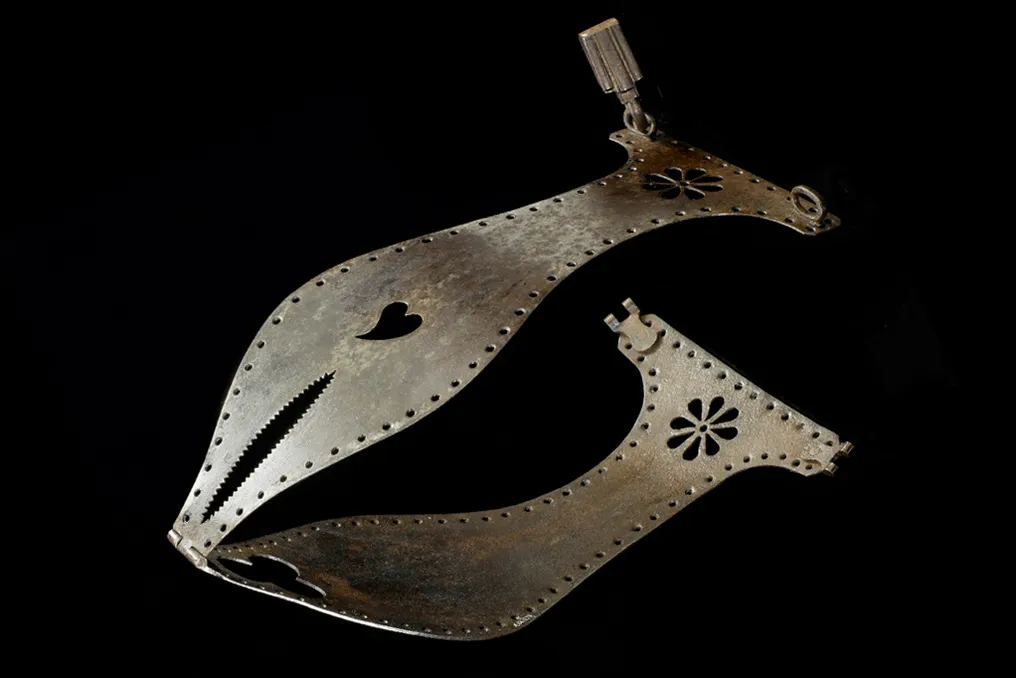
The chastity belt in the Middle Ages is quite a bizarre and cruel concept: a metal casing designed to restrain women's intimate parts to forcibly maintain their purity. This idea clearly reflects the misogyny characteristic of medieval society. However, outside popular imagination, the historical accuracy of this story is very low.
European texts contain mentions of devices for maintaining chastity throughout the first millennium AD, but before the 12th century, these references appeared exclusively in a theological context, serving as metaphors for fidelity and purity. These 'belts' were not real objects but served as a way to express the requirement for women to remain virgin and pure until marriage.
The first surviving mention of a physical description of this object dates back to 1405 and is contained in a book called 'Bellifortis,' whose central theme was military engineering. It features a rather detailed drawing of a chastity belt: a leather belt for the hips, two loops for the legs, and in the genital area—a metal basin with holes for urination.
Nevertheless, the authenticity of the description is questionable. Professor of History Albrecht Klassen from the University of Arizona, author of a book debunking the chastity belt myth, notes that the author of 'Bellifortis' uses eschatological jokes throughout his work, and that no registered authentic medieval specimens corresponding to the image exist in real life. Most likely, the image was satire.
Around the 16th century, the chastity belt began to appear more frequently in illustrations, engravings, and woodcuts. During the Renaissance, the same scene was often depicted: the belt was assigned to married women who were required to observe modesty while their husbands were away fighting in war (he often took a key with him).
Even during this period, these depictions were mostly humorous, emphasizing the absurdity and ineffectiveness of the situation. One of the most famous paintings from the late 16th century, a German illustration, shows a semi-nude wife in a belt handing a key to her husband who is saying goodbye. However, a lover is already waiting for him behind the bed canopy with a duplicate key. Even then, chastity belts were not taken seriously.
Moreover, the notion that these items were intended more for humor and entertainment than for practical purposes is key to understanding the myth: despite their falsehood, these items were as amusing to the public of that era as they are to us today, leading to the idea that 'chastity belts were used in the Middle Ages.'
Thus, the 16th and 17th centuries are marked as the age of the chastity belt. In the 18th and 19th centuries, supposedly preserved examples of these items began to appear across Europe: belts of various sizes, models, and materials. Chastity belts for dogs were even discovered. Today, historians believe that almost all these artifacts were fakes, created as satire based on popular misconception.