Reflecting on the inherent imperfection of human creations leads to an analysis of how vehicles, regardless of their nature, are subject to criticism and imagined improvements. Although the pursuit of perfection is a commendable ideal, such as Volvo's ambition to achieve zero fatalities in serious accidents, the process to attain such immunity is uncertain.
Enthusiasts frequently analyze new releases, either with praise or complaints, examining rational vehicles with the rigor of automotive judges. Even titans like the Ferrari F-40 and McLaren F-1 are subject to scrutiny, leading to imaginary or real modifications, such as those made by Gordon Murray's company.
The article proposes going beyond historical data analysis, offering opinions on what could have improved two notorious cars in the national market and possibly altered the status of a global icon. A third, more controversial example would involve the timid return of a revenue stream that had disappeared.
Improvements to the Del Rey 2.3
When the Ford Landau was succeeded by the Del Rey, the usual consumer of the previous model felt a significant loss. The vast metallic carpet over wheels, with a powerful engine under the hood, was replaced by a Ford Granada that presented serious capacity problems. The comfort of reading newspapers in the back seat, with ample space, was lost, as the Del Rey was considered small and had insufficient wheelbase to be a true Ford luxury car.
Despite being the vehicle that introduced electric windows in Brazil, the Del Rey could not compete with the Landau. If the platform did not allow for lengthening beyond the Corcel base without compromising cost rationalization, there was the possibility of using a more robust engine than the pre-CHT Sierra, which was used in the Corcel. This engine, the 2.3-liter OHC George, nicknamed 'Taubaté' for having its Brazilian casting in São Paulo, could have revitalized the Del Rey, providing reliable power for a car that should maintain its spirit of luxury.
The disadvantages of not using the large four-cylinder engine are known: weight, poor economy, and installation difficulty due to a crossbar in the Corcel/Del Rey hood. However, the target audience for the Del Rey would probably prefer a more agile and smooth-operating car over one with slightly lower consumption, given that it was a luxury automobile. The additional engine would weigh about 80 kilograms, but Ford engineering could have positioned it further back.
In 1984, this engine was considered for a completely new replacement for the Del Rey, Project Omega II, but it never materialized. The 2.3-liter, which was exported, was chosen to power this body, instead of the 1.6-liter, which was the motive base of the blue oval subsidiary. From a marketing perspective, it would be interesting to see a 1983 Del Rey competing on the straightaway with a brand new CHT-engined Escort XR3, the brand's contender car, suggesting a fear from Ford of diminishing the appeal of the Escort.
Later, the Del Rey received the Volkswagen AP800 from Volkswagen for the 1990 line, significantly improving the executive, although the car was already behind its competitors at that time.
Ferrari F50 with F1 gearbox
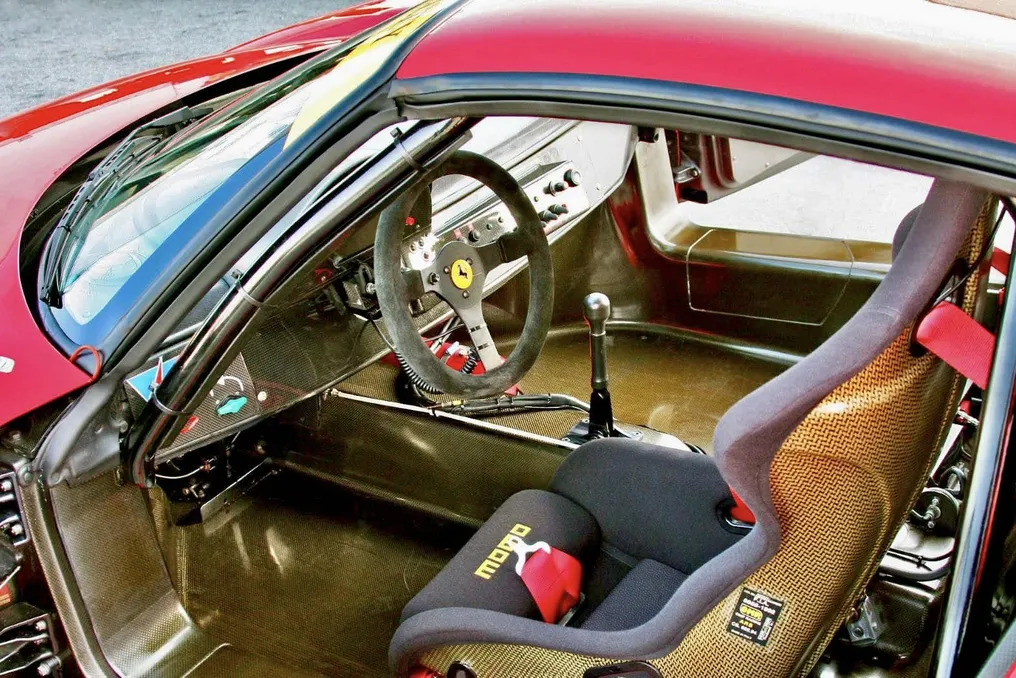
The F50 is described as an impressive supercar, with an engine derived from a Formula 1 design—using a different block, similar but simplified cylinder heads for actuation, and five valves per cylinder. Its aggressive look is built upon a carbon fiber monocoque, with the 4.7-liter V12 and gearbox fixed to the structure.
This model represented a strong link for the brand with motorsport, seeking to philosophically replicate the Maranello monopostars. Launched in 1995, the F50 had a peculiarity: it was no longer the most powerful car in the supercar segment, as the Bugatti EB 110, Jaguar XJ 220, and McLaren F-1, launched earlier, possessed more power and top speed.
The F50 presented performance figures marginally superior to the 1987 F40, but its controversial look and smoother handling, facilitated by a friendlier gearbox and a linear engine, created a strangeness among admirers accustomed to the brutality of its predecessor. Despite being easier to drive, the engine vibration transmitted directly to the driver generated criticism.
Ferrari management's intention was to focus on feeling, handling, and driving experience, differentiating itself from rivals like Bugatti and Jaguar, which were fast but lacked the championship DNA of an F1 racer. The McLaren, although technologically advanced, presented distinct characteristics. The shadow of the F40 remained large, preventing the F50 from receiving the deserved recognition for over thirty years.
It is possible that the F50 could have been different if Ferrari had developed the F1 gearbox, actuated by butterfly valves, in time to debut it in its most radical road car. Officially, this type of gearbox appeared in 1997 with the F355 F1, a six-speed sequential transmission that reduced shifts to 125 milliseconds, representing technology coming directly from the race tracks.
} } ]