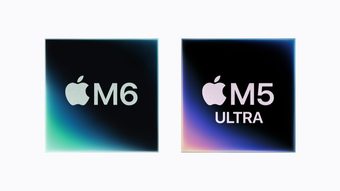
Apple announced on Tuesday, August 25th, the introduction of the new generation of M6 and M5 Ultra processors. These new chips will be incorporated into the Mac mini and Mac Studio, being sold in Brazil in price ranges varying between R$ 10,799 and R$ 69,999. The updates primarily focus on improvements related to artificial intelligence, although they also offer benefits for intensive video editing activities.
The M6 is expected to be the main model in Apple's processor line, which traditionally has variations such as Pro and Max for more demanding uses. Rumors indicate that the base chip should match the performance of the M5 generation, while professional models of this proprietary chip are only expected to launch next year, in the M7 line.
The M6 represents Apple's entry into the 2-nanometer manufacturing process, which allows for higher transistor density in a smaller space and improves component efficiency. Its architecture now features 12 CPU cores, distributed as follows:
The Graphics Processing Unit (GPU) received two additional cores, totaling 12 graphics cores. Each graphics core now has a dedicated neural accelerator for AI operations. Additionally, the M6 integrates two 16-core Neural Engines, capable of operating simultaneously with system resources. Unified memory reaches 32 GB, presenting a bandwidth of 170 GB/s, which represents an increase of approximately 10% compared to the M5.
In contrast, the M5 Ultra continues the line presented in 2025, which had already received the Pro and Max versions earlier this year. This new variant was specifically designed to handle extremely high-performance professional demands, such as three-dimensional rendering and running large-scale AI models.
This chip uses UtraFusion technology, which connects two M5 Max processors. Since each M5 Max is already composed of two matrices, the M5 Ultra arrives with four unified matrices and a bandwidth exceeding 4.4 TB/s.
According to Apple, the memory capacity of the M5 Ultra allows machines to keep AI models with hundreds of billions of parameters internally, eliminating the need for external processing. To achieve this, the chip incorporates a 32-core Neural Engine, promising to accelerate LLM prompt processing up to four times when compared to the M3 Ultra, according to the company.
Both the M5 Ultra and M5 Max can be used in the Mac Studio configurations, which also receives innovations in its connectivity. Deliveries of the new versions of the Mac Studio and Mac mini equipped with M6 are scheduled to begin on September 22nd. The prices of the new equipment are detailed in the original source. Configurations of the Mac Studio with 512 GB of unified memory are planned to be available at the end of October.