The death of an actor does not necessarily mean the disappearance of their character. For a long time, the entertainment industry solved this problem in a simple way—by hiring a new performer. Although this sometimes caused some confusion among the public, life went on. However, the emergence of artificial intelligence has offered a new option that poses a question to the industry that it has never had to answer before.
In 2023, CD Projekt Red used AI to preserve the voice of a Polish actor who passed away two years before the release of 'Cyberpunk 2077: Phantom Liberty'. In 2025, Epic Games allowed the late James Earl Jones to communicate in real-time with Fortnite players as Darth Vader. In both cases, permission was obtained from the family, but the results turned out to be completely different.
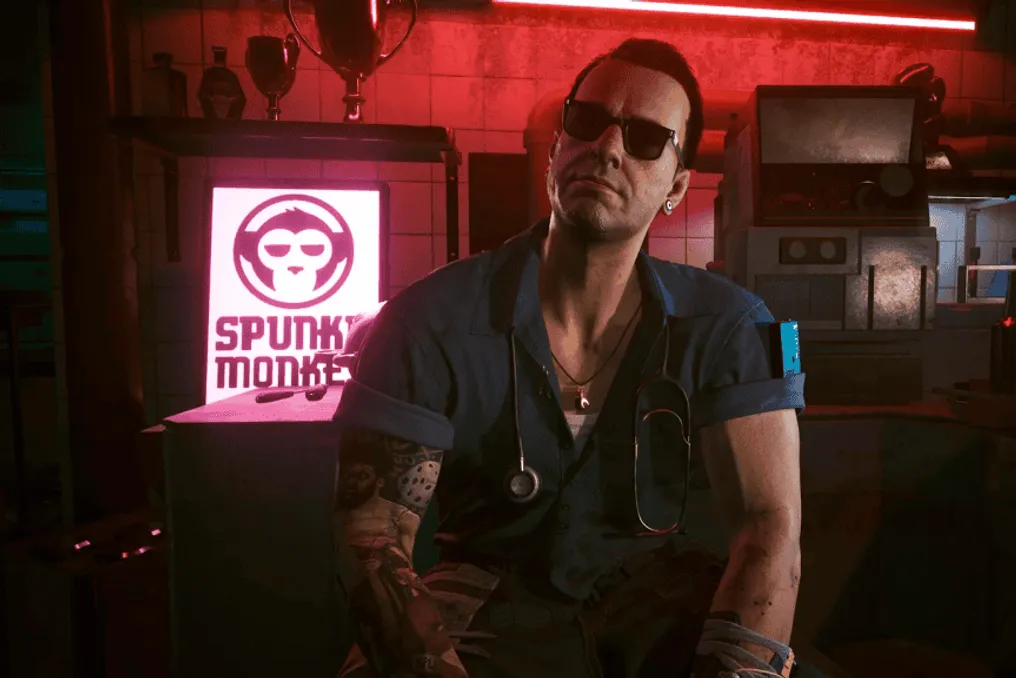
Viktor Vector, although not the most central character in the original game's plot, remains a significant figure in 'Cyberpunk 2077'. He serves as a 'safe haven' for the protagonist, a moral support, and even a father figure who always gives advice and helps when possible. Despite being a 'medic' and an NPC providing enhancement services, his care for the protagonist is evident, as he always strives to do the best, even exceeding his duties.
This character was originally voiced by the Polish actor Milogost 'Milek' Rzeczek, who tragically died in 2021. Two years later, with the release of 'Cyberpunk 2077 Phantom Liberty', CD Projekt did not want to change the actor voicing this character, which prompted the company to make an unusual decision. Although a new actor, Janusz Zadura, provided a new voice-over imitating the original style, his voice was altered using Respeecher to resemble Rzeczek's voice.
Overall, the reaction of the Polish public was very positive. This step was accepted as a respectful tribute and a memorial to the deceased actor. Furthermore, the support and consent of the family contributed to this positive reaction. Nevertheless, replacing human voices with AI raises concerns among voice actors and artists, while critics question the long-term impact of voice cloning.
In 2025, Fortnite modeled the voice of the late actor who voiced Darth Vader so that players could interact directly with the character. The experiment was conducted using two conversational AI models: Google Gemini 2.0 Flash and ElevenLabs Flash v2.5, which were used in a test mode (as published in the official blog). The company also encouraged players to converse verbally with the character. However, the test was unsuccessful: Darth Vader said strange things, as well as insults and other unacceptable comments.
Epic Games quickly corrected the situation after many videos began appearing on social media. Moreover, despite the actor's family permission, the resonance was not the most favorable, especially among voice actors. Beyond becoming a joke, mainly on YouTube, this case became the subject of a labor lawsuit. SAG-AFTRA (Screen Actors Guild – American Federation of Television and Radio Artists) filed a lawsuit against Llama Productions, an Epic Games subsidiary, with the NLRB (National Labor Relations Board).
The lawsuit claims that the company took these actions without proper negotiation with the guild and denied voice actors the opportunity to work who could imitate the iconic character's voice. The NLRB is currently reviewing the case, and no decision is anticipated yet.
The use of AI generates various conflicts, especially in the artistic aspects of games. There is a very fine line separating tribute, plagiarism, and an attempt to replace human creative labor. However, in the case of 'reviving actors' voices,' a crucial question arises: 'why?'
What is the goal or interest in bringing a deceased person's voice back to life? In the case of 'Cyberpunk 2077,' this can be seen as a tribute: a recently deceased actor in a DLC released two years after the main game. In the case of Fortnite, it looks more like the exploitation of an iconic image within a partnership that often uses the brand to increase game engagement. Even if that is not the case, that is the impression left on the public and voice actors.
Artificial intelligence has opened up a vast horizon of possibilities, leading to the constant appearance of new applications and features. But, as the saying goes, there is a measure to things. Not everything that is possible is necessary, and not everything is actually useful. This is the main question that needs to be resolved regarding the countless functions that AI presents to us over time.