This week will feature the last eclipse of 2026, characterized as a partial lunar event. This phenomenon is expected to attract significant attention due to the high degree of darkness that will cover the lunar surface, potentially taking on dark tones ranging from brown to reddish-copper, simulating almost a total lunar eclipse.
The spectacle is scheduled to begin on the night of Thursday (27th) and extend until the early morning hours of Friday (28th). According to the platform Starwalk.space, the coverage of the lunar disk will exceed 96%, while technical measurements indicate a magnitude of 0.93. This percentage difference is attributed to distinct calculation methods.
While the 96% index represents the total proportion of the lunar surface under shadow, the 93% value measures the area affected when crossing the Moon's diameter in a straight line. Both statistics confirm that almost the entire celestial sphere will be obscured by Earth's shadow, although the event is not classified as a 'Blood Moon' because it is not total.
A thin band of the lunar disk will remain illuminated by the Sun. However, the visual observation will provide an experience very similar to that of a total lunar eclipse. For residents of Brazil, the situation is favorable, as the country will be in an ideal position to follow the entire event from beginning to end.
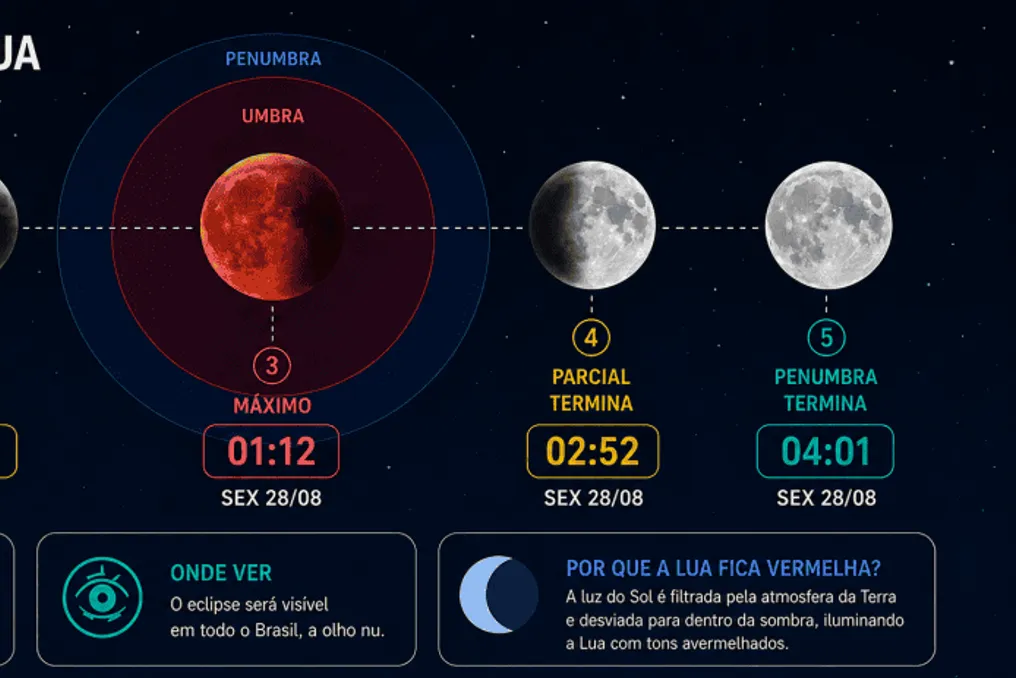
In practically all regions of Brazil, the Moon will be at a very high point in the sky, facilitating naked-eye observation without horizontal obstructions. The lunar elevation varies between 59 and 85 degrees above the ground in the capitals. In the North, Northeast, and Central-West areas, the celestial body will be near its zenith during the early morning, while in the Southeast and South, it is recommended to look north to locate the bright and elevated satellite.
The reddish coloration of the Moon is explained by the Earth's atmosphere. When sunlight passes through the layers of air, blue light scatters in various directions. Red and orange light waves, on the other hand, undergo a slight trajectory deviation, allowing them to reach the lunar surface hidden by the Earth's shadow. This mechanism is identical to what makes sunsets reddish.
The intensity of this color may change during the observation morning, being influenced by atmospheric factors such as dust, pollution, humidity, and smoke. Cleaner air will result in a clearer and more pleasant reddish hue.
Eclipse Schedule Details
Considering Brasília time, the discrete penumbral phase will begin at 10:23 PM on Thursday, followed by the more defined partial phase around 11:33 PM. The peak of darkness in the sky will occur at 1:12 AM on Friday. The main partial phase will completely end around 2:52 AM, and the penumbral phase will cease shortly after 4 AM.
Unlike solar eclipses, observing a lunar eclipse poses no risk to eye health; special filter glasses or advanced equipment are not necessary. Using binoculars or small telescopes can enrich the family experience, aiding in viewing craters and the gradual advance of the shadow over the terrain.
Although light pollution in large cities does not prevent the viewing of the celestial body, those intending to photograph the moment will get better results in more distant and darker locations. The only unpredictable element that may hinder public observation is climatic instability, such as heavy clouds, dense fog, or rain, which can obscure the sky during the early morning.