When seeking information, individuals can choose three methods: consulting Google, interacting with an artificial intelligence (AI) chatbot like ChatGPT, Claude, or Gemini, or speaking directly with a person. With the growing integration of AI into Google Search, the first two paths tend to generate similar experiences, unlike human interaction, where knowledge resides in people's minds.
The fundamental distinction lies in the fact that a consulted human possesses real knowledge about the subject and can resolve or even raise new questions, whereas AI does not possess this intrinsic knowledge. Although chatbot responses convey a sense of credibility, being well-structured and coherent, it is crucial to understand that the platform does not hold the knowledge about what it is communicating.
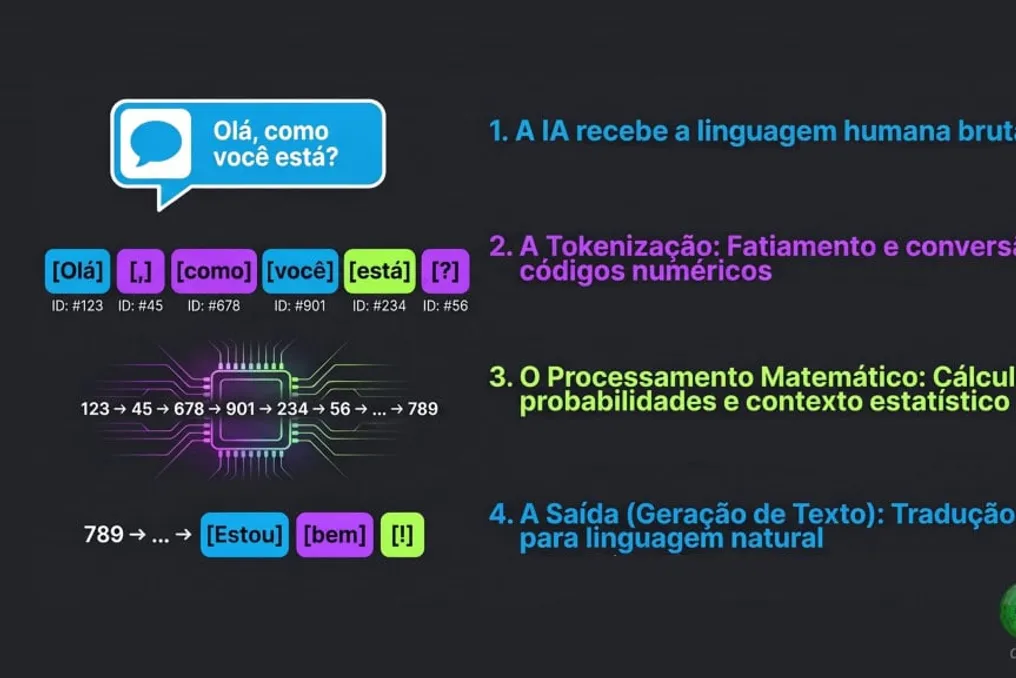
Communication between humans and AI operates in distinct languages. Even if an individual masters all world languages, they will not speak the same language as the machine. Humans use a vocabulary of words, while the machine processes only tokens, which are blocks with numerical designations.
Fabrício Carraro, Program Manager at Alura, explained in an interview with Olhar Digital that a token is equivalent to a subword. He exemplified that the words 'feliz' (happy), 'triste' (sad), and 'divisível' (divisible) are individual tokens. For words like 'indivisível' (indivisible) or 'infeliz' (unhappy), the token 'in' is used, corresponding to a specific number in the language model's vocabulary, which, when added to the token 'feliz' (happy), forms the word 'infeliz' (unhappy).
When interacting with ChatGPT, the process is more characterized as a 'word calculation' than as an articulation of thoughts. According to Carraro, the AI selects thousands of tokens from its vocabulary and assigns a probability to each one, based on what it learned during the training phases.
Training a Large Language Model (LLM) requires immense volumes of data; reading daily would not allow reaching the amount of data processed by ChatGPT in about one hundred thousand years. After initial training, reinforcement learning occurs, a moment when the LLM is adjusted to be useful to humans.
Carraro detailed that, in this post-training phase, the model is taught to present answers in the format expected by humans for a given question. This reinforcement learning also aims to instruct the AI on which responses are desirable and which are not.
When responding, the AI executes millions of mathematical operations, as every neuron in the neural network is essentially a mathematical equation. During inference, the AI chooses each word based on its training, generating the next token according to the probabilities established in pre-training, post-training, and reinforcement learning; in short, the chatbot is only producing what is statistically most probable.
Although generative AI platforms do not possess inherent knowledge, technology companies have implemented features to mitigate this limitation. One such feature is the incorporation of internet search capability, which has increased accuracy when answering current questions, such as recent sports results or Oscar winners.
Another technique is called 'reasoning.' Carraro emphasized that the machine does not think, but the internal mechanism simulates a mental process. Companies like Google and OpenAI have adopted the strategy of having the model internally generate multiple micro-questions and elaborate answers for them without exposing this process to the user. This allows the AI to detect errors, try alternative approaches, and provide a more reliable answer, significantly improving accuracy.
Despite the AI not 'knowing' anything, its usefulness remains undeniable for clarifying doubts, generating content, and improving productivity. Kenneth Corrêa, an AI specialist and professor at FGV, considers that AI platforms are, theoretically, extremely advanced calculators.
In practice, LLMs with trillions of parameters are observed capable of generating answers or completing commands with skills that exceed their learning base. These tools, although they may 'hallucinate,' produce a significant volume of results. Corrêa argues that AI should not be reduced to a mere sophisticated calculator, as this ignores the impact it generates.
The Program Manager at Alura mentioned that some discoveries obtained with these powerful models may be integrations of existing knowledge, organized in a novel way, requiring only 'brute force' to be located.
The FGV professor gave an important warning: these tools lack morality and ethics. They express confidence both when providing the correct answer and when doing so incorrectly. For this reason, human supervision is indispensable, as only humans can validate the answers and determine their use.