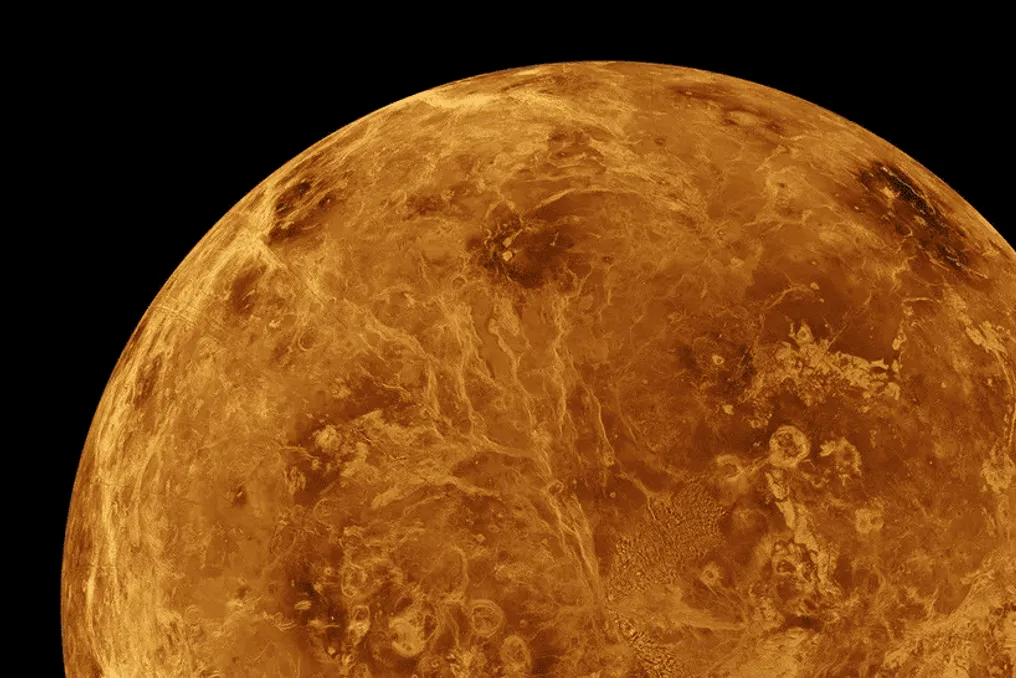
Venus possesses one of the most unusual calendar systems in the Solar System: a full rotation on its axis takes about 243 Earth days, while its orbit around the Sun lasts approximately 225 days. This is explained by the planet's extremely slow rotation, which occurs in a direction opposite to that of most other planets.
This movement is called retrograde rotation. Unlike Earth, Venus rotates from east to west. Consequently, if one could observe the sky from the surface of Venus, the Sun would appear to rise in the west and set in the east. This phenomenon is not merely a curiosity; it alters the passage of time on the Venusian surface.
Scientists define a sidereal day as the time interval required for a planet to complete one rotation relative to distant stars. For Venus, this period is approximately 243 Earth days. The Venusian year, conversely, corresponds to the time needed for the planet to complete an orbit around the Sun, which is about 225 days. It is this difference that creates the apparent paradox where the day is longer than the year.
There is another unit of time that makes the history even more intriguing. The interval between two sunrises on Venus is about 117 Earth days. This is known as the solar day, which depends on both the planet's rotation and its orbital motion. Because Venus rotates slowly in a retrograde direction while moving around the Sun, these two motions combine. The result is a solar day lasting about 117 days, which is significantly less than the 243 days of the sidereal day.
In practice, this means that a full period of daylight lasts approximately 58.5 Earth days, followed by about 58.5 Earth days of night. However, the explanation becomes less clear here. Scientists know how Venus currently rotates, but there is no single, proven answer as to how the planet achieved this configuration. Retrograde rotation could be the result of a combination of various processes that occurred over billions of years.
One possibility under consideration relates to atmospheric tides—movements of the atmosphere caused by uneven heating from sunlight. A study published in the journal Nature in 1978 suggested that these tides might create a torque, or a force capable of changing the planet's rotation. The model posits that this effect could compensate for the gravitational tides created by the Sun and help explain Venus's observed slow rate of rotation.
More Details:
Another hypothesis involves major impacts that occurred during Venus's formation. In the early Solar System, rocky planets experienced a phase marked by collisions with large bodies. Such an impact could have substantially altered the speed or direction of Venus's rotation. Nevertheless, this hypothesis cannot be considered a proven cause of retrograde rotation.
Subsequent research published in the journal Icarus deepened the study of the relationship between atmospheric tides, gravitational tides, and the evolution of Venus's rotation. Models show that these effects can act together over long periods, gradually changing the state of the planet's rotation. This helps explain why Venus is so different from Earth. While our planet rotates relatively quickly and in the conventional direction, Venus exhibits an extremely slow and retrograde rotation. However, the exact origin of this configuration remains a subject of scientific inquiry.
What seems certain is the absence of a simple explanation such as 'one event made Venus spin backward.' The current configuration is likely related to the interaction of forces that acted over vast timescales, including the planet's atmosphere and the Sun's gravitational influence.