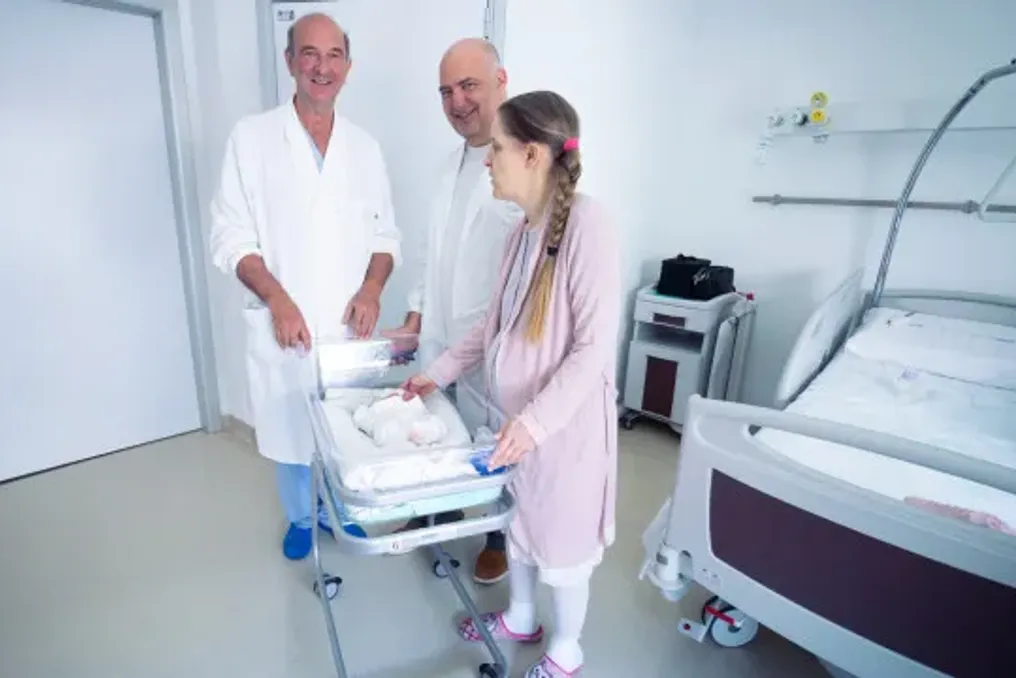
In Italy, a woman underwent her eighth Cesarean section during the birth of her eighth child at the Women and Child Hospital Borgo Trento in Verona. This woman had eight pregnancies that progressed physiologically, but the surgical team performed the operation 'in the exact same place as previous ones to avoid ruptures,' considering the risks associated with the intervention.
The hospital unit reported in a statement on August 22 that 'everything went well for Christina and her newborn Luna, who is the eighth child and the eighth Cesarean section. The baby is healthy, as are the mother and father Roberto.' The same message noted that the seven siblings—three boys and two girls—immediately came to visit Luna.
Christina, quoted by the medical facility, shared her experience, saying: 'I am pleased to talk about my eighth Cesarean section as a sincere thank you to Dr. Bergamini and his team, whom I owe the birth of our Luna and the three children who preceded her. I was never afraid; I was always supportive of my family; this time, with the eighth Cesarean section, required a little more rest than other times. What is truly necessary for recovery is the hand of the surgeon, which is fundamentally important. Luna was a surprise, but we are very happy.'
According to the document, Valentino Bergamini, Director of the Operating Unit of Obstetrics and Gynecology at the Women and Child Hospital Borgo Trento, has been monitoring the woman since her fourth pregnancy, with the first child born in 2000.
The hospital recalled that the Cesarean section, performed by Dr. Bergamini together with Dr. Nikolaos Papadopoulos and the surgical team, was carried out in the same location as before to prevent ruptures. He added that in Christina's case, everything went best, but a woman with eight Cesarean sections represents an exceptional case.
The institution emphasized that 'the clinical complexity lies both in obstetric monitoring and the surgical procedure,' because 'multiple surgical scars can cause very significant adhesions between the abdominal wall, uterus, bladder, and intestines, profoundly altering normal pelvic anatomy.'
Furthermore, it was noted that 'under such conditions, access to the operation and organ dissection can be particularly difficult, with an increased risk of bleeding and damage to surrounding organs. Another aspect to consider is the possible presence of placental anomalies, especially in cases of placenta previa or accreta. It is precisely because of these potential complications that one must seek care at a properly equipped tertiary center, such as the WCH Borgo Trento, which has experience in obstetric surgery and possesses a multidisciplinary team of obstetricians, anesthesiologists, and neonatologists,' the hospital stated.
Bergamini, in turn, added that 'this case reflects an important personal and family decision: the decision of a woman who faced her eighth pregnancy and so many other Cesarean sections.' He continued: 'Faced with this generous acceptance of life, we immediately decided to support and accompany the patient, providing all the experience of the service team. Our task, as doctors, is to guarantee maximum possible safety for all women who decide to become pregnant, offering competence, experience, and proper organization, especially in cases of particular complexity. Our role is to be on the side of life and women.'