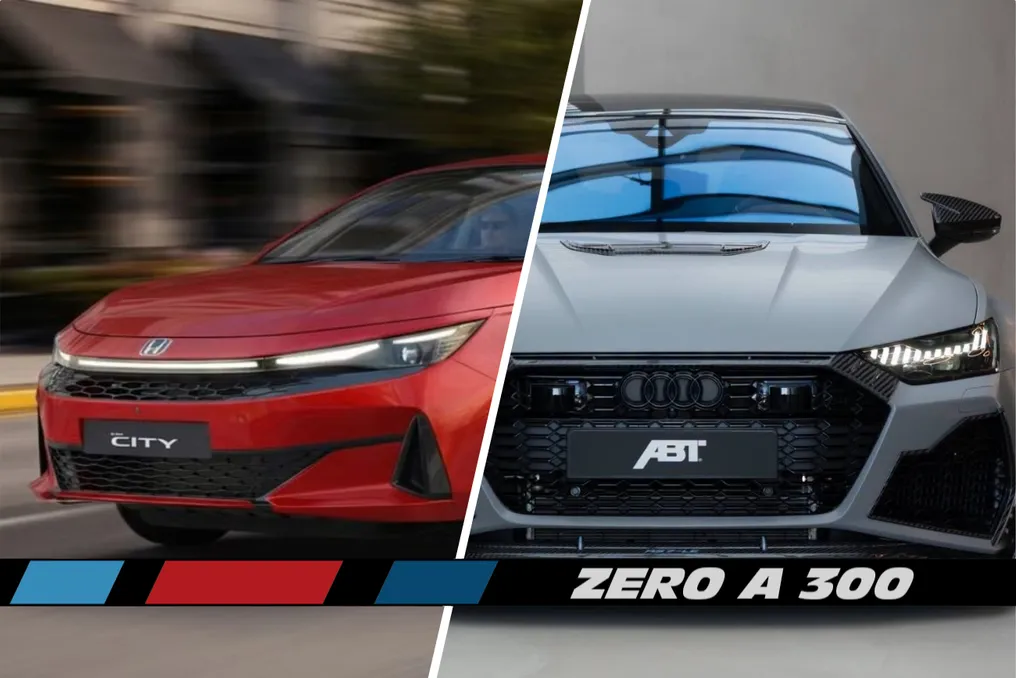
Several significant events have occurred in the automotive industry, including the potential release of an updated Honda City in Brazil, the launch of a special edition Audi RS7 from ABT Sportsline, and advancements in transport technology.
According to Autoesporte, the updated 2027 Honda City model has been undergoing testing in Brazil since 2025, and its arrival is now anticipated. Dealerships have received notifications about the imminent arrival of the refreshed model, which is expected to appear in showrooms between October and November of this year. It is important to note that this is not a new generation but a deep restyling modification, giving the City an appearance more similar to the Prelude coupe: it will feature a wider and lower grille, a redesigned bumper, and more aggressive headlights connected by a light strip.
The mechanical characteristics of the vehicle will remain unchanged: it will use a 1.5-liter naturally aspirated engine with direct injection, producing 126 hp and 15.5/15.8 kgf·m of torque (for gasoline/ethanol). The only available transmission option remains a seven-speed CVT. In Asian markets, there is a plug-in hybrid version, the e:EV, equipped with two electric motors and a 1.5-cycle Atkinson engine, which produces the same 126 hp but can achieve fuel economy exceeding 25 km/L. This hybrid package is planned for Brazil but not for the City; it is intended for the new generation HR-V, whose debut is currently scheduled for 2028.
Honda has not disclosed pricing for the new City. Currently, both the sedan and hatchback start from 117,500 reais for the base LX version. The most expensive options include the City Touring sedan priced at 153,200 reais and the City Touring Sport hatchback, which costs 155,300 reais and features a sportier style. Given that the City update is predominantly aesthetic, no significant price changes are expected.
In another area concerning trucks, Ram is preparing to auction the first model of the Rumble Bee SRT. This pickup has three atmospheric V8 engine options equipped with a supercharger. The model was recently announced and will arrive at US dealerships in late 2026 or early 2027. However, those who do not wish to wait can participate in the auction on September 11th during the Las Vegas Auction by Barrett Jackson, where proceeds will go to charity.
The specific pickup under consideration is the SRT variant, equipped with the iconic V8 Hellcat engine in the engine bay. The original 6.2-liter supercharged engine produces 788 hp and 93.9 kgf·m of torque. As this is a historically significant example, Ram decided to provide it with a Direct Connection package, which includes a larger compressor and increases power to 'over 900 hp' (the exact figure has not yet been announced). The body is painted in a special two-tone design: the lower half is Diamond Black, and the upper half is Molten Red, both with a Crystal Pearl-Coat pearlescent finish. Additionally, the pickup is adorned with red graphic elements on the sides, a black stripe on the hood, and a red 'RAM' emblem on the grille.
Furthermore, the buyer will receive a 2005 Ram 1500 SRT-10 completely free—a version that used the Dodge Viper V10 engine. This pickup was modified by the RealTruck workshop and received a yellow-and-black paint scheme with graphics inspired by the Viper on the sides. The 8.3-liter V10 engine produces 507 hp and 72.5 kgf·m of torque. Although these figures are significantly lower than those of a modern supercharged V8, this is from twenty years ago, and at that time, this power was sufficient to make the Ram 1500 SRT-10 the fastest pickup truck in the world upon release. Specifically, it accelerates from 0 to 100 km/h in approximately five seconds, and its top speed is 248 km/h.
In road traffic regulation, the CNH do Brasil application (formerly CNH Digital) has gained a new feature integrating with free-flow toll payment systems, which began being implemented on major Brazilian roads in 2023. One of the main complaints regarding the free-flow system was inconsistency in billing, both through the app and when disputing unjustified payments. Now, the application centralizes information and allows users to check passages through electronic toll booths nationwide.
Thanks to this new functionality, users can view outstanding debts, a complete report of registered passages, and trip details on federal, state, and municipal highways. The new feature consolidates all movement data, indicating the responsible operator for each section, the registration date, the debt amount, and the tariff status, and also provides a link to the official payment channel for each operator. To access the feature, the driver must open the CNH do Brasil app, select the 'Veículos' tab, and tap 'Pedágio eletrônico'. Trip history is saved on the platform for up to five years. However, it should be noted that CNH do Brasil does not process payments directly, acting only as a centralized notification and consultation channel, warning the driver about debts and reminding them of the 30-day deadline for tariff settlement.
This innovation occurs during a transitional regulatory period established by the National Transport Council (Contran) and the Ministry of Transport, which is valid until November 16, 2026. During this 200-day window for settling debts, new fines and points on the personal record for late free-flow payments have been suspended. As a result of this incentive, over 1.32 million fines were canceled after drivers settled their tariffs. Those who paid the fine before the rule was introduced can also request reimbursement from the issuing authority, provided they paid the due passage before the end of the transition period. After November 17, 2026, with the end of the transition phase, standard enforcement will once again apply fully in cases of non-payment.
Ferrari has also registered a patent for a new active aerodynamics system with the United States Patent and Trademark Office (USPTO). Since supercars and hypercars have long surpassed the 1000 hp threshold, and some reach 0-100 km/h in under two seconds, aerodynamics is the next limit. The patent demonstrates a new active aerodynamic complex. Particular attention is drawn to the car in the document sketches: it is a supercar with a mid-to-rear engine layout, differing from all existing Ferrari models, featuring a low front end and a teardrop shape, while the side air intakes resemble Formula 1. The main innovation is located at the rear: a retractable rear wing that pivots backward when activated, similar to the system used in the McLaren W1, transforming the car into an active long tail to increase downforce and minimize aerodynamic drag.
The patent also includes technical diagrams applied to the Purosangue SUV. The illustrations show that the SUV's taillights feature a hinged joint mechanism that allows them to lower to direct airflow, thereby enhancing the effectiveness of the small rear spoiler and ensuring greater stability at high speeds. As with any intellectual property registry, the publication of a patent does not guarantee the immediate appearance of these components in production models, but it clearly outlines Ferrari's intentions for the next generation of supercars.
ABT Sportsline, a traditional German tuner specializing in Audi vehicles, presented the RS7 Legacy Edition — 1 of 1 GRIZZLY. This model represents a kind of farewell series for this vehicle. Although Audi has not announced the end of RS7 production, ABT Sportsline is getting ahead of the curve. According to the tuner, this car serves as a thank you to Audi for the existence of the RS7, whose current generation (the second in A7 history) was introduced in 2019 and is likely not to last long. Firstly, because the A7 and S7 were discontinued in 2025, leaving the RS7 as the sole representative of the family. Secondly, considering Volkswagen Group's plans for radical reduction in the number of models sold across all its brands, the fate of the RS7 is in question. The four-door coupe with a 4.0-liter V8 biturbo and over 600 hp is not a model that typically survives such strategic reductions, and there are currently no plans for a replacement.
Returning to the Legacy Edition, the car features Slate Grey paint with Shadow Blue accents, open carbon fiber aerodynamic elements, and exclusive gold wheels. The interior also incorporates carbon fiber, complemented by Alcantara upholstery for the seats and dashboard, with ABT emblems on the headrests and a star-patterned ceiling. However, the mechanics are most important. The original V8 biturbo RS7 produces 629 hp and 86.7 kgf·m of torque, allowing it to accelerate from 0 to 100 km/h in 3.5 seconds. The ABT version reaches 760 hp and 99.9 kgf·m of torque. The tuner did not disclose the details of how the extra power was achieved, but it is presumed to be related to increased boost pressure (or the use of larger turbos), ECU reprogramming, and flow optimization. They also did not specify how much faster the RS7 became after modifications, but this may not be as important.
As the project name suggests, the ABT RS7 Legacy Edition — 1 of 1 GRIZZLY is a unique specimen that was undoubtedly ordered by a client with impeccable taste.
Additionally, Lamborghini unveiled the Temerario Tricolore during the 'The Quail, A Motorsports Gathering' event. This is a special edition of their hybrid supercar equipped with a twin-turbo V8 engine. Enthusiasts of the brand will undoubtedly recall the origin of this name: in 2011, to commemorate the 150th anniversary of Italian unification, Lamborghini released the Gallardo Tricolo.