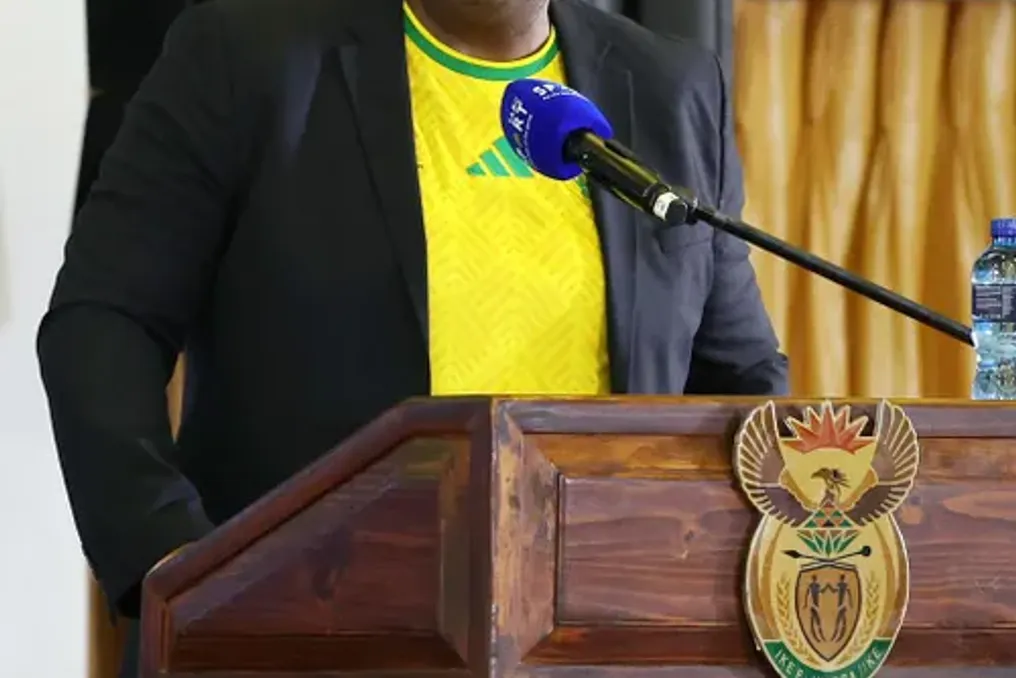
Sports Minister Gethon McKenzie has given SAFA until September 9th to submit a plan for implementing the VAR system in South African football. If this requirement is not met, the association will have to return millions so that the Ministry can consider other options.
SAFA has until September 9th to account for the 20 million rand allocated for VAR, as the Ministry of Sport confirmed that these funds remain untouched. The Department of Sport, Arts and Culture issued a detailed statement to clarify the funding and progress of the long-awaited project, which is under increased scrutiny amid ongoing refereeing disputes in the Betway Premiership.
These 20 million rand were transferred to SAFA on March 6th, two days after the announcement. SAFA confirmed in writing on August 18th that the entire amount was preserved and unused in a separate account with accrued interest. To date, the only public funds spent on the VAR project amount to 765,257.03 rand, covering a technical mission to fact-find in Spain in November 2025.
The Department also dispelled misunderstandings regarding larger sums previously mentioned publicly. In October 2024, it was stated that up to 90 million rand might be available, and later an amount of 82 million rand was allocated. Ultimately, the National Treasury approved 20 million rand as the first tranche, with further funding depending on the implementation progress.
SAFA
The VAR implementation process began in October 2024 when Sports Minister Gethon McKenzie met with NEC SAFA in Gqeberha, and the association officially accepted the adoption of the technology. Subsequently, SAFA released a request for proposals in April 2025 and then established a tender evaluation committee involving representatives from SAFA, DSAC, and PSL.
The process was then aligned with FIFA's VAR Implementation Assistance and Approval Programme, which requires a detailed project plan, a VAR project team, and an approved technological solution. The technical mission traveled to Spain in November 2025, and SAFA later submitted a revised three-year implementation plan valued at approximately 54.7 million rand. This plan envisaged the start of official personnel training with matches in July 2026, experimental deployment of VAR during the Nedbank Cup semi-finals in 2026/27, and full launch from the 2027/28 season.
However, progress subsequently stalled. DSAC requested a written progress report from SAFA in April, but it was not provided. In May, NEC SAFA approved the project but required a review of the budget before final approval. By July, SAFA CEO Lydia Mponiapo confirmed that the department's funds had not been used.
Gethon McKenzie called on SAFA to ensure Pitso Mosimane is paid at least the same salary as the outgoing Bafana Bafana coach Hugo Broos, should his appointment be finalized. The Department ultimately demanded the return of 20 million rand on August 13th. SAFA responded five days later, confirming that the funds remained untouched but requesting an additional 21 days to complete an internal budget audit. This extension was granted, and SAFA must now provide a report by September 9th.
McKenzie's Warning to SAFA
McKenzie warned that if SAFA fails to provide a satisfactory report and a credible procurement schedule, the department will recover the money and explore alternative paths with FIFA and CAF. McKenzie stated: 'I put VAR on the table and told the country it was coming, so the disappointment in the pace of progress belongs to me as much as to anyone else.' He added: 'I want to apologize to every South African I let down. But I am not going to pretend. The money is there; it hasn't been touched.' McKenzie is firmly convinced that VAR will eventually be implemented, stating: 'VAR must come into our football. If it cannot come as we planned, it will come another way. But it will come.'
Currently, the Ministry's position is clear: no public money has been lost, but valuable time has been wasted.