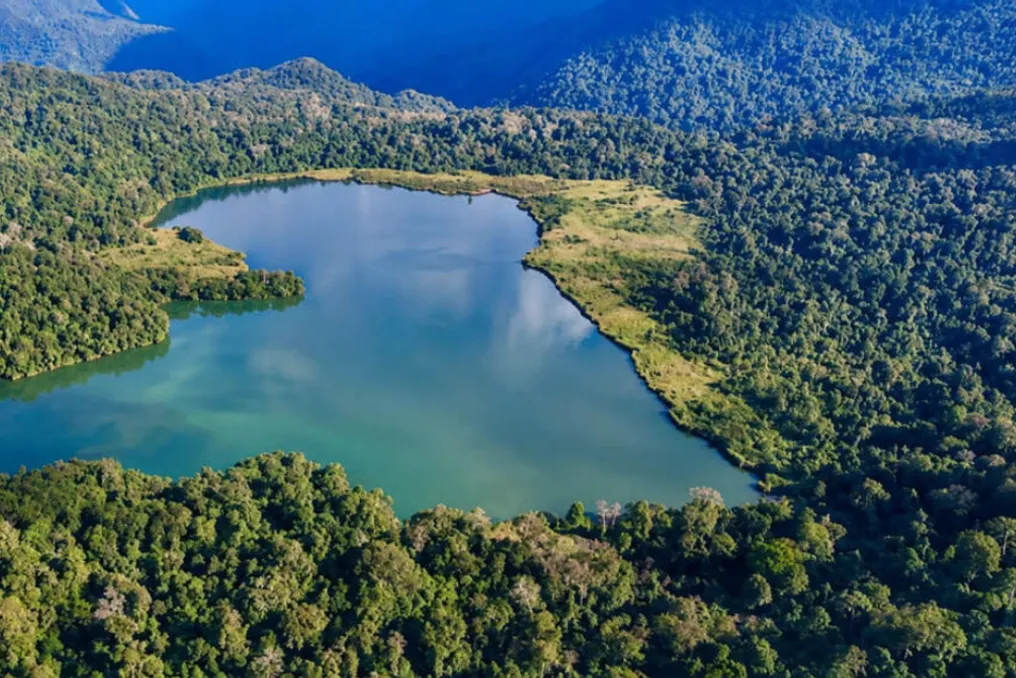
In December 2024, a group of researchers trekked over 16 kilometers through the Tigra Kamlang reserve and protected area to reach Glao Lake, located at an altitude of 1168 meters above sea level in the Eastern Himalayas. This freshwater lake, fed by mountain streams and surrounded by dense vegetation, is revered as sacred by the Mishmi community.
Less than two years later, on August 3, 2026, Glao Lake was included in India's list of Ramsar sites, becoming the first wetland of international importance in the state of Arunachal Pradesh. Thus, the network of Ramsar sites in India increased from 26 in 2014 to 101 in 2026.
When a wetland receives Ramsar site status, it is marked as an important step in nature conservation. However, questions arise: what exactly does this wetland gain? What requirements must be met to receive this designation? What changes after the status is granted? And what happens to those wetlands that never make it onto this list?
What does the term 'Ramsar' mean?
The name originates from the city of Ramsar in Iran, where the Ramsar Convention, officially known as the Convention on Wetlands, was adopted in 1971. India joined this Convention on February 1, 1982. The Convention establishes a framework for the conservation and 'wise use' of wetlands and their resources.
For a wetland to be listed as a Ramsar site, it must meet at least one of nine criteria related to ecological, botanical, zoological, limnological, or hydrological significance. While this may sound technical, simply put, the wetland can qualify if it is a rare or unique type, supports endangered species, or serves as a habitat for large populations of animals dependent on wetlands.
However, recognizing the importance of a wetland is only the beginning. This importance must be documented. The country proposing the site must define its boundaries and record its ecological character in the Ramsar Information Sheet. This requires answering practical questions: where does the wetland begin and end, which species depend on it, how does water flow, what makes the site ecologically important, and what must remain untouched to maintain the wetland's function.
Answering these questions requires scientific data, mapping, monitoring, and management. Glao Lake serves as a clear example of how this process looks in practice.
Why was Glao Lake included in the Ramsar list?
Glao Lake is located within the Tigra Kamlang reserve and protected area in Arunachal Pradesh. More than 150 species of trees and 49 species of orchids are registered within this wetland and its watershed. The broader Kamlang landscape supports tigers, leopards, cloud leopards, and snow leopards, while the lake itself provides habitat for water-dependent species, including the critically endangered white-necked stork.
Nevertheless, listing the species reveals only part of the reasons for the wetland's importance. On December 18 and 19, 2024, a team from Wetlands International South Asia, accompanied by staff from the Tigra Kamlang Reserve and Protected Area Forest Department, assessed the lake. After trekking over 16 kilometers across rough terrain, the team documented its ecological, hydrological, and socio-economic characteristics. They viewed the lake holistically: its biodiversity, water systems, surrounding landscape, and human interaction with it.
The study also recorded the cultural significance of Glao Lake, as the Mishmi community considers it sacred. It is this combination of factors that matters: wetlands can serve as wildlife habitats and water systems while being closely linked to people's lives, livelihoods, and cultural relationship with the landscape.
Glao Lake demonstrates how a wetland can gain international recognition. It also raises the following question: what about ecologically important wetlands that never receive such status? What happens to those wetlands that remain outside the Ramsar list?
Currently, there are 101 Ramsar sites in India, but this number does not reflect all the wetlands that deserve protection. The Ramsar Convention itself emphasizes the need for national wetland inventories, which help governments identify, document, and prioritize wetlands potentially suitable for designation.
The state of West Bengal provides a simple example of the difference between ecological value and inclusion in the Ramsar list. This state already has Ramsar sites: the East Calcutta Wetlands were designated in 2002, and the Sundarbans Wetland was added in 2019. However, there are many other wetlands, ponds, floodplains, swamps, and water bodies in West Bengal that are outside this list. Their importance does not disappear due to the lack of an international designation.
The East Calcutta Wetlands themselves show that our perception of a 'valuable wetland' can be flawed. It is an urban ecosystem historically associated with sewage, aquaculture, agriculture, and livelihoods. The Ramsar description indicates that its resource restoration system helps clean Calcutta's sewage while supporting fisheries and agriculture, providing livelihoods for tens of thousands of people. Simply put, it means a wetland can be located near a densely populated city, helping manage its wastewater, support food production, and sustain families. A wetland does not necessarily have to be remote or pristine to be significant.
So why doesn't every important wetland become a Ramsar site? Because granting status requires sufficient scientific information to demonstrate the site's compliance with one or more Ramsar criteria. Its boundaries must be defined, its ecological character documented, and its management potential understood. Then, the national authority prepares the Ramsar Information Sheet and submits the necessary data for designation. And even after completing this entire process and receiving the designation, conservation work does not stop.
What happens after gaining status?
India's Wetlands Rules (Conservation and Management) 2017 oblige states to take measures, including defining the boundaries and influence zones of wetlands, identifying prohibited, regulated, and permitted activities, preparing integrated management plans, and monitoring the risk of adverse changes to the ecological character. These formulations may seem distant from daily life, but the issues they point to are easy to visualize. Pollution can enter the water, invasive plants can spread across the surface, construction can alter the surrounding landscape, and tourism can increase. How a wetland is managed affects the people who depend on it for fishing, agriculture, or other sources of income.
Ramsar site status signifies that a wetland holds international importance. To keep it healthy, decisions must be made long after the declaration. Here, conservation ecologist Dibyadip Chatterjee argues that the conversation needs to become more practical. Speaking to The Better India, Chatterjee insists that conservation must account for events occurring after intervention, rather than stopping at the most obvious problem. For him, conscious conservation is the starting point.
He suggests that conservation measures should not be viewed as isolated actions. Whether the intervention involves removing invasive plants, restoring the wetland, or restricting human activity, the subsequent ecological, social, and practical consequences must be considered. Consider water hyacinth. The startup 'Kumbi Kagaz' from Assam converts invasive water hyacinth into chemical-free eco-paper. This startup promotes sustainable development and innovation.
Chatterjee asks: what happens next? If a wetland produces tons of invasive biomass, where will all that material go after removal? 'Removal is not enough'—this is the core idea of his approach. Extracted vegetation must be processed using sustainable, standardized, and, if possible, zero-waste systems capable of turning biomass into useful products or resources. Otherwise, an attempt to solve one environmental problem might create a waste management problem elsewhere.
For wetlands surrounded by people, this way of thinking becomes particularly crucial, as ecological management and daily life often intersect. For Chatterjee, this is especially relevant in wetlands where ecological management is inseparable from issues of waste, livelihoods, and the realities of daily life. In other words, conservation intervention must be evaluated not only by whether it eliminates an immediate threat but also by whether the solution itself remains sustainable after the visible work is done.
Glao Lake and the urban wetland in West Bengal may seem very different. Their differences show why wetland conservation cannot follow a single formula. Arunachal Pradesh had no Ramsar sites before Glao Lake's designation, but this does not mean its wetlands lacked ecological value. The state's complex topography and limited accessibility helped keep parts of its landscape relatively untouched. The region also has deep cultural ties between indigenous communities and rivers, forests, lakes, and mountains.
However, access can change. As infrastructure expands and previously inaccessible landscapes become more accessible, the factors limiting human pressure may also change. Therefore, the study of Glao Lake in December 2024 examined tourist activity alongside ecological condition, hydrology, biodiversity, and local dependence. This becomes particularly relevant after international recognition. If more visitors start coming to Glao Lake because of its Ramsar site status, conservation planning must account for this growth.
The urban wetland faces a completely different set of challenges. In West Bengal, a wetland can be located near roads, residential settlements, sewage channels, fish ponds, and industrial zones. Protecting it may require simultaneously addressing issues of drainage, pollution, land encroachment, invasive species, waste, and livelihoods. One cleanup or weed removal action cannot solve all these problems. Wetland management must be thoughtful for the actual landscape used by people and wildlife.
Before India searches for the 102nd Ramsar site
Even though the number of Ramsar sites in India has reached 101, there may be a temptation to ask which wetland will be number 102. However, a more useful question is: how well do we know the wetlands that are already around us? A scientifically based inventory can identify wetlands that may meet one or more Ramsar criteria. Detailed ecological studies, hydrological surveys, biodiversity assessments, and mapping can then determine if a site is suitable.
Underneath all this scientific work lie rather simple questions. Which species depend on the wetland? What role does it play in flood regulation or water storage? Does it support significant populations of waterfowl? Is it a rare or representative type of wetland? Do local communities depend on it for fishing, agriculture, or other sources of income? And what happens when...
[ ]