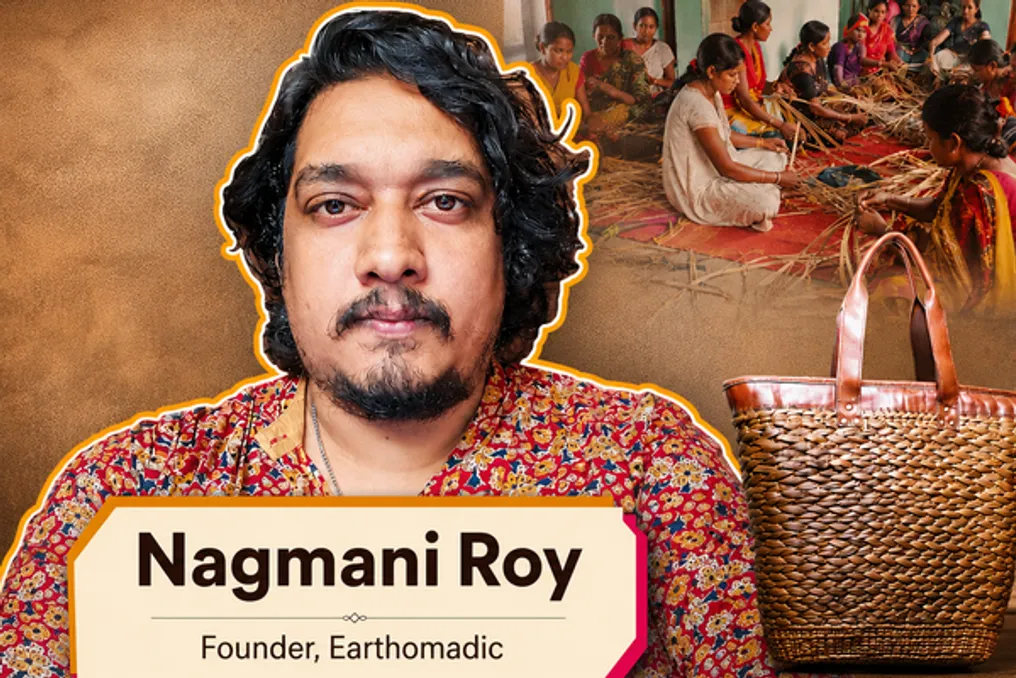
After his brand, which had 42 stores, was threatened with closure, Nagmani Roy redirected his efforts to support 1700 women from the state of Bihar.
Nagmani Roy's journey began in a small village in Bihar, from where he went to the National Institute of Fashion Technology (NIFT) in Hyderabad. There, he built a fashion brand with 42 stores across the country. However, the direction of his life changed drastically when the retail business closed during the COVID-19 pandemic, and he returned to Vaishali, his native region.
In his village, he noticed that many women possessed traditional skills but lacked access to markets, design, and stable income. It was then that the Earthomadic Foundation and Project Anuswaar initiatives were launched. The goal of these projects is to connect traditional crafts with the modern market and create sustainable livelihoods for rural women.
The founder of Earthomadic Foundation, Nagmani Roy, shared his experience transitioning from fashion retail to rural entrepreneurship. He spoke about how he managed to link local artisans with the market.
Nagmani spent his childhood in a middle-class family in Bihar. For a long time, the main source of family income was his grandfather, who worked as a teacher in a government secondary school. Nagmani attended public schools up to secondary level. Later, his father started a business, and the family's financial situation gradually improved.
He then pursued education in fashion design at NIFT Hyderabad and graduated from university in 2009. Studying design gave him an understanding not only of clothing and fashion but also of customers, markets, production, and business.
Nagmani Roy notes that his early life experiences taught him that limited resources are not always a weakness; they teach one to work hard, use what is available efficiently, and recognize opportunities. NIFT helped give this thought a new form.
After graduating in 2009, Nagmani chose the path of entrepreneurship instead of seeking employment. In 2010, he founded Kazari, a women's clothing retail brand. Over approximately 11 years, the business grew to 42 stores.
During this period, he deeply studied various aspects of running a business, including product development, sourcing raw materials, manufacturing, team management, marketing, and financial management.
The emergence of COVID-19 dealt a severe blow to the retail business, ultimately leading to its closure. Nagmani returned to Vaishali in Bihar. It was here that he had the chance to look at the skills and economic potential of rural women from a new perspective.
Nagmani emphasizes: 'I saw that many women have skills, time, and the desire to work, but there are very few economic opportunities. Initially, we started providing training in various crafts. Gradually, we realized that training alone is not enough for change. Understanding design, product, quality, and the market is equally necessary.'
The work, which started with bamboo, later expanded to crafts such as sikki, sujini, terracotta, appliqué, leather, hook, jute, and water hyacinth. Earthomadic was founded with this approach in mind.
The model is not limited to just providing training. Before starting work with the community, its existing capabilities, raw materials, and needs are studied. After that, work is done on skill development, design, product development, quality, production, and market access.
Project Anuswaar is part of this same process. Its goal is not just to prepare a trained individual but to transform them into an artisan who can earn a living from their craft continuously.
Nagmani believes that 'we want to take the artisan from skill to product, and from product to market. If a woman has mastered a craft, but her products are not selling, then the impact of the training remains incomplete. For us, real change happens when the skill continues to transform into an opportunity for income.'
Water hyacinth serves as an example. This fast-growing aquatic plant can be a problem for many water bodies. However, by using it as raw material, useful items can be created.
In Bihar, earning models based on water hyacinth are also encouraged. Under the central government's RAMP (Revitalization and Acceleration of MSMEs) program, a plan developed for Bihar noted the potential to expand clusters related to water hyacinth and banana fiber.
In April 2025, a skill development program for water hyacinth crafts was launched in Lakhnapur, Begusarai. The goal of this initiative was to train women and turn an environmental problem into a source of income.
For Nagmani, this model is important because it combines three elements: local resources, traditional skills, and the market.
Thanks to Earthomadic, about 1700 rural women have been trained. Of these, about 300 artisans are currently actively working in various clusters and groups.
In the Satpura cluster in Vaishali, about 130 artisans work using water hyacinth. About 30 sikki artisans work in Rajpakara, and about 30 leather artisans work in Belsara. Clusters for crochet and jute were also established in Kishanganj.
Nagmani asserts: 'For us, impact does not just mean stating the number of people trained. The main question is how many of them work continuously, how many have had the opportunity to earn, and how many are connected to the market. Our goal is not to increase the number of people receiving training, but to increase the number of earning artisans.'
Earthomadic Foundation was not originally a traditional commercial startup. Early work was carried out using Nagmani's own resources, project opportunities, partnerships, and businesses related to women's groups.
Over the last four years, through women's wings such as Venu Shilpkala Kendra and Meiosis Impex, about 1.5 crore rupees have been received from sales of products and training services.
Work is currently underway to give these products a unified Earthomadic brand. The task is not only to increase sales but also to create a model where the value generated by the business returns to the artisans, product development, and market access.
Nagmani Roy's next goal is to scale this model. Over the next three to five years, he plans to expand work with natural and alternative fibers, such as water hyacinth and banana fiber. Concurrently, there is a plan to combine traditional techniques with modern design in categories such as home goods, fashion accessories, furniture, and lighting.
Nagmani concludes: 'Before, I viewed success in terms of the number of stores, sales, and business growth. Today, success means something else to me. If a woman previously had no economic opportunities and now earns through her skill, that is success. If a traditional craft finds its place in a new market, that is also success.'
Nagmani Roy's journey from fashion retail to providing rural livelihoods is interesting because it shows two different forms of entrepreneurship. Previously, he created products for buyers. Now, he is trying to create markets for people who already know how to produce those products.
The road ahead for Earthomadic is long. Ensuring the sustainability of rural clusters, maintaining quality, and reaching larger markets will be challenging. However, Nagmani's story demonstrates that entrepreneurship is not just about creating a company; sometimes it is about building systems in which another person's skill can find a path to earning.