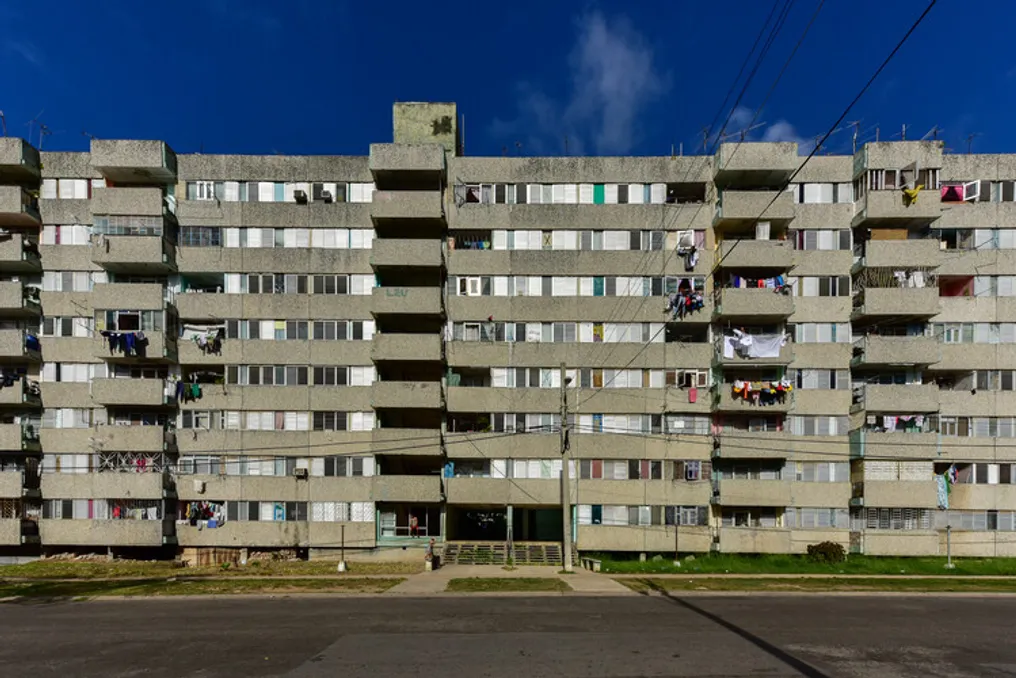
In the 1970s, Cuba faced a serious housing shortage across the national territory, caused by population growth, rural-to-urban migration, and the degradation of the existing housing stock. The solution implemented by the government consisted of a system that diverted ordinary workers from their usual occupations to construction sites. This program, called Microbrigades, restructured several districts of Havana, combining autonomous collective construction with technical support provided by the State, leaving a lasting mark on the capital's urban landscape.
Each Microbrigade was an apartment block erected by factory and office workers, not by specialized civil construction laborers. Companies sent teams composed of mechanics, administrative staff, or general service assistants to the work sites. To ensure overall structural soundness, the State assigned a small team of specialists in architecture, structural engineering, and foremen to supervise each project, train the workforce, and ensure the stability of the buildings. Thus, the relocated individuals dedicated their time to building the housing complexes, while their colleagues who remained in offices and factories maintained their routine activities—a method known as 'collective effort.'
From an architectural perspective, the Microbrigades were characterized by the standardization and industrialization of components. Due to resource limitations and the lack of specialized construction labor, state entities relied heavily on modular systems. In this scenario, four-to-five-story buildings, each with approximately twenty apartments, were constructed using prefabricated and semi-prefabricated systems that did not require high professional qualification. This allowed non-specialized volunteers to carry out most of the physical work under supervision.
Upon completion, the housing units were not necessarily allocated to the builders themselves. Allocation was determined by a combination of social needs (such as family size and current living conditions) and revolutionary merit (which included attendance, productivity, and volunteer hours worked). This decentralized distribution linked productivity directly to housing access, transforming the home into a social reward managed by peers, rather than a marketable commodity or a decree-decided asset.
Despite the architecture of the Microbrigades often being criticized for its monotonous aesthetic and rigorous utilitarianism, architects and urban planners in Cuba explored various projects and materials to introduce social flexibility into these rigid structures. Architects like Fernando Salinas conceived of industrialization not as a repetitive and sterile model, but as an adaptable tool capable of generating people-focused environments. In this sense, the neighborhoods created by the Microbrigades were often planned as complete social communities, linking green areas, public squares, nurseries, primary schools, and community polyclinics to the residential blocks.
In 1971, the Alamar project was formalized, one of the most notable undertakings of this program. It is a satellite city located east of Havana, intended to accommodate over one hundred thousand residents. By 1972, the area already featured the construction of seventy-two Microbrigades, and it is estimated that by 1973 this number exceeded one hundred, employing about three thousand workers—the so-called 'microbrigadistas.' By 1975, the area already had fully established schools, supermarkets, and parks.
Currently, Alamar represents the most evident physical legacy of the Microbrigade era: an extensive network of precast concrete blocks, which is still associated in popular memory with Soviet-style mass housing. More broadly, the Microbrigades are analyzed internationally as a case study on self-managed housing, demonstrating both the potential and the limits and consequences of mobilizing voluntary labor to reduce the housing deficit in a centralized economy.
The legacy of the Microbrigade movement remains complex. Critics point out that the reliance on untrained labor resulted in structural problems, maintenance difficulties, and urban dispersion marked by homogeneous concrete blocks. Some studies also highlight the repetition and uniformity of the design of these constructions as factors that contributed to the formation of an urban fabric incapable of integrating local youth. However, from an architectural perspective, the Microbrigades constitute one of the boldest experiments of the 20th century in collective self-construction. Today, they serve as an example of a strategy used to dissolve the barriers between those who build and those who reside, making the process of urban development itself a civic exercise.