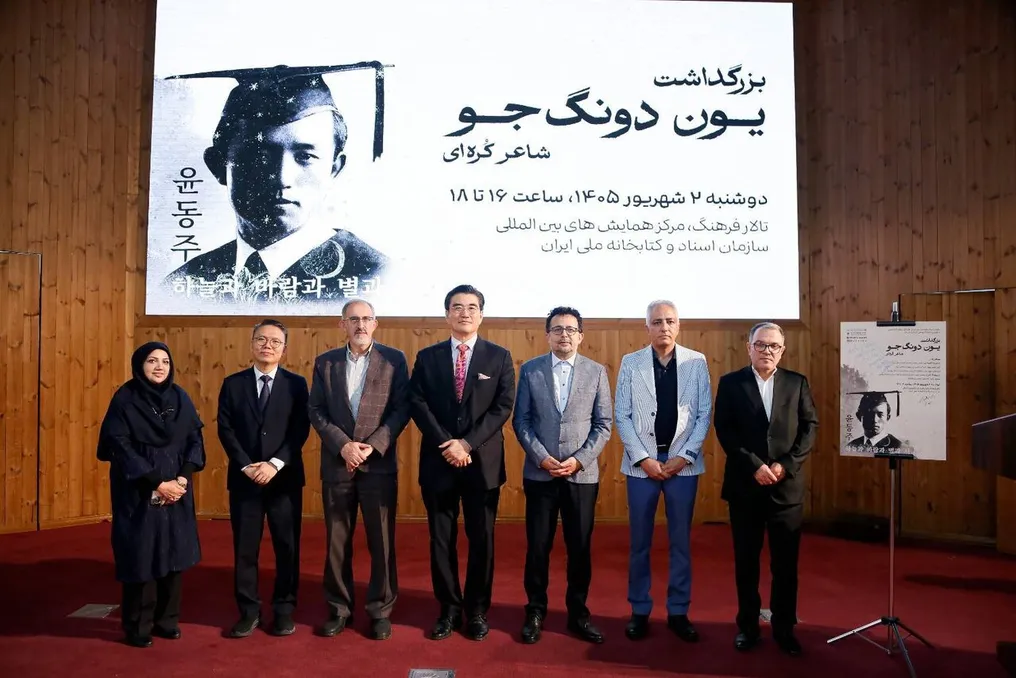
The National Library and Archives of Iran (NLAI) held a solemn ceremony in Tehran on Monday, August 24, to honor the memory of Yun Dong-ju, one of Korea's most beloved contemporary poets. The event took place in the Farhang Hall of NLAI and was jointly organized with the Embassy of the Republic of Korea in Tehran and Yonsei University.
Attendees included cultural figures, university professors, researchers, and poetry enthusiasts from both countries. This gathering emphasized that poetry and literature remain among the most enduring means of interstate dialogue, providing deep insight into the historical and cultural experiences of different peoples.
Speakers at the ceremony included Golamreza Amirkhani, President of NLAI; Kim Junpyo, the Korean Ambassador to Iran; Joo Il-soon, Dean of the College of Liberal Arts at Yonsei University; Shin Ji-young, Vice Dean of the same college, and Said Reza Ettahadi, translator and researcher.
Golamreza Amirkhani, head of NLAI, stressed that the organization is engaged not only in preserving the country's written heritage but also in cultural diplomacy, noting that the current event is part of this program. He added that work to strengthen ties with various countries worldwide has intensified over the past one or two years, and a program dedicated to the renowned Korean poet is currently underway.
The President of NLAI also mentioned the fiftieth anniversary of the establishment of Iranian studies departments in Korean universities, stating that about 1500 students from Korean universities have already graduated from programs studying Iran, becoming worthy ambassadors of Iran's history, culture, and civilization in South Korea.
Amirkhani spoke about the cooperation between the libraries of the two countries, reporting that the first special room for Korea was established in 2009, where hundreds of English-language books are now kept for researchers studying Korean literature and bibliography. He expressed hope for further expansion of interaction between the countries through the National Library.
Ambassador Kim also delivered a speech, welcoming everyone to the seminar dedicated to Yun Dong-ju. He noted the impressive scene upon his arrival and compared the attendees to the famous Korean group BTS, calling them a 'bridge between Tehran and Seoul.' Ambassador Kim thanked Golamreza Amirkhani and all the organizers, as well as Professor Joo Il-soon, Ms. Shin Ji-young, and Said Reza Ettahadi.
He shared his observation that Iran is a country that loves books and poetry, and he considers the rapprochement between Iran and Korea through literature natural. In 2010, a 'Korean Corner' was created thanks to the cooperation of national libraries, which was later developed into a multimedia space with support from Samsung. Today, they go beyond simply displaying books, discussing the lives and inner worlds of the authors.
Ambassador Kim particularly highlighted the significance of Yun Dong-ju to him, as the poet is a graduate of his university. He recounted how Yun Dong-ju's poems served as a compass in his youth, encouraging selflessness and kindness. After arriving in Iran, he met poets such as Hafez and discovered that Iranian poetry teaches one to look at life more broadly, much like Yun Dong-ju's poetry helped him understand life in Korea.
Joo Il-soon, speaking online, drew attention to the difficult conditions of the Iranian people, stating that war destroys not only homes but also human dignity. He also commented on the modern world governed by artificial intelligence, where algorithms replace human thought. The Dean of Yonsei University emphasized that Yun Dong-ju's poetry carries a profound flight outside of time and borders in a turbulent era, posing the question of conscience to humanity instead of offering ready answers.
Shin Ji-young, the vice dean, named Yun Dong-ju one of Korea's most beloved poets, comparing him to Hafez in Iran. She explained that the poet continued to write simple and beautiful poems in the Korean language despite colonial oppression, including the ban on using the Korean language and forced name changes. She explained the concepts of 'Han' (internal experience of pain) and 'Heun' (aspiration for optimism).
Regarding the preservation of Yun Dong-ju's works, Shin Ji-young noted that their dissemination became possible due to 'beautiful friendship.' She also mentioned the deep connection between Yun Dong-ju and Mehdi Akhavan-Saleh as poets who sought to preserve conscience and love in dark times. Said Reza Ettahadi, the translator, stated that the recognition of his translations after five years strengthened his belief in the power of books. He explained the complexity of translation, striving to maintain the content while avoiding complete Persianization of the poetry, and discussed collaborating with a Korean translator to ensure the text's accessibility to the Persian-speaking audience.