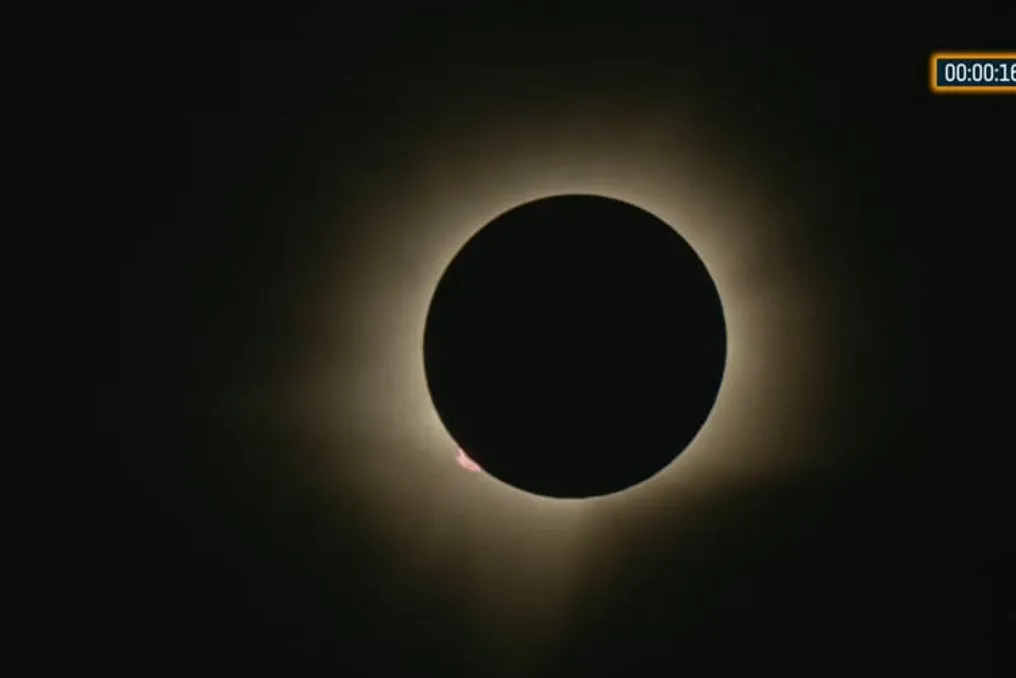
Eclipses are astronomical events that occur when one celestial body is positioned in front of another relative to a light source, resulting in the projection of shadows and a change in the appearance of the celestial bodies involved.
Recently, the last solar eclipse of the year was observed. Additionally, this week, between Thursday night (27th) and Friday morning (28th), a partial lunar eclipse will occur, concluding the 2026 calendar for this type of event.
About the last eclipse of 2026
This partial lunar eclipse is scheduled for August 27th and 28th, with a predicted time between 10:23 PM and 4:01 AM, according to Brasília time zone. The entire country of Brazil is located within the area of maximum visibility, allowing residents from all regions to follow the phenomenon from beginning to end. Because it occurs in the early morning, the Moon will be high in the sky, which facilitates viewing the Earth's shadow covering part of the lunar disk. In addition to South America, the event will be clearly visible across North America, Europe, and Africa.
A solar eclipse happens when the Moon is positioned between the Sun and the Earth. In this specific alignment, the natural satellite obstructs total or partially the sunlight, casting its shadow onto a section of the planet. For this reason, observing this phenomenon is restricted to certain areas of the Earth, and its appearance varies depending on the observation location.
Solar eclipses can be categorized into three primary types: Partial, where only a portion of the solar disk is obscured by the Moon; Total, when the satellite completely covers the Sun for a period, exposing the corona, the outermost layer of the solar atmosphere; and Annular, which occurs when the Moon passes in front of the Sun but fails to cover it entirely, usually because it is farther from Earth and appears smaller in the sky, maintaining a luminous ring around it.
There is also the hybrid eclipse, such as the one recorded in April 2023, an unusual event that can exhibit characteristics of both a total and annular eclipse, depending on the point on Earth from which it is observed.
Lunar Eclipses
The lunar eclipse operates under the opposite logic. In this scenario, the Earth is situated between the Sun and the Moon, causing the planet's shadow to be projected onto the natural satellite. Since the Moon does not generate its own light, its brightness decreases when entering the Earth's shadow.
There are also three main classifications for lunar eclipses: In a total lunar eclipse, the entire Moon passes through the darkest part of the Earth's shadow, although it does not disappear completely and may take on a reddish hue. In a partial eclipse, only a fraction of the Moon penetrates the darkest shadow, while the rest remains illuminated. In a penumbral eclipse, the satellite passes only through the outer and less dense region of the Earth's shadow, resulting in a more subtle and potentially difficult-to-notice change in brightness.
In summary, the fundamental distinction lies in the alignment: in a solar eclipse, it is the Moon that casts its shadow onto the Earth; in a lunar eclipse, it is the Earth that projects its shadow onto the Moon.