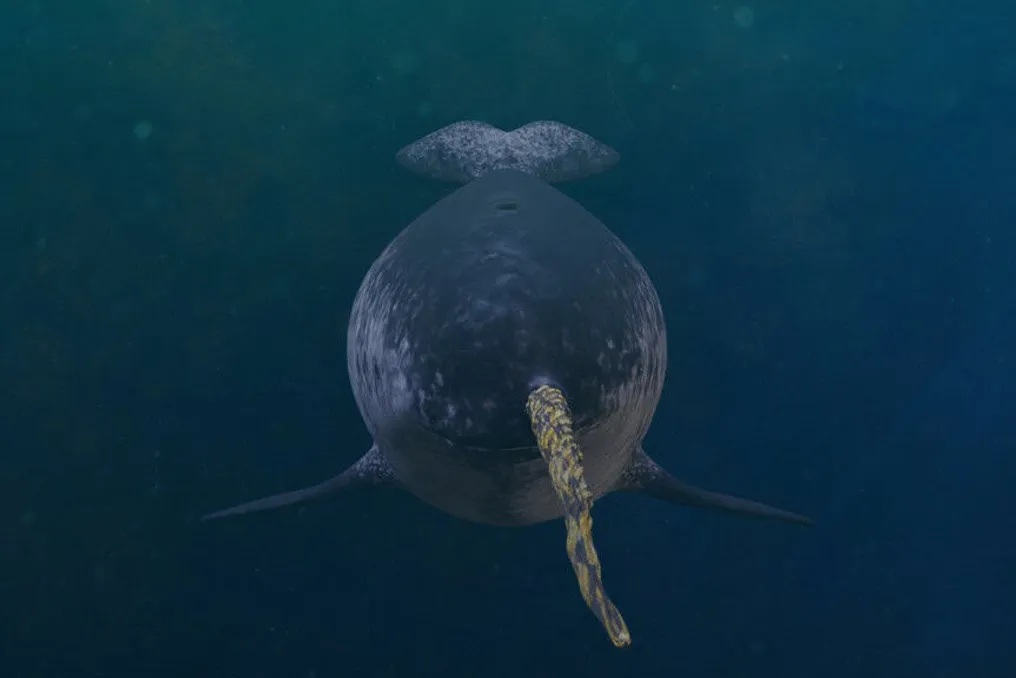
The notorious 'tusk' of the narwhal, which can reach three meters in length, has been the subject of recent study, where researchers discovered how this structure manages to exhibit spiral characteristics while simultaneously being surprisingly straight.
The secret to this characteristic lies in the composition of the tooth. Three-dimensional analyses revealed that two types of tissue form spirals in opposite directions, a finding that aids in understanding one of the most unique forms found in the natural kingdom.
This tusk develops from the left canine of males, running along the jaw and upper lip until it becomes fully visible. In contrast, the right canine follows a different path, remaining inside the skull.
The peculiar appearance of this structure generated a historical legend: during the Middle Ages, these appendages were traded as magical unicorn horns.
How the structure is carried during dives
Henrik Birkedal, a chemist at the University of Aarhus in Denmark and lead author of the article published in Nature Communications, offered an analogy about the challenge of transporting such a structure during dives. He compared the situation to 'riding a bicycle with a broom tied to one's head.'
To obtain the results, the team used advanced three-dimensional X-ray imaging methods on three European particle accelerators known as synchrotrons.
The tusk is composed of dentin in its inner part and cementum in the outer layer. It was at this point that the key to solving the enigma emerged: the researcher explained that, unlike screwing a screw into wood, where it penetrates deeper with each turn, in the narwhal the reverse movement occurs, where the 'screw' advances out of the head.
The investigations also brought another important discovery: inside the tusks there are growth layers analogous to tree rings. These layers can help scientists track the life trajectory of these animals, which have the potential to live up to 80 years.
The team analyzed tusks preserved in museums, in addition to specimens provided by Inuit from Greenland who catch narwhals for consumption.
Function of the structure: hunting, dominance, or sense
There is still an outstanding question: what is the exact function of this prominent structure? Although there are theories that it may be used for hunting or to detect variations in water temperature and salinity, the study's authors consider these hypotheses less likely, given that the tusk grows almost exclusively in males.
An alternative clue was observed when researchers saw two males seemingly comparing their tusks in front of a female. This behavior suggests a link to displaying dominance or attracting mates.
Mads-Peter Heide Jorgensen, co-author of the research and researcher at the Greenland Institute of Natural Resources, supports this latter explanation, stating that 'this is undoubtedly the most probable function of the tusk.'
On the other hand, Martin Nweeia, an expert in narwhal tusks from Harvard University, who did not participate in the study, proposes a different view, suggesting that the structure may operate primarily as a highly developed sensory organ.
Despite the disagreements about its purpose, Nweeia classified the research as 'yet another valuable contribution to the knowledge of the microanatomy and morphology of the narwhal tusk.'