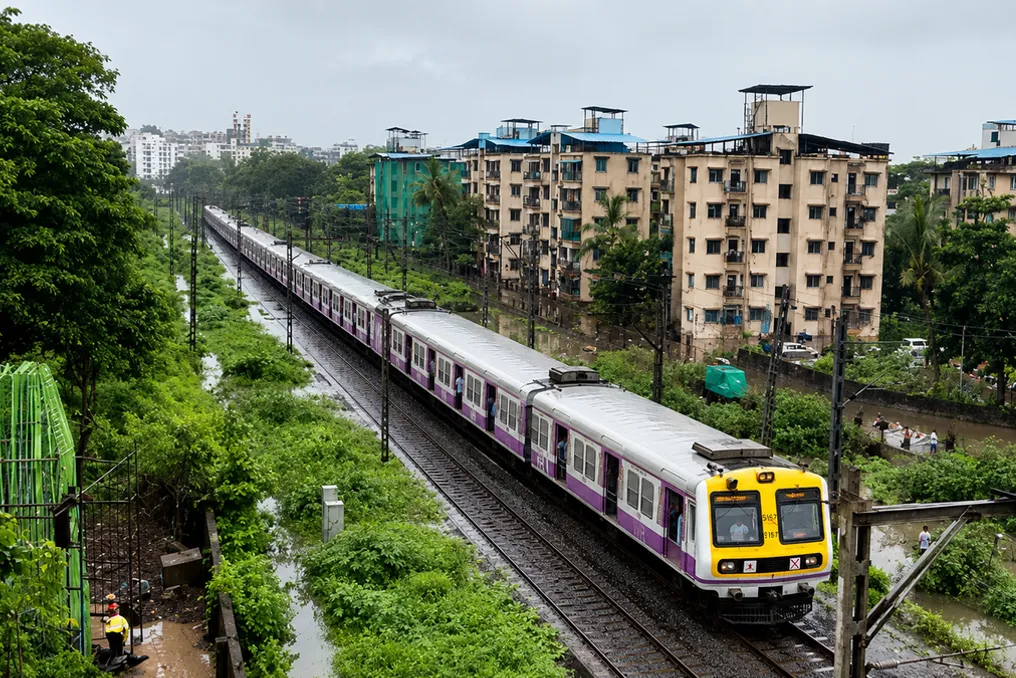
Every night, families living in slums along the railway lines of Delhi hear the same sound: a passing freight train with a noise level of about 100 decibels, which is almost double the safe level set by the Central Pollution Control Board of India (CPCB) for residential areas. For a long time, this was considered the inevitable price of living near the tracks.
However, the growing body of scientific research conducted by scientists from Delhi Technological University (DTU) is now measuring the degree of loudness, frequency, and sleep disturbance caused by this exposure, while also proposing ways to improve the living conditions of millions of Indians who live near railway corridors.
What the figures show
The first clear signal appeared in 2024 when a DTU team led by Rajiv Kumar Mishra, an associate professor of environmental science and engineering, conducted noise measurements at 10 points near Delhi railway stations. In all locations, CPCB limits were exceeded, and the most common complaint among surveyed residents was sleep disturbance.
A subsequent study in 2025, conducted jointly with CSIR-Central Institute of Road Transport, was more extensive: it tracked 1057 train passages in 14 informal settlements. The noise level in all studied locations exceeded residential standards, in some cases by 85%. Freight trains proved to be the noisiest offenders, averaging 100 decibels, while diesel locomotives were consistently louder than electric ones.
For comparison, WHO guidelines on environmental noise pollution recommend that railway exposure remain below 54 dB during the day and 44 dB at night, which is slightly stricter than CPCB residential norms—55 dB and 45 dB. Even by its own standards, DTU data indicates that entire areas are subjected to repeated exposure significantly exceeding recommended levels every night.
What long-term noise exposure does to the body
Noise meter readings only tell part of the story. WHO guidelines on environmental noise pollution for Europe since 2018 link long-term noise exposure to sleep disorders, cardiovascular and metabolic diseases, cognitive impairment in children, and negative impacts on mental health.
The research indicates that nighttime noise, even if it doesn't fully wake a person, can fragment sleep and trigger the release of stress hormones. This, in turn, is linked to increased blood pressure, heart disease, strokes, obesity, and diabetes, as well as impaired memory, comprehension, and critical thinking skills in children.
Noise is only half the problem
Homes located near the tracks absorb not only sound but also vibration transmitted through the ground. Mahavir Singh, former senior scientist at CSIR-National Physical Laboratory, notes that current monitoring methods in India are good for regulatory compliance but do not always reflect the real experience of residents: repeated passages, nocturnal disturbances, and years of cumulative exposure.
Brind Kumar from IIT (BHU) similarly emphasizes that while reverberation makes noise dominant at station platforms, vibration can pose a particular problem for homes along open stretches of tracks. For families living there, the issue is often not one isolated loud event but the cumulative effect of sound, jolts, and interrupted sleep.
This distinction can also guide India toward more effective solutions. Instead of simply checking if one train meets the decibel standard, monitoring could begin to account for train passage times, their frequency, and what residents experience throughout the night.
Ways to reduce noise on tracks
Railway noise is not an insurmountable problem. Indian Railways has already implemented several engineering measures capable of reducing it. KPS Verma, former executive director of the Organization for Development and Standards, points to interventions such as welded rails, rail grinding, and improved braking materials.
These measures can reduce the noise generated by wheels and brakes, while the ongoing transition to quieter electric locomotives offers another opportunity to reduce impact on busy corridors. The next step is to expand this thinking beyond the railway system and to the communities living alongside it.
This may mean identifying settlements facing the highest nighttime exposure and prioritizing them for targeted monitoring. In some areas, planners might consider installing noise barriers, improving building insulation, and other protective measures to reduce sound penetration into homes. Solutions may vary depending on the railway corridor, but DTU studies offer India something it has lacked until now: detailed, location-specific data that can help direct resources where they are needed most.
Listening to residents near the tracks
One of the biggest opportunities lies in combining measuring instruments with real life experiences. A sound meter can record the peak sound of a passing freight train, while residents can explain whether that train woke up their children, interrupted their night's sleep, or shook their homes. Combining these two types of evidence can create a more complete picture of railway noise in India.
Manish Purshotam Manohare from IIT Delhi warns that the lack of long-term health data in India should not be taken as proof that the problem does not exist. India can build its own long-term evidence base by acting proactively, bringing together transport engineers, environmental health researchers, and urban planners.
India has previously solved parts of the noise problem
There is reason to believe that public attention can lead to practical changes. In Mumbai, the sustained campaign of eco-activist Sumaira Abdulali helped bring the issue of noise pollution into the public eye and contributed to the notification of over 2000 quiet zones. In Thane, a lawsuit prompted the Bombay High Court to demand the installation of sound meters at police stations. In Delhi, a campaign against excessive use of horns, construction, and other forms of urban noise has been ongoing for years.
Railway noise can now benefit from a similar approach: regular community-level assessments, nighttime monitoring, and planning that considers the people living closest to major transport infrastructure.
Turning measurements into meaningful change
DTU studies have done important work: they have turned everyday experience into an evidence base. For families living near the railway lines of Delhi, a passing train is not an abstract environmental problem. But by measuring 1057 train passages in 14 settlements, researchers gained a stronger foundation for identifying where interventions can be effective and who needs them first.
Living near a railway line does not guarantee poor health. However, millions of people should not be forced to simply accept recurring nighttime noise as the price of proximity to public infrastructure. India already possesses quieter railway technologies, better maintenance methods, and growing experience in environmental monitoring. Now, these tools need to be brought closer to the communities living near the tracks. Trains should not stop running, and they shouldn't. But as India expands and modernizes its railways, researchers hope that the people living near them can finally become part of the progress intended to protect them.