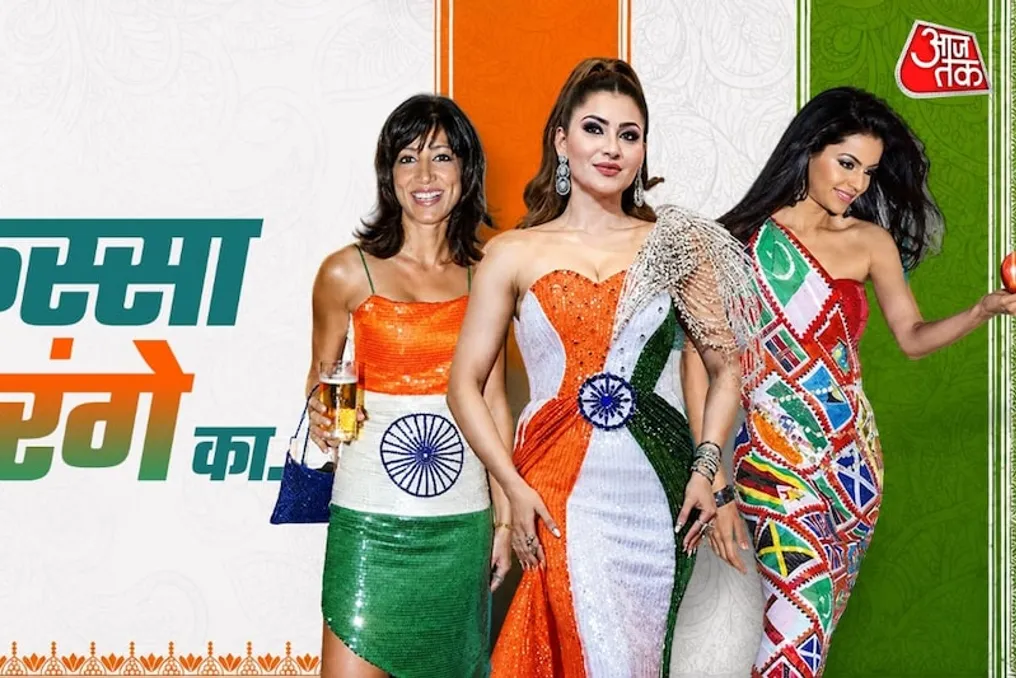
When the colors of the tricolor become a fashion trend, it sparks debate. The history of this phenomenon stretches from Mandira Bedi's saree to Urvashi Rautela's dress.
Recently, Urvashi Rautela appeared at the Grand Finale of Miss Universe India 2026 in Jaipur. Her tricolor dress attracted significant attention. It was an unadorned, long, strapped dress adorned with a design resembling the Ashoka Chakra at the waist, executed in saffron, white, and green tones. While this might have been just a glamorous fashion moment for Urvashi, her outfit reignited an old discussion: is wearing clothing inspired by the tricolor an expression of patriotism, or is it considered an insult to the national flag?
Urvashi, who was serving as a judge for Miss Universe India for the third consecutive time, appeared alongside Sushmita Sen, the first Miss Universe India. When asked about her appearance, she stated that she 'is India' and feels like India. However, this fashion choice once again triggered a wave of controversy surrounding the use of the tricolor.
It is important to understand that Urvashi's dress was inspired by the tricolor, not an exact replica of the national flag. It utilized saffron, white, and green colors, along with a design inspired by the Ashoka Chakra. This subtle distinction is often how Indian fashion designers incorporate the tricolor.
The law does not prohibit wearing a combination of saffron and green; it sets rules regarding the true depiction and improper use of the national flag. According to the Flag Code of India, the national flag cannot be used as clothing, uniform, or a dress. Furthermore, there are clear restrictions on printing or embroidering the national flag on fabrics or garments. The national flag must not touch the ground.
Moreover, the Prevention of Insults to National Honour Act, 1971, makes insulting the national flag punishable. Under the law, public insult to the national flag can result in imprisonment, a fine, or both. Following amendments in 2005, provisions were added concerning wearing the national flag below the waist or using it as material for clothing. Nevertheless, the use of small, respectful lapel pins is permitted, indicating the legal boundary between tricolor-inspired fashion and the actual use of the national flag on clothing.
Urvashi's dress appears to be on this boundary—between the letter of the law and its spirit. Such debates are not new in Indian fashion.
In 2007, Mandira Bedi also found herself at the center of a similar controversy. During the Cricket World Cup final hosted by the country, she wore a saree designed by Puneet Nanda, which featured the flags of all participating nations, including the Indian tricolor. The tricolor was noticed on part of the saree near her feet during the broadcast. This led to a dispute. When the match was paused due to rain, Bedi returned to the screen in different attire. Reports indicated that Puneet Nanda later apologized, stating he never intended for the Indian flag to be so close to Bedi's feet. Bedi herself explained that she specifically chose that saree for the final because it contained the flags of all 16 participating countries.
An even older and more high-profile case involves designer Malini Ramani. This incident was revisited during the debates surrounding Urvashi's dress. At the opening party of the first fashion show in India, Ramani wore tricolor attire: an orange top, a central chakra design, and a green skirt. According to reports and fashion archives, this outfit caused such a stir that calls were made to shut down the entire fashion show. Ramani was forced to issue public apologies in major newspapers. It was even reported that the police confiscated the controversial dress and displayed it on a mannequin in jail. It took about 18 years before this matter was resolved and Ramani's name cleared.
Although there is a significant contrast between Malini Ramani's outfit and Urvashi Rautela's dress nearly two decades later, the core question remains the same: Indian designers use the tricolor colors to showcase identity and patriotism, while a segment of society views this symbol through the lens of national dignity.