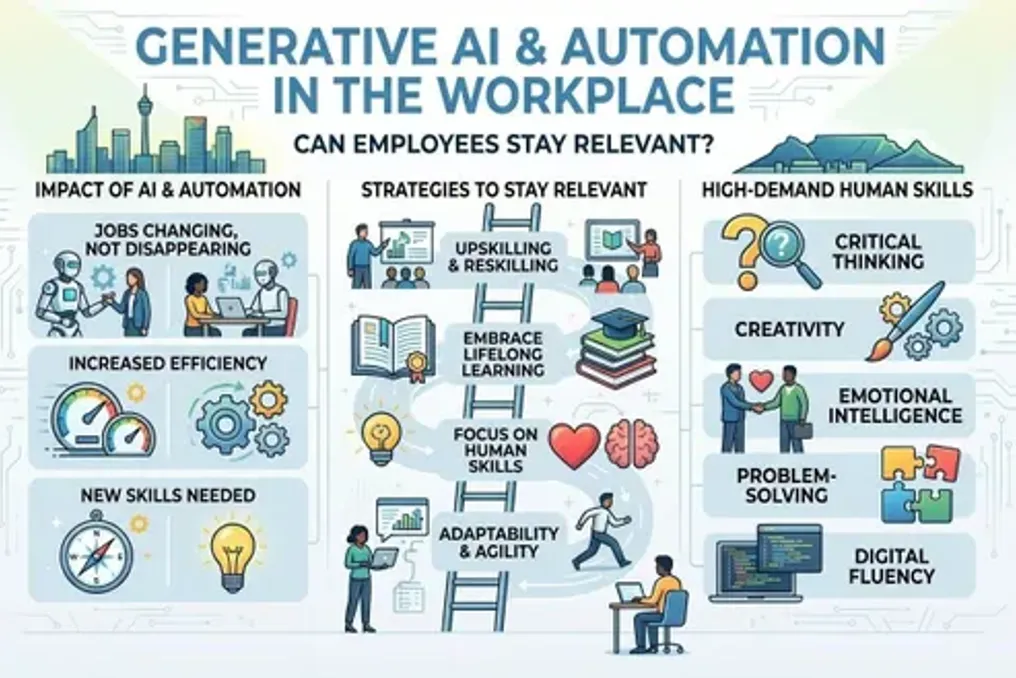
According to experts, the significance of humans in the workplace is maintained by the necessity of human control over AI decisions, provided that employees master the use of artificial intelligence tools. Today, organizations are no longer asking about automation but rather about who can successfully navigate this transition.
Although advanced artificial intelligence systems are transforming data-intensive industries such as finance, call centers, education, and law, technology specialists emphasize that this wave is aimed not at destroying jobs but at rethinking them.
As firms from South Africa utilize initiatives like the International AI Readiness Accelerator to create more sophisticated systems, the pressing question becomes not job preservation, but whether the workforce possesses the necessary skills to collaborate with these systems.
Some sectors have already begun engaging stakeholders to implement AI in their processes. For instance, the hospitality industry stated at its recent annual meeting at The Hospitality Industry Think Tank that 'AI will not replace your job, but the person using AI will.' In the hospitality sector, AI is viewed as a way to free up time for human interaction, such as providing more personalized service, better understanding guest needs, and building meaningful relationships that strengthen loyalty.
Sethi Moloi, CEO and founder of Khoi Tech, noted that in South Africa, new AI tools are most likely to affect industries that are data-intensive, have complex processes, or rely on a large volume of repetitive intellectual work. Such sectors include banking, insurance, and financial services, call centers and customer service, professional services such as law, accounting, consulting, marketing, and media, as well as technology and software development, mining, manufacturing and energy, healthcare, education, retail, agriculture, logistics, transport, and public and social services.
Moloi clarified that 'affected' positions do not necessarily imply job elimination. He stated that in many industries, the biggest change will occur in how people work, what skills are valued, and how quickly organizations can deliver services. He added that the World Economic Forum already identifies AI and machine learning specialists as among the fastest-growing roles in South Africa, and AI and big data skills are becoming increasingly important across all industries.