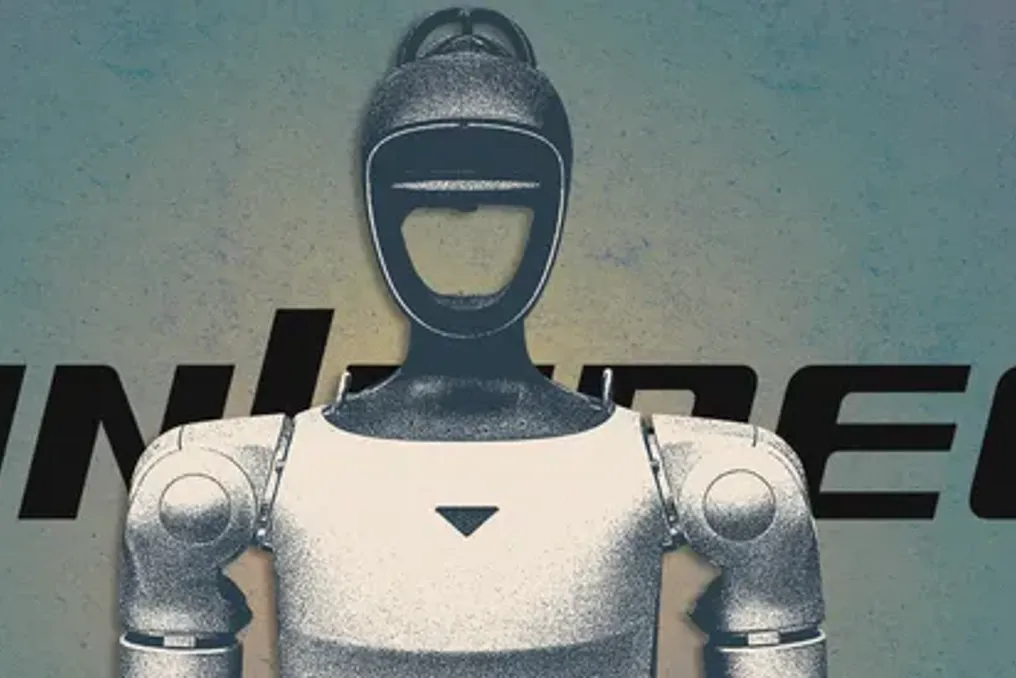
Unitree Robotics has introduced its Superman robot, which has set new records in terms of speed and maneuverability, thereby placing China at the forefront of the robotics industry.
On August 17, Unitree Robotics published a 30-second video on the Chinese social network Weibo. The video featured a headless humanoid named Superman performing a jump of six and a half feet and running at a speed exceeding 28 miles per hour. This speed surpasses any historical human record set by Usain Bolt, whose maximum speed was 27.78 miles per hour.
Two days after the publication, the Hangzhou-based company listed on the Shanghai stock exchange. The company's shares briefly reached $163.66, representing a 629% premium to the offering price. This valued the company at nearly $66 billion during the day before closing at $50.8 billion for the day, an exceptional valuation for a pure robotics company. The only comparable is another Chinese company, UBTech, which was valued at $4.9 billion during its initial public offering in December 2023.
This move is seen as a concluding element in China's effort to build a powerful ecosystem around embodied artificial intelligence. Beijing has elevated robotics to a strategic importance for the future economy within the broader technological competition with the United States. Research firm Omdia predicts that China's share in global humanoid robot sales will reach almost 90% in 2025, while American competitors Tesla, Figure AI, and Agility Robotics have sold only about 150 units.
McKinsey research suggests that embodied AI—synthetic brains with bodies to interact with the physical world—will develop faster than any other industry in the coming years. This is a race to create one of the main drivers of the 21st-century economy. Unitree's IPO clearly demonstrates the lag of the US.
Superman, presented by Unitree founder Wang Xinsing, is arguably the most athletic robot observed to date. It is capable of jumping 6.6 feet high while standing and achieving a top speed of 28.3 mph. For comparison, in April, the modified Unitree H1 set a running record for a robot at approximately 22.4 mph. At the 2025 World Humanoid Robotics Games, the winner in the high jump cleared a height of about 3.14 feet.
The machine is headless. Superman is estimated to be at least 6 feet 3 inches tall. Its legs, measuring 2.8 feet long, are longer than the legs of the standard Unitree H1, a proportion aimed at increasing stride length for higher speed. The robot is not equipped with arms or grippers, nor does it have head-mounted sensors present in the commercial H1 and G1 lines. It is known that its joints use the typical Unitree design, featuring high torque density built around rare-earth magnets—components globally controlled by China.
No other technical specifications are currently available. According to Unitree, Superman is an 'experimental platform for studying highly dynamic movements.' The company claims it is an entirely new unit 'developed in less than three months, with many opportunities for improvement in the coming months.' The figures provided lacked a test track, measurement methodology, or third-party verification. Total mass, degrees of freedom, battery capacity, sensor details, or mass production schedules were also not provided.
The demonstration was impressive and strategically timely, occurring just two days before the listing on August 19. Unitree became the first general-purpose robotics company—not just the first humanoid manufacturer—to list on the mainland Chinese stock market. Retail demand for shares exceeded the available supply by more than 8,000 times, a figure Reuters noted as unprecedented on the Star Market, China's equivalent of NASDAQ.
Unitree's sales are growing rapidly. In the first quarter of 2026, they increased by 68.5% compared to the previous year, and by July, the company had cumulatively produced a record 18,000 bipedal humanoids across various models. Their robots have already gone viral through running, dancing, and martial arts performances, and they are beginning to enter the real world. CATL, a major lithium-ion battery manufacturer, is deploying humanoids in Luoyang; Japan Airlines is testing the Unitree G1 for baggage at Haneda Airport, Tokyo, until 2028; State Grid, China's national power grid, has launched a $1 billion robot maintenance plan; and the Unitree R1 is being sold abroad for under $5,000, unlike Elon Musk's projected $20,000–$30,000 for Optimus.
In May, following Musk's high-profile announcement, Wang climbed into the GD01 chassis, a 1102-pound mech worth about $574,000, circled it, and punched through a concrete wall with one blow. The company names this model Superman, another move in Musk's style. However, the billionaire from South Africa's Optimus has had little impact on the real world so far.
Given this demonstrative aspect and its company's success, it is unsurprising that Unitree's CEO received a distinguished spot at the summit of leading Chinese tech entrepreneurs organized by President Xi Jinping in February 2025. But Unitree and UBTech are just the beginning of what is to come. Companies little known in Western countries—such as AgiBot, Deep Robotics, Leju, X Square Robot, and LimX Dynamics—are likely to join the public market alongside major names like Xpeng and BYD, which are heavily investing in the embodied AI industry.
During a robotics conference in Beijing in 2026, Wang stated: 'We are moving towards the 'ChatGPT moment' in embodied intelligence.' This moment is being created, sold, and now traded on the Shanghai stock exchange, while the US appears to still be watching from the sidelines.