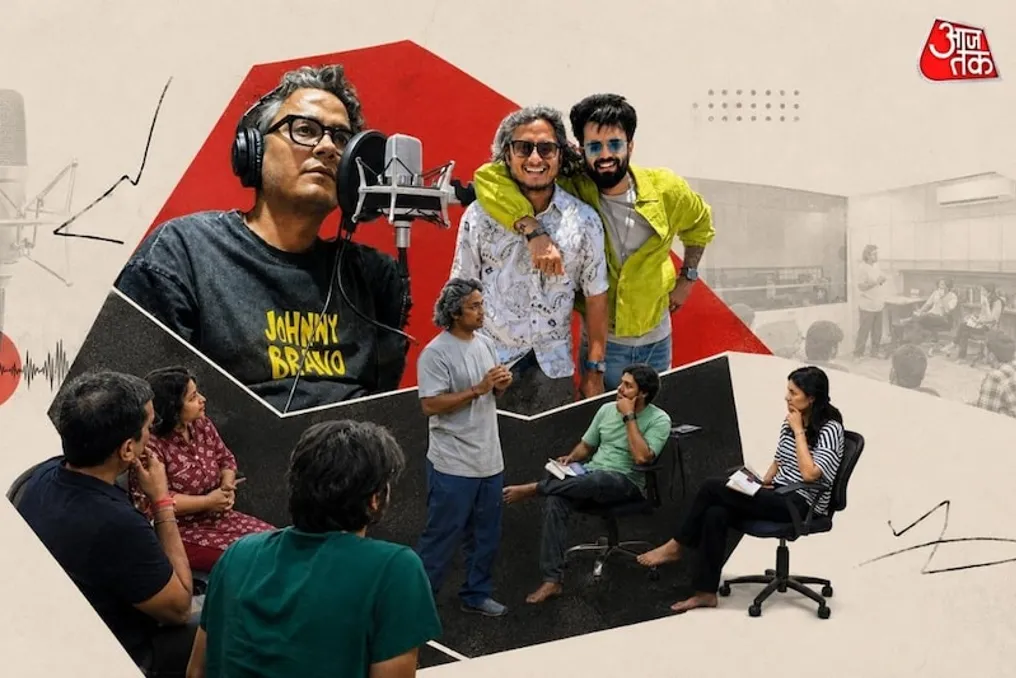
Amit Deondi shares his experience, explaining that his path to voice acting was not straightforward. He started by preparing for the NDA exam, then went through theater, worked in a bank, participated in radio auditions, worked in Mumbai studios, and freelanced, constantly acquiring new skills.
The main lesson from his story is that a career rarely develops in a straight line. Sometimes you have to work a regular job, sometimes auditions are rejected, and sometimes you have to start from scratch in a new city.
Amit asserts that there is no strict or established route to entering the world of voice acting. After completing 12th grade, young people can choose courses related to theater, acting, mass communication, or languages, although a specific specialization is not mandatory. In this field, voice, timing, acting skills, and language proficiency are more important than a diploma. Theater experience is very useful here because it teaches deep understanding of emotions, dialogue delivery, and characters. Furthermore, the stronger one is in English and other languages besides Hindi, the wider the doors open in voice acting and localization.
The emergence of voice AI and voice cloning is forcing the voice acting industry to undergo significant changes. Today, machines can translate and imitate voices in mere moments, so simply having a 'clear voice' will not be enough in the future. Amit states that neither he nor the industry is worried about this. However, new artists must focus on acting skills, deep understanding of emotions, language adaptation, and technical skills. AI can copy a voice, but the ability to convey the pain, anger, or fear of a character by understanding their inner state is a unique human talent.
Today, viewers are not limited to Hindi or local content; Korean, Chinese, and English films and series are watched across India, while Indian content is becoming global. Consequently, the importance of voice acting and localization has increased more than ever. To bring an international story to the hearts of local viewers, it is not enough just to translate words; dialogues must be culturally adapted. This is why many new fields have emerged in this area beyond simple voice acting, including voice scriptwriters, dialogue adapters, voice directors, casting, and audio post-production.
Speaking of Amit's key projects in voice acting, he voiced characters such as Gary the 'Snack' in 'Zootopia 2', Quicksilver in the 'X-Men' and 'Avengers' films, Q in James Bond films, Neil in 'Legend of Hanuman', Gattu in 'Gattu Battu', and Miki Online in 'Motu Patlu', as well as Kimon in 'Kemon Ache'. Additionally, he voiced the Hindi versions of Jonathan Byers and Jeffrey Dammer in 'Stranger Things'. His participation was also in the Hindi version of Gary from 'Zootopia 2'. Among his international works are major projects like 'The Adventures of Tintin' and 'How to Train Your Dragon', where he voiced Hiccup. Amit also wrote Hindi dialogues for international films, including 'Toy Story 5', 'Avatar: The Way of Water', 'Fantastic Four', and 'Mission: Impossible - Fallout'.
Amit's experience is not limited to voicing films and web series. He has worked on many popular television and entertainment shows and collaborated with famous hosts and actors in various projects. Among the projects he participated in are 'OMG! Ye Mera India' with host Krishna Abhishek, 'Dugout Dishoom' with Varun Dhawan and Akash Gupta, 'Science of Stupid' with Manish Paul, 'Mystery Hunters' with Ranvijay Singh, 'Animals Gone Wild' with Javed Jaffrey, and 'Crazy Wheels' with Raghav Juyal. Moreover, Amit is currently writing the script for the 11th season of 'OMG! Ye Mera India'. In these projects, his work was not limited to scriptwriting; Amit also provided vocal direction during the recording of all hosts.
A significant milestone in Amit's career was the Hindi adaptation of 'The Odyssey'. Amit shared that manifestation plays a huge role in his life. He mentioned that a year ago, he wished to write 'The Odyssey', but he didn't know that the project he was working so hard on would come to him. He received a call, and he participated in adapting English content for the Indian audience. Here, the work was not just translating words, but presenting an international story to the Indian audience in a natural language and with the correct emotions. This work demonstrates that...