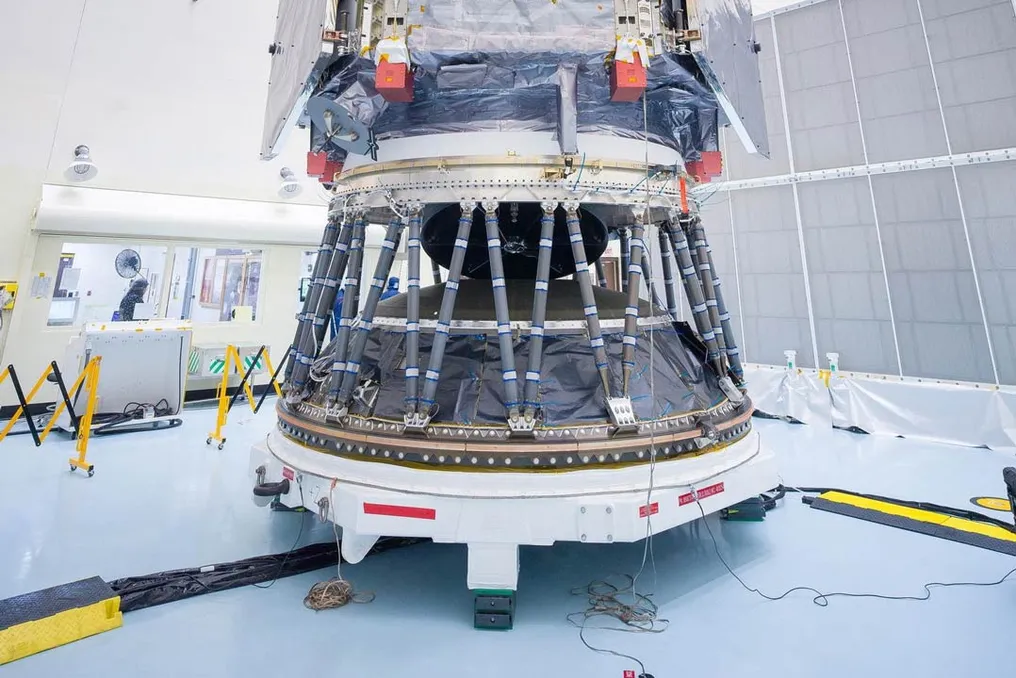
NASA's US space agency is preparing to launch its next flagship space observatory. Scientists plan to use this instrument to study the universe's greatest mysteries, including dark energy and dark matter, as well as to test gravity on a massive scale and search for planets outside the solar system.
The Nancy Grace Roman Telescope, a project costing about $4 billion USD, is scheduled for launch this Sunday from NASA's Kennedy Space Center in Florida. The instrument will be placed into orbit using a SpaceX Falcon Heavy rocket. According to officials from the American space agency, the launch will occur nine months ahead of schedule.
The Roman Telescope is the successor to the Hubble Telescope, launched in 1990, and the James Webb Telescope, launched in 2021. It possesses capabilities that could expand upon the knowledge gained by these pioneering observatories, which continue to operate.
The panoramic view of space and the high survey speed of the new telescope give scientists the opportunity to study the cosmos in an unprecedented way, as wide-angle surveys will allow for the analysis of its structure, composition, and evolution.
Julie MacEnery, a senior research scientist on the Roman project at NASA's Goddard Space Flight Center in Maryland, told reporters: 'Roman's extensive coverage will allow us to find the strange, the rare, and the unusual.' She added that Roman's primary instrument combines exceptional performance and sensitivity with the ability to rapidly and efficiently survey large areas of the sky. According to MacEnery, the telescope's main investigation will take over a year.
Structure of the Universe
MacEnery explained that this study will cover over two billion galaxies, allowing researchers to study how structures in the universe—stars, galaxies, and galaxy clusters—grew and developed. Furthermore, it will measure how our universe has expanded over time. This data will be key to unlocking the fundamental nature of dark matter, dark energy, and the fabric of the universe itself.
The Big Bang event, which occurred approximately 13.8 billion years ago, initiated the universe, which has been expanding ever since. In 1998, scientists discovered that this expansion is actually accelerating, and an invisible force—dark energy—was hypothesized as the cause of this process.
The composition of the universe includes ordinary matter—stars, planets, gas, dust, and all familiar Earth elements—as well as dark matter and dark energy, whose physical nature remains unknown. Ordinary matter accounts for an estimated 5% of the content. Dark matter, known by its gravitational influence on galaxies and stars, may account for about 27%. Dark energy is thought to constitute about 68%.
Cosmologist Mustafa Ishaq from the University of Texas at Dallas, a member of the Roman scientific team, asked: 'What are the key questions: is dark energy simply a property of empty space that remains constant over time, or does it evolve?'
Recent results from the DESI collaboration—Dark Energy Spectroscopic Instrument—point to promising signs of temporal evolution of dark energy. Ishaq noted that the observed acceleration may indicate the need to modify our theory of gravity on the largest scales. Answering this question is one of the most important goals of modern cosmology.
Physicist Albert Einstein presented his theory of general relativity in 1915, explaining gravity, and it remains fundamental. The Roman Telescope maps galaxy clusters and how matter bends light through a phenomenon called gravitational lensing.
According to Ishaq, such measurements allow verification of whether Einstein's theory remains valid across billions of light-years, or if changes to the theory of gravity are required. He emphasized that this is important because it touches upon one of the most fundamental questions in physics: what law governs the universe on its largest scales?
To date, over 6,350 exoplanets—planets outside our solar system—have been discovered while scientists search for evidence of potential life beyond Earth. Roman will conduct one of the most comprehensive searches for exoplanets in history. It is expected to discover thousands of new planets and provide the first statistical summary of planetary systems similar to ours. Additionally, it will demonstrate new technologies for directly imaging some relatively close exoplanets.
After launch and separation from the rocket, the telescope will head to Lagrange Point 2, located approximately 1.6 million kilometers from Earth, which is about four times farther than the Moon. The Webb Telescope is also located at this orbital point, whereas Hubble is in low Earth orbit.
The Roman mission is planned for five years, although NASA stated that the telescope may have enough fuel for another five years. The administration of US President Donald Trump attempted to cut or completely halt funding for Roman during both of his terms, but the US Congress maintained the funding. The telescope is named after Nancy Grace Roman, NASA's first chief astronomer. Roman passed away in 2018 at the age of 93.