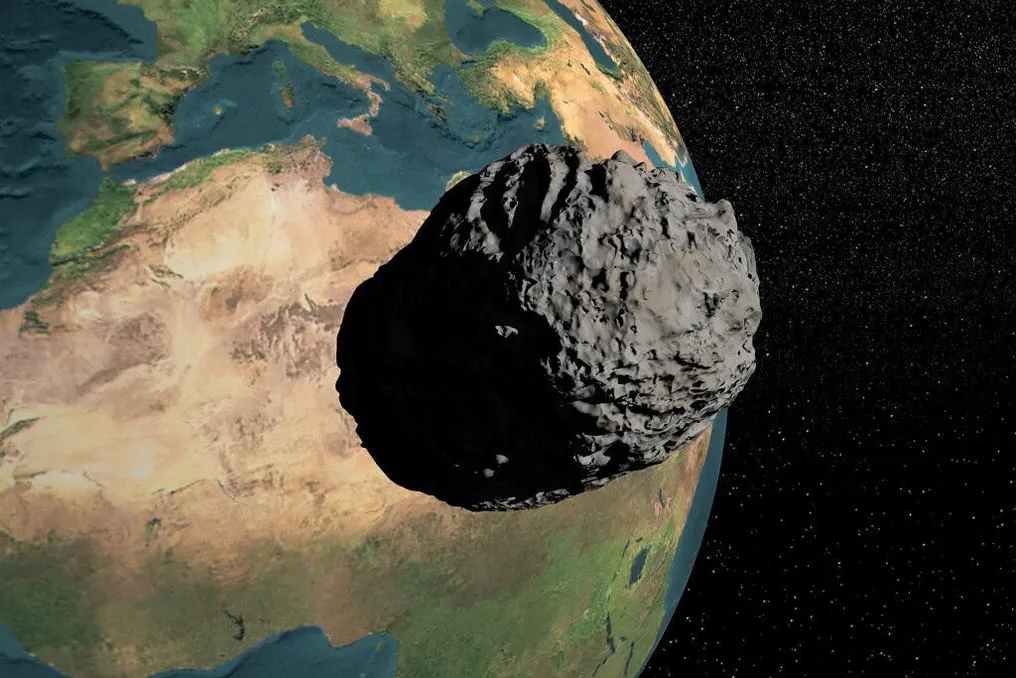
An asteroid about 160 meters in diameter poses a serious threat to Earth if it approaches, as such space rocks are capable of causing destruction in a large city. However, some asteroids are difficult to detect due to their very dark surfaces. In this regard, researchers have studied a strategy that seems fantastical: using a nuclear bomb to destroy or alter the trajectory of the object, according to information from the portal Science Alert.
The research, conducted by astrophysicist Iseya Santistevan from the Lawrence Livermore National Laboratory, included a series of simulations to test this possibility. The work analyzed a megaton nuclear charge against a 160-meter asteroid, and it was found that this strategy could work under certain conditions.
The essence of the method does not necessarily involve placing the bomb directly on the surface of the asteroid. Since these objects can rotate and have surfaces that make landing difficult, such a mission would be extremely challenging. Simulations showed that the explosion could occur just a few meters from the surface and still cause significant damage.
The main mechanism of action is not the shockwave passing through space. Instead, the researchers point to the X-ray radiation released by the nuclear explosion. From 70% to 80% of the energy of such an explosion can be released in the form of this radiation, which will directly affect the surface of the asteroid.
Upon hitting the surface, the X-ray radiation transfers energy to a thin layer of rock. The material heats up, vaporizes, and is ejected into space. The ejection of this material is capable of changing the asteroid's velocity, acting as a kind of impulse capable of correcting its path.
The explosion will also create a shockwave inside the rock itself. This effect can lead to the formation of deep cracks and fissures, increasing the probability of object fragmentation. Researchers consider this mechanism particularly important for large asteroids or those discovered too late for simple trajectory correction.
To assess the object's behavior, the team developed three three-dimensional simulations based on the shape and porous structure of the Bennu asteroid. Fracture models inspired by the Chelyabinsk and Abpaanu meteorites were also used, as they possessed useful characteristics for reproducing the behavior of cosmic rocks.
In the scenario where the explosion occurred at a distance of ten meters from the surface, 98.2% of the asteroid's material was completely damaged, and approximately 97% began moving at a speed exceeding the object's escape velocity. Significant parts also shifted in opposite directions, indicating a possible start of asteroid disintegration.
When the distance increased to 25 meters, a smaller amount of energy reached the asteroid directly. Nevertheless, the X-ray radiation covered a larger surface area. Within 68 milliseconds, 92.6% of the material was completely damaged, compared to 78.1% in the equivalent scenario with an explosion at a distance of ten meters.
Despite the results obtained, researchers do not yet know what the final fate of the fragments will be. The longest simulation tracked only 145 milliseconds of the process and took 59 days to run, using 1680 processors. Therefore, the fragments may disperse, continue to pose a danger, or even rejoin under their own gravity.