
GalaxySpace completes first commercial satellite delivery from China to Southeast Asia
Read more
Pandaily
pandaily.com

GalaxySpace completes first commercial satellite delivery from China to Southeast Asia

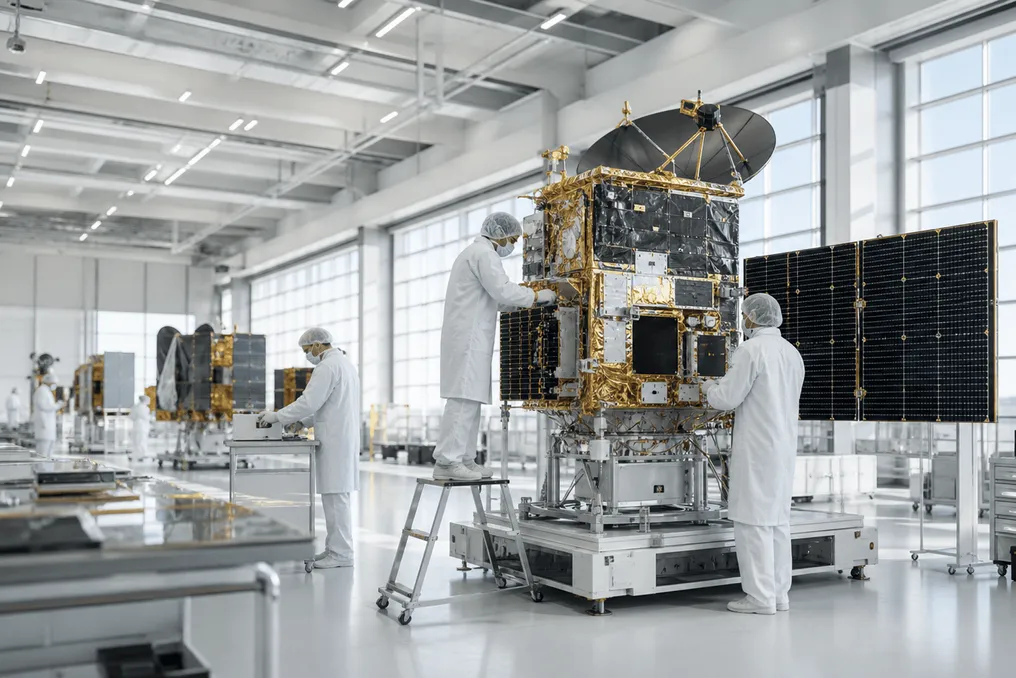
GalaxySpace has completed the first commercial delivery of an entire satellite from China to Southeast Asia. On August 25th at 11:21 Beijing time, the Long March 6C rocket launched from Taiyuan Spaceport, placing seven satellites into orbit.

Among these spacecraft was the Lingzhi-09 Thai CubeSat, which was developed and delivered by GalaxySpace to the Geo-Information and Space Technology Development Agency of Thailand (GISTDA). This marks the first instance where a Chinese commercial space company has successfully conducted the assembly, launch, and delivery of an entire satellite to Southeast Asia.

Thailand became GalaxySpace's first international destination. Co-founder Liu Chang stated that this collaboration confirmed the company's capability to carry out engineering work across the entire chain abroad. In 2024, GalaxySpace, in collaboration with Mahanakorn University of Technology, built a ground test station in Bangkok, conducting pilot projects on device and satellite operation, as well as telemedicine—this was the first overseas deployment of low-Earth orbit broadband satellite internet in China. After two years, the company transitioned from the testing phase to commercial delivery.

The Lingzhi-09 CubeSat is designed to collect Earth observation data over Thailand and to support Thai universities in education regarding satellite design, tracking, and remote sensing. GalaxySpace reported that this delivery constitutes a comprehensive package including 'satellite plus ground system plus capacity building,' with Thai technical specialists receiving training in China and teams accompanying the commissioning process on site.

Pi Chusri, Deputy Executive Director of GISTDA for Space Technology, welcomed this initiative not only as a technology transfer but also as a tool for talent development and knowledge exchange. The geography of Southeast Asia, characterized by numerous islands, makes terrestrial networks expensive, giving satellite services a distinct advantage in remote, maritime, and emergency communications. Scientists from the Chinese University of Political Science and Law and Tsinghua University noted that the deal went through a full cycle—from compliance verification to overseas delivery—offering a model that other domestic commercial space firms interested in export can utilize.

Support from Beijing's policies, including the 2026 measures to deepen pilot testing and satellite export zones, as well as optimizing cross-border data flow assessment, is turning the export of commercial space into a reproducible path. Since Southeast Asia, the Middle East, and Africa show real demand for remote sensing and satellite internet, the 'Belt and Road' corridor for space information opens up broad opportunities for more Chinese companies, allowing GalaxySpace to deepen its participation in global cooperation in the space economy.
Similar stories

Wenchang factory capable of producing up to 1000 satellites per year, accelerating China's space program
Read more
pandaily.com

Wenchang factory capable of producing up to 1000 satellites per year, accelerating China's space program

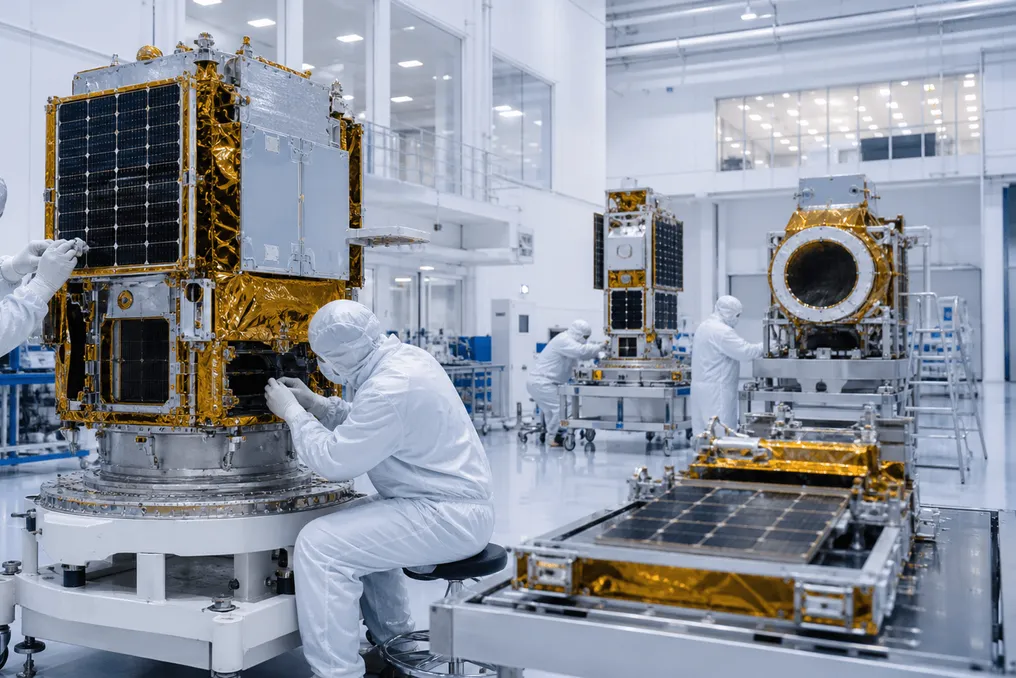
The satellite superfactory in Wenchang, China, passed expert inspection in June and is preparing for the start of pilot production with a planned annual capacity of 1000 satellites. For comparison, China has launched just over a thousand satellites in its entire history, and only around 350 spacecraft were placed into orbit in 2025—which accounts for approximately four months of the planned output of this single facility.

The urgency of this process is driven by orbital needs. China plans to establish two constellations—Qianfan and the national Guowang network—which together are expected to total about 28,000 satellites by 2035. At the 2025 pace, meaning 350 satellites per year, achieving this goal would take 80 years, but the window of available orbital slots will not wait.

Traditional satellite manufacturing operates on an 'island' principle, where engineers from different specialties work around a fixed workstation. This method takes between 1.5 and 5 years and costs tens of millions of dollars per unit, which prevents scaling up to thousands of units. GeeSpace, a subsidiary of Geely, opened the first satellite superfactory in Taizhou, reducing delivery time to 28 days and lowering costs by 45%. GalaxySpace aims to reduce the cost of low-Earth orbit satellites from hundreds of millions to millions of yuan, while MinoSpace provides a capacity of over 150 satellites per year.

The Wenchang factory goes further. It is jointly funded by the China Aerospace Science and Technology Corporation and the local government. It is built near a spaceport, allowing satellites to move directly from the production line to the rocket, eliminating the need for transportation and retesting over thousands of kilometers. The '1+1+8' system integrates the factory, testing center, and eight component manufacturers on one site.

Significant efficiency improvements have been achieved: the assembly of an entire satellite has been reduced from a week to one day, with the fastest process taking half a day. Nevertheless, Wenchang ultimately aims for speed not only compared to China's past domestic production but also under the time constraints set by players like SpaceX and the gradually closing orbital window.

China is creating the 'Beidou City' in Zhuzhou: Transition from startup to mass satellite launches in four years
Read more
pandaily.com

China is creating the 'Beidou City' in Zhuzhou: Transition from startup to mass satellite launches in four years

The application of the Beidou system has reached a key stage of industrialization, international expansion, and market integration. According to the Beidou China Space-Time Industry White Paper for 2026, the output volume will reach 1.33 trillion yuan, with navigation alone reaching 629 billion yuan, representing a growth of 9.24%, and products are exported to over 140 countries. In Zhuzhou city, Hunan Province, a complete ecosystem for Beidou application has formed, covering the entire region—from satellite launch to data reception and scenario implementation.

Hunan Sailerdete satellite factory, located in the Beidou Zhuzhou Industrial Park, is an AI-enabled intelligent object for satellites. It is capable of producing 150 small satellites annually in the weight class of 50 to 500 kilograms, performing assembly, vibration, magnetic, and vacuum-thermal testing. Among these spacecraft is XR-11, the first high-resolution remote sensing satellite at a height of 0.5 meters, which was launched in May 2025 on the Lijian-1 Y-7 launch vehicle. This satellite weighs only 135 kilograms, making it one of the lightest in the world, and it is used for monitoring crops and natural resources.

Cost savings are critically important to achieving scale. Four major challenges in the commercial aerospace industry—high cost, long delivery times, operational complexity, and low production volume—are being addressed within the action plan for 2025–2027 by implementing standardized mass production to reduce development and launch costs. According to An Hao, co-founder and deputy general manager of Sailerdete, the AI smart factory is highly automated due to the modular design of the satellite platform and flexible reorganization of the production line. As a result, the production and launch costs of XR-11 were reduced by more than half, allowing for repeat orders and closing the cycle of a mature commercial cycle. This factory is the first pulsating microsatellite intelligent production line in Hunan approved by the National Development and Reform Commission.

While Sailerdete handles satellite manufacturing, Zhuzhou Taikong Xingji Satellite Technology is responsible for their application. Founded in 2022, it manages the Zhuzhou constellation, which is the country's first commercial hybrid remote sensing radar constellation. By August 2026, there will be 8 SAR satellites in orbit. When optical satellites cannot operate at night or in poor weather conditions (cloud cover, rain, fog), SAR images reliably penetrate clouds, ensuring millimeter-level deformation monitoring. Chairman Fu Sinke stated that the company has developed a complete measurement, operation, and management system, as well as a satellite data processing center that covers data reception, standard product manufacturing, and applications ranging from terrain mapping to emergency response.

The industrial chain is forming around Sailerdete as the leader. Downstream are suppliers such as Reshu Technology, Hongxing Technology, and Xingqi Aerospace, while upstream rocket manufacturers include Yushi Space and Zhiyu Aerospace, which specializes in reusable liquid rockets. More than a quarter of the top 50 companies in the commercial aerospace industry have established themselves in Zhuzhou, and nearly 200 enterprises are located in the Beidou Industrial Park. The Beidou Zhuzhou cluster reached a volume of 22.96 billion yuan in 2025, showing a growth of 33.82%, and comprises 187 companies, ranking first in the country based on pilot evaluations of Beidou applications. The fifth International Summit on Beidou Applications, themed 'Together with the World, Together with Beidou, Expanding the Planet's Potential,' will take place in September.

Popular