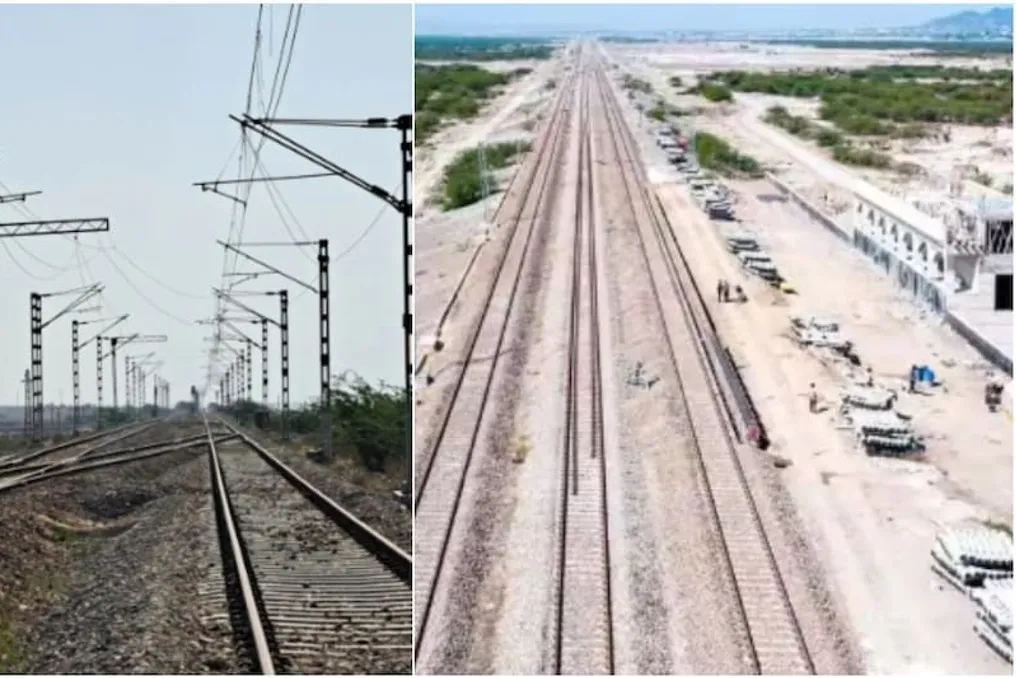
Construction of Indian Railways' high-speed test track worth ₹967.07 crore nears completion
Read more
Aaj Tak
www.aajtak.in

Construction of Indian Railways' high-speed test track worth ₹967.07 crore nears completion

The first specialized high-speed test track for Indian Railways is nearing completion. This track, spanning approximately 59 kilometers and located between Gudha and Tatana Mitri in Rajasthan, is being built with a total budget of ₹967.07 crore.

According to the railway, testing and trials of various types of rolling stock, including the Vande Bharat train, are expected to commence on this high-speed track between 2027 and 2028. The project is being developed by the Research Designs and Standards Organisation (RDSO), and the administrative responsibility lies with the North Western Railway (NWR).

This test track is being constructed in the Nava area, which falls under the Jodhpur division, and is situated about 70 kilometers from Jaipur. According to Amit Sudarshan, the Chief Public Relations Officer of NWR, this infrastructure will help the railway implement new technologies more quickly.

The specialized test track project was approved in two phases: the first phase received approval in December 2018, and the second phase in November 2021. The entire complex includes seven major bridges, 129 minor bridges, and four stations: Gudha, Jabdinagar, Nava, and Mitri.

Necessary modifications have been made at the Gudha station to integrate the test track into the existing railway network. The North Western Railway has modified the existing Kyosan electronic interlocking system to connect the specialized RDSO test track. Furthermore, adjustments have been made to the slot control scheme and the indication circuit of all 18 points on the Gudha end, aligning with new safety guidelines and aimed at enhancing operational safety.

This 59-kilometer test track is designed to accommodate several sections for conducting diverse tests. It comprises 23 kilometers of main line and a 13-kilometer high-speed loop at Gudha. A 3-kilometer accelerated testing loop is being built at Nava, and a 20-kilometer curve testing loop is being constructed at Mitri. Moreover, a 4.5-kilometer curved track for static rolling stock testing has already been completed and commissioned.

The railway reports that work on the 31.5-kilometer high-speed section and the 3-kilometer accelerated testing loop is nearly complete, with finalization planned by September 2026. Additionally, the 20-kilometer curve testing loop at Mitri is in an advanced stage, and its commissioning is expected by the end of 2026.

This new infrastructure is intended not only for checking the speed and performance of trains. It will also be used to test track materials, bridges, TRD equipment, signaling systems, and geotechnical parameters alongside rolling stock. Amit Sudarshan emphasized that the new 59-kilometer broad-gauge specialized track between Gudha and Tatana Mitri will be the first in India to possess comprehensive capabilities for testing rolling stock according to international standards such as UIC-518 and EN-14363.

Similar stories

Indian Railways launches new weekly 'Amrit Bharat' train between Gujarat and Bihar
Read more
www.aajtak.in

Indian Railways launches new weekly 'Amrit Bharat' train between Gujarat and Bihar

To strengthen the railway connectivity between Bihar and Gujarat, Indian Railways plans to launch a new weekly express train, 'Amrit Bharat,' between Ahmedabad and Bhagalpur. Ticket sales for train number 19423 will begin on Friday, August 21st, at PRS counters and on the IRCTC website. This train will cover the distance from Ahmedabad to Bhagalpur in approximately 36 hours and 10 minutes.

The railway company has decided to convert the existing special train 09447/09448 Ahmedabad-Patna-Ahmedabad into a regular service. This service will now operate as the weekly express 'Amrit Bharat' 19423/19424 Ahmedabad-Bhagalpur-Ahmedabad. According to Eastern Railway data, Bhagalpur, known as the City of Silk, will receive improved rail connectivity with Ahmedabad, a major industrial and economic hub of Gujarat. This decision was made by the railway in light of the growing passenger demand on this route.

Train number 19423 will depart from Ahmedabad on Wednesday, August 26, 2026, at 18:30. It is scheduled to arrive in Bhagalpur on Friday morning at 6:40. The journey from Ahmedabad to Bhagalpur will take about 36 hours and 10 minutes. The return train, number 19424, will depart from Bhagalpur on Friday, August 28, 2026, at 16:45. It is expected to reach Ahmedabad on Sunday morning at 5:25. The return journey will take approximately 36 hours and 40 minutes.

The new 'Amrit Bharat' express will be equipped with general unair-conditioned and sleeper class coaches. The maximum operational speed of the train is expected to be between 110 and 130 kilometers per hour. This train will run once a week.

Between Ahmedabad and Bhagalpur, the train will stop at several important stations, including Anand, Chhayapuri, Godhara, Dahod, Ratlam, Bhavani Mandi, Ramganga Mandi, and Kota. Further on, the train will pass through Savai Madhopur, Gangapur City, Hindon City, Bayana, Idga Agara, Tundla, Govindpuri, and Subedarganj. In Bihar, the main stops will be Pandit Din Dayal Upadhyay Junction, Baksar, Ara, Danapur, Patna, Bakhtiyarpur, Mokama, Kiul, Abhaipur, Jamalpur, and Sultanganj.

The new train will provide passengers traveling between Bihar and Gujarat with another direct rail option. Passengers from Bhagalpur, Patna, Danapur, Baksar, Kota, Ratlam, Anand, and Ahmedabad will benefit particularly. Since the train has general unair-conditioned and sleeper class coaches, it presents a useful option for regular passengers. Thanks to this railway decision, the connection between Bhagalpur, an important trading city in Bihar, and Ahmedabad, a key industrial center of Gujarat, will be strengthened.

Experimental Chinese train sets world acceleration record, reaching 800 km/h in five seconds
Read more
www.albawaba.com

Experimental Chinese train sets world acceleration record, reaching 800 km/h in five seconds

An experimental Chinese magnetic levitation (Maglev) high-speed train has broken the world acceleration record, traveling from a complete stop to 800 km/h in just five seconds.

This experimental train, previously unveiled in China this year, is intended to revolutionize the field of high-speed rail transport, paving the way for ultra-high-speed trains. It is capable of accelerating from zero to 800 km/h in 5.3 seconds before being able to come to a complete stop.

The operating principle of the experimental Maglev is based on using magnetic force to lift the train above the rails, which completely eliminates friction. The train gains maximum speed through magnetic waves that push it forward via coils.

Even more impressive is the fact that the train can execute a controlled full stop using its own braking systems, reducing its speed from 800 km/h to zero in approximately 200 meters.

This is the third instance in six months where the train has set this record, as Chinese scientists continue to expand the technological boundaries of this vehicle, making it faster.

Currently, standard Maglevs in China operate at speeds of about 320 km/h, with the fastest reaching 350 km/h; however, the 800 km/h train is an exclusive experiment and is not yet designed for passenger transport. Nevertheless, scientists hope that the principles underlying this technology will lead to progress in the development of rocket and jet technology.

Furthermore, researchers from the National University of Defense Technology of China are working on creating ultra-high-speed Maglevs for passenger transport, with one such prototype demonstrating acceleration up to 697 km/h in just two seconds.

Popular