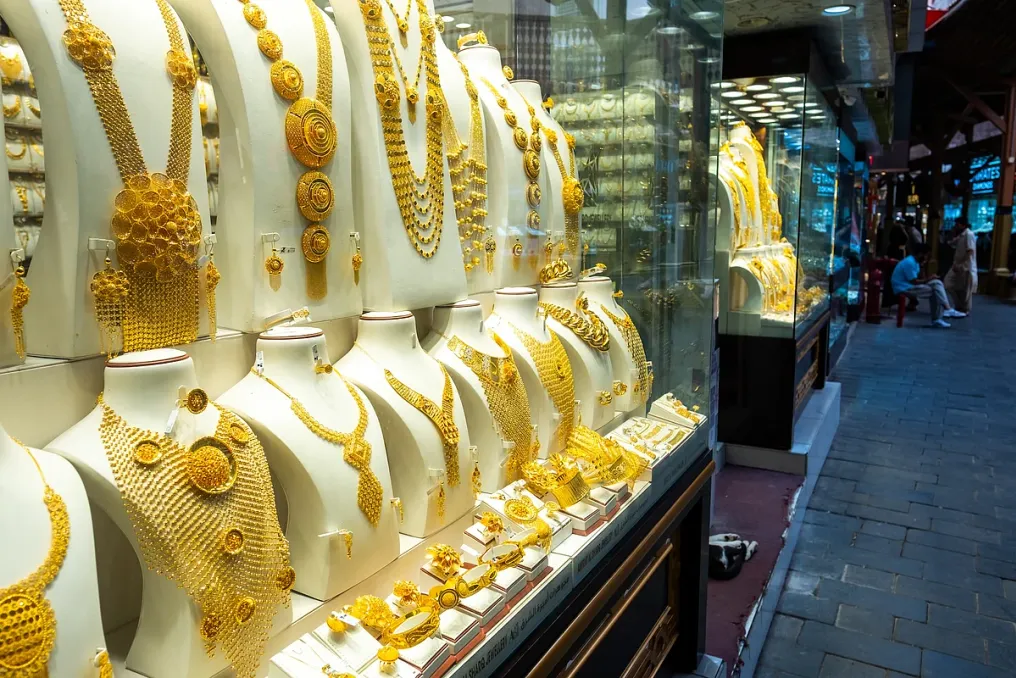
UAE Residents Fix Gold Prices Through Installment Schemes Ahead of Diwali and Navratri Holidays
Read more
Khaleej Times
www.khaleejtimes.com

UAE Residents Fix Gold Prices Through Installment Schemes Ahead of Diwali and Navratri Holidays

A growing number of residents in the United Arab Emirates are turning to price fixing schemes and gold accumulation plans. These tools allow them to lock in the cost now and pay for it in installments, instead of making a full purchase at the market price on the day of the transaction, as gold prices approach a three-month high ahead of the Diwali and Navratri festivals.

Industry leaders note that this trend indicates a shift among consumers towards more disciplined and planned purchasing, as clients increasingly prioritize price certainty over the expectation of better deals.

On Tuesday morning in Dubai, the prices for 24-carat and 22-carat gold were AED 557.5 and AED 516.25 per gram, respectively. Globally, the spot gold price traded at $4626 per ounce.

Anil Dhanak, Managing Director of Kanz Jewels, reported that the jewelry chain has seen a noticeable increase in inquiries and participation in accumulation and price fixing programs compared to the last festive season. He noted that interest is particularly high among buyers who have already decided on holiday jewelry purchases and aim to hedge against further price increases, describing this rise as 'healthy, not purely volume-driven.'

Chirag Vora, Managing Director of Bafleh Jewellers, stated that requests for gold accumulation schemes usually increase two to three weeks before the holidays, and price fixing becomes an integral part of holiday planning alongside choosing jewelry. He forecasts continued demand growth this year, especially for wedding and larger traditional pieces, as buyers try to minimize expenses.

John Paul Alukkas, CEO of Joyalukkas Jewellery, also confirmed an increase in inquiries and participation in the gold price fixing program compared to the same period last year, interpreting this as evidence of 'growing customer preference to secure prices in advance' in an extremely volatile market.

The Indian festivals of Navratri will take place around October 11, and Diwali in early November this year. Among Hindus, buying gold during Navratri is considered very auspicious and a symbol of welcoming prosperity and divine blessings.

Although high gold prices remain the main driver, jewelers added that the ongoing regional conflict has heightened customer caution. Alukkas emphasized that uncertainty has increased awareness of gold as a safe-haven asset, with decisions increasingly being shaped by price volatility alongside wedding and holiday plans.

Dhanak agreed that the conflict has led to 'greater consumer caution,' but insisted that the high and unstable price environment remains the more significant factor. Vora reached a similar conclusion, noting that customers 'rarely state the reason' for fixing rates, but regional and global uncertainty has added 'another layer to an already strong instinct.'

According to Dubai jewelry industry leaders, price fixing schemes are increasingly used as a hedging tool. Dhanak explained that such mechanisms provide clients with 'greater predictability' and protection against paying significantly higher prices later, according to the program's terms.

Vora noted that despite prices having decreased compared to previous peaks this year, they remain at an unprecedented level and have started rising again in recent weeks—it is in this environment, he said, that fixed rates 'prove their value.'

Shamlal Ahmed, Managing Director of International Department of Malabar Gold & Diamonds, reported that under the 50% Advance Plan, UAE buyers can deposit half the gold cost upfront and fix the current rate for up to three months. Furthermore, the 100% Advance Plan allows clients to lock in the current price for up to six months.

He added that these schemes offer both protection and flexibility: if prices rise during the fixing period, buyers complete the purchase at the lower fixed rate, and if prices fall, they can acquire the item at a lower current market price.

Regarding typical program structures, Dhanak clarified that timelines vary depending on the seller, but clients generally prefer manageable monthly payments over long-term commitments, with flexibility in timing and payment amount becoming increasingly valuable. Vora added that Bafleh Jewellers' most common structures reach 12 months, though shorter fixing periods are preferred by buyers who have already decided on a purchase, while longer accumulation plans are better suited for wedding jewelry and large festive purchases. Jewelers stated that during this festive season, they are paying close attention to structured savings and loyalty benefits. Vora also mentioned that Bafleh Jewellers' Gold Savings Scheme and Gold SIP options allow clients to build up purchases through disciplined monthly contributions, receiving bonus payment values or fee waivers upon redemption during Diwali and Navratri.
Similar stories

Gold prices in Dubai exceed 550 dirhams per gram amid dollar weakening
Read more
www.khaleejtimes.com

Gold prices in Dubai exceed 550 dirhams per gram amid dollar weakening

Gold prices in Dubai surpassed the 550 dirham per gram mark over the past weekend. This rise was driven by strong technical indicators and the weakening of the US dollar. In August, the price of 24-karat gold in Dubai increased by approximately 70 dirhams per gram.

The question arises whether the precious metal can reach the 600 dirham per gram level again, which was recorded at the end of January 2026. Analysts note that the price of the precious metal is influenced by both growth-promoting and decline-inducing factors, including the war in the Middle East, declining jewelry demand, and the weakening dollar.

On Friday, spot gold closed at $4,603 per ounce, showing a gain of 1.99 percent over the weekend. In the United Arab Emirates, the prices for 24-karat and 22-karat gold rose to 554.75 and 513.75 dirhams per gram, respectively. Other options, such as 21K, 18K, and 14K, also closed higher, at 492.5, 422.25, and 329.25 dirhams per gram.

Naeem Aslam, Director of Investments at Zaye Capital Markets, stated that the current gold price ecosystem is determined by a combination of falling Treasury bond yields, the weakness of the US dollar, and persistent political uncertainty. He noted that Donald Trump's three-day pause on proposed 50% tariffs against Canada after announcing a trade agreement reduces one source of short-term economic friction and may temporarily ease demand for safe-haven assets.

However, according to Aslam, Trump's comments regarding Iran and ongoing geopolitical uncertainty maintain a significant risk premium. Furthermore, the focus on maintaining American leadership in artificial intelligence, technology, and digital assets may increase overall risk appetite, but these topics do not directly eliminate gold's sensitivity to real yields, currency fluctuations, fiscal conditions, and geopolitical hedging.

Bond and currency channels remain particularly important for gold prices. The yield on long-term US Treasury bonds sharply fell after increasing reverse repurchase operations to $4 billion per operation from $2 billion.

Aslam emphasized that the trade pause may reduce some immediate safe-haven demand, but heightened fiscal concerns, Middle Eastern uncertainty, and questions about the direction of US monetary policy continue to provide competing sources of support. Consequently, a market is forming where changes in yield direction and the dollar could cause significant short-term movements, even if geopolitical risk remains generally unchanged.

He added that the gold market is supported by several overlapping forces, not a single catalyst. These forces include growing portfolio protection demand due to geopolitical tension, softer inflation components supporting discussions about future rate cuts, weak housing market activity indicating that restrictive financial conditions are still in place, and stable expectations for business inflation, reducing the risk of a new broad inflationary shock outside of energy. For gold, the most important variables right now are real yields, the US dollar, and oil prices.

Samir Hassan, Senior Market Analyst at xs.com, believes that gold's recovery is occurring amid a new phase in the capital market cycle. The market is observing a shift from high-yielding US Treasury bonds to alternative assets amid fixed-income market uncertainty. This shift followed the announcement by the US Treasury Secretary of a plan to double the reverse repurchases of long-term Treasury bonds to lower yields, which apparently caused a broad negative reaction in the market, alongside growing concerns about the sustainability of US public debt, which reached a new threshold of $40 trillion.

Hassan also noted that the inflow of funds into physical gold exchange-traded funds contributed to the rise, including $2 billion through SPDR Gold Shares (GLD). However, despite this optimistic scenario for gold, high-risk bearish factors, especially those related to the Middle East, cannot be ignored. The region is in a state of uncertainty between peace and war, as the negotiation path appears blocked, while risks of multi-front military escalation remain high.

Hassan speculated that Donald Trump decided not to engage in escalation before the mid-term elections scheduled for November next year, after which decisive elections will take place in Israel. Trump may not want to face these elections amidst extremely high gasoline and diesel prices, as well as bond yields affecting long-term borrowing costs. Instead, Trump chose the path of economic pressure on Iran in the hope of forcing it back to negotiations and making concessions regarding the Strait of Hormuz and its nuclear program, or even overthrowing the regime.

Hassan pointed out that the risks of war in the Middle East could lead to a renewed restriction of capital outflow into gold not only due to inflation risks and high bond yields, whose influence is beginning to wane, but also in light of declining investment liquidity in the Middle East and Asia. Moreover, World Gold Council data showed that global investments in gold and jewelry demand decreased in the second quarter of this year. According to Hassan, during wartime, people might prefer liquidity to cover basic expenses, or national currencies not pegged to the dollar might lose value, which could hinder the inflow of liquidity into investments, including gold.

Gold price in Dubai reached 541 dirhams per gram, increasing by 17.5 dirhams in a week
Read more
www.khaleejtimes.com

Gold price in Dubai reached 541 dirhams per gram, increasing by 17.5 dirhams in a week

Gold prices in Dubai continued to rise on Thursday morning, showing an increase of 17.5 dirhams over the past week. The rise was driven by the decrease in US Treasury bond yields from multi-year highs and the maintenance of the US dollar at multi-month lows.

The price of 24K gold traded at 541 dirhams per ounce, which is higher than on Wednesday's market and 15 dirhams compared to Tuesday's closing. Other varieties of yellow metal—22K, 21K, 18K, and 14K—also showed growth, reaching 501, 480.5, 411.75, and 321.25 dirhams, respectively.

On the global spot gold market, there was a growth of 0.09 percent, with the price standing at $4491.47 per ounce. Silver rose by 2.16 percent and traded at $67.14 per ounce.

Analysts note that both gold and silver are attempting to recover after a sharp sell-off that occurred on Tuesday. This process is supported by falling treasury yields and dollar weakness.

Since the UAE dirham is pegged to the US dollar, the monetary policy of the UAE directly depends on US Treasury yields. Vijay Valecha, Investment Director at Century Financial, explained that softer US economic data lowered expectations for further tightening by the Fed, and markets are now focused on the FOMC meeting protocols in July and upcoming Jackson Hole statements for additional policy signals.

He added that lower rates and a weaker dollar remain favorable factors for precious metals, although rising oil prices and fiscal issues may sustain high volatility. Valecha believes that both metals maintain a short-to-medium term bullish bias, supported by falling rates, dollar weakness, and the expectation of less restrictive Fed policy. Meanwhile, support levels of $4323 for gold and $62.65 for silver remain critical for holding.

From a technical perspective, gold remains constructive after maintaining the support level at $4323 and is now trying to regain momentum above the $4360 mark. The next significant resistance level is $4435. The analyst noted that a breakthrough above this level could strengthen the bullish structure and open the way to the $4450–$4500 zone. On the other hand, $4323 remains a key support, followed by $4227. As long as gold holds above $4323, the recent decline can be viewed as a correction within a broader uptrend.

Families in the UAE are cutting back on school supply costs through budgeting and reusing items
Read more
www.khaleejtimes.com

Families in the UAE are cutting back on school supply costs through budgeting and reusing items

As the 2026-2027 academic year approaches, parents are seeking ways to manage the expenses associated with the start of the school year. These methods include price comparison, budgeting, reusing school supplies, and utilizing discounts.

Om Hasher, a mother of two children from Dubai, begins the process by checking the school supplies already available at home before visiting stores. She reviews her children's items from the previous year and creates a list only of what needs replacement. She notes that she separates purchases into necessary and optional items, setting a budget for each child to avoid buying unnecessary or duplicate goods. Sometimes she buys certain supplies in bulk if it is more cost-effective, especially those that will be used throughout the year.

Planning has also helped other parents distribute costs and avoid spontaneous purchases. Maryam Hajji Mohammed, a mother of two daughters entering the 7th and 4th grades in Ras Al Khaimah, began preparing for the new academic year as early as July. Before ordering uniforms, she checked with the school and teachers whether the uniform and logos would remain unchanged. She then ordered official and sports uniforms according to her daughters' measurements, which allowed her to choose a longer and more modest style instead of buying ready-made clothes in a larger size.

Maryam also donated her daughter's old school uniform to a local Charity Fund that organizes exhibitions for needy students, thereby giving the clothing a second life instead of letting it sit unused at home. Regarding stationery, bags, labels, and other accessories, she preferred to shop online. This allowed her daughters to choose what they wanted using filters to compare prices. Living in an area with limited access to nearby shops, she noted that online shopping also helped avoid crowded stores, parking issues, and long queues during the rush at the beginning of the school year.

Price comparison across different stores and online platforms is part of Om Hasher's approach. She has noticed significant differences in the prices of school bags, lunch boxes, colored supplies, and stationery featuring popular characters. She emphasizes that sometimes items of the same quality are available much cheaper in another store, so she does not buy from the first place she finds.

For Amna, another mother from Dubai with five daughters, checking last year's supplies is also the starting point for her back-to-school purchases. She first inspects all the items from the previous year, separating damaged or unnecessary ones, and then buys only what is missing. Amna also monitors online promotions and recently took advantage of discounts on school bags, lunch boxes, and other necessities. However, she believes that product quality remains an important criterion when deciding if a discount is worth it.

Om Hasher warns parents against blindly following large discounts, advising them to check the original price and compare it with prices elsewhere before making a purchase decision. She argues that not every discount means the price is truly lower. Furthermore, she asks herself questions about the actual necessity of the item, its quality, and its potential use. If the item is already owned or not needed, she will not buy it, even at a big discount, because buying something unnecessary is not saving money.

Reusing supplies is another common way to reduce costs. Om Hasher says that school bags, pencil cases, and lunch boxes can often last for more than one year if they are in good condition, and leftover paints, pens, folders, and rulers can also be reused. Amna agrees that this applies to school bags, although children sometimes want to change them. She adds that bags can remain useful outside of class, for example, for carrying toys and other items during family outings.

Maryam also tries to minimize school supply waste. At home, she keeps partially used notebooks, colored pencils, stationery, and craft materials in a special corner for her daughters' drawing and other activities. Items that are in good condition but no longer needed are either donated or given to relatives and friends. Such habits help extend the lifespan of school supplies and reduce the need to replace everything at the beginning of each school year.

Overall, the approach in these three families is not about completely foregoing spending, but about making every purchase meaningful: by checking existing stock, planning ahead, comparing prices, evaluating discounts, and finding ways to reuse or pass on items that are still in good condition.

Popular