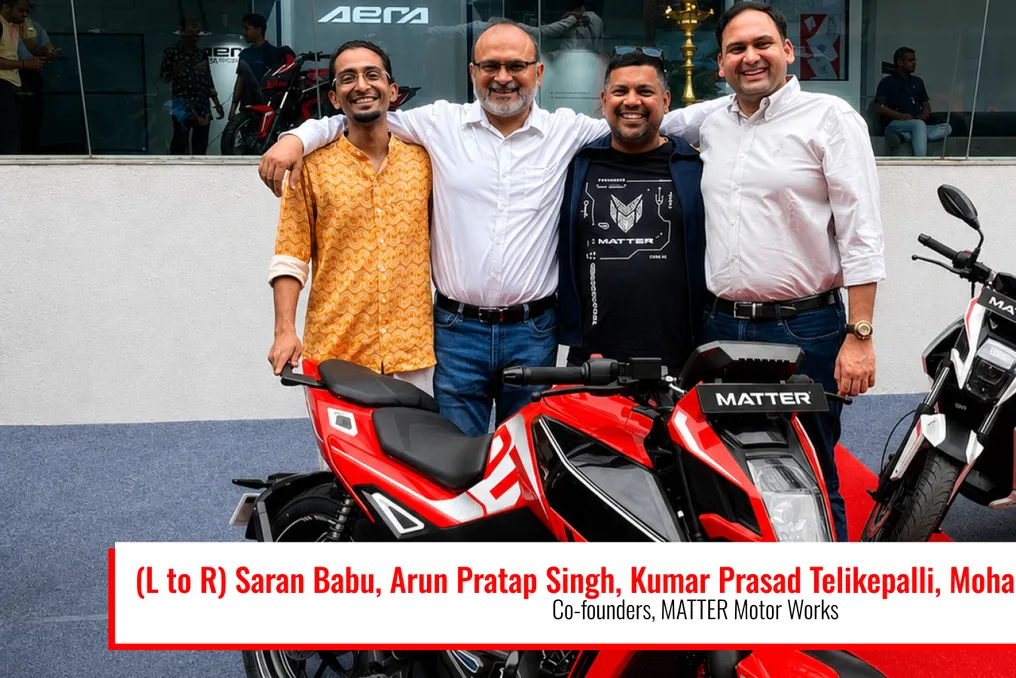
Startup MATTER raises $25 million to scale electric motorcycle business
Read more
YourStory [india, en]
yourstory.com

Startup MATTER raises $25 million to scale electric motorcycle business

MATTER Motor Works, an electric vehicle startup that developed the AERA platform, has raised $25 million (equivalent to approximately 240 crore rupees) in venture capital from existing investors.

The investment round included organizations such as Helena, a global problem-solving organization with a venture division; deep-tech investor Capital 2B; Japan Airlines; and the corporate venture funds TransLink and Shakopee Mdewakanton Sioux Community, a federally recognized Dakota tribe government in Minnesota with a diversified business base.

Thanks to this investment, MATTER's total raised capital has reached about 1000 crore rupees. The company reported that over 750 crore rupees of the collected funds have already been directed towards production processes, research, development, and market entry.

Based in Ahmedabad, the company plans to use the fresh funding to expand its supplier and manufacturing network, increase brand promotion and distribution expenses, and launch four new motorcycle models over the next 12–24 months.

MATTER was founded in 2019, and a significant portion of the electric vehicle technology, including the battery, powertrain, electronics, and software, was developed by the company itself.

The AERA model is positioned as the first motorcycle in India with a gearbox utilizing a four-speed HyperShift mechanical transmission instead of the single-speed solution common among two-wheeled electric bicycles. It is also equipped with a liquid-cooled battery and engine, an onboard charging system capable of operating from a standard 5-amp household socket, a claimed range of 172 km, and a connected 7-inch touchscreen.

Founder and Group CEO Mohal Lalbhai noted that the latest investment demonstrates the support of investors who backed MATTER even before its motorcycles started reaching customers. He added that the capital will help accelerate both growth and the product roadmap.

The two-wheeler electric bicycle market in India has shown rapid growth this year: in July, retail sales reached a record 204,266 units, becoming the first month to exceed the 200,000 mark. According to Vahan data presented by Autocar India, sales grew by 56% in the first seven months compared to the same period last year. Only TVS sold 55,477 electric motorcycles in July, while Ather is also actively building its position.

Investment flow follows this growth. River raised $120 million in August to expand production and add models, while Yulu raised $93 million to expand its electric fleet for logistics and delivery. Ather raised 1300 crore rupees through a qualified institutional placement in July after listing, with the funds intended for expanding production and creating new products. Investors are increasingly financing companies that have moved beyond prototypes and are attempting to demonstrate the feasibility of repeatable production, distribution, and demand.

Meanwhile, the market continues to be shaped by government policy. The PM E-DRIVE scheme provides a total funding of 10,900 crore rupees and supports the production, charging infrastructure, and electric vehicles. The government extended this scheme until March 2028, and an August notification further extended and increased allocations for two-wheeler electric vehicles.
Similar stories

Aerospace startup Airbound raises $37 million to expand autonomous aircraft business
Read more
business-standard.com

Aerospace startup Airbound raises $37 million to expand autonomous aircraft business

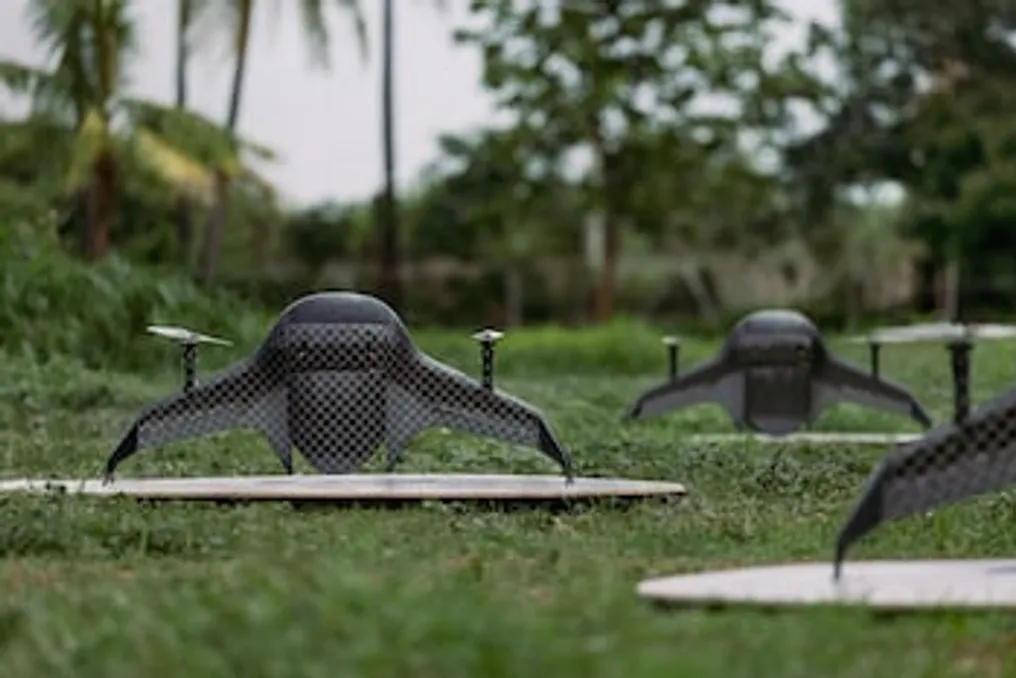
Bengaluru-based aerospace startup Airbound, which develops light autonomous aerial vehicles for delivery, has raised $37 million in a Series A funding round. The company also signed an agreement with Andhra Pradesh to establish a drone delivery network in three cities, marking a step toward commercializing its aircraft and expanding their application in logistics.

The funding round was led by Greenoaks, with participation from new and existing investors, including DoorDash, Lachy Groom, Lightspeed, and Humba Ventures. Since its launch in 2023, Airbound has raised nearly $50 million.

Airbound stated that the Series A funds will be used to accelerate engineering development, scale up production, and execute go-to-market initiatives.

Naman Pushp, founder and CEO of Airbound, said: 'We believe in a world where all movement happens in the air. Not some of it. Not most of it. All of it. A world where flying is cheaper than a bus, where moving one package costs less than transporting 20 tons by truck, and where we look at cars the way we look at horses today.'

He added that the company is building a system where 'the best physics leads to the best economics, unlocking the potential to move people and goods for a fraction of the cost.'

Airbound combines advancements in autonomy and materials science with what it calls a physics-based approach, developing transport aircraft designed to weigh less than the payload they carry. The company noted that transporting a single passenger or about 100 kg of cargo typically requires a specially built aircraft weighing around 400 kg, including fuel and payload, meaning most of the weight goes into lifting the aircraft itself rather than the transported goods. Airbound claims its vehicles are designed to reverse this formula so that most of the weight in flight is the carried cargo.

Neil Shah, a partner at Greenoaks, commented: 'Goods transportation has always forced a choice between speed and cost.'

He continued that trucks are cheap but slow, and airplanes are fast but expensive, and nothing has broken this trade-off in a century. 'Airbound is doing that. When one autonomous aerial vehicle can move one package with the economic efficiency of a fully loaded 20-ton truck, fast and cheap delivery ceases to be a trade-off, and roads cease to be the standard.'

Airbound's vehicles, developed, manufactured, and operated in India, are assembled and tested domestically. The company reported completing over 1,000 autonomous flights without mission failure in partnership with Narayana Health, transporting diagnostic samples between medical facilities and reducing delivery time from hours to minutes.

As part of the agreement with Andhra Pradesh, Airbound will build a drone delivery network connecting three cities to ensure faster and cheaper transportation. The company plans to scale this network to 10,000 daily flights, supporting retail, e-commerce, and medical delivery in the region. Airbound believes this program could serve as a model for broader air delivery operations nationwide.

Pushp emphasized the complexity of the task, noting: 'The delivery threshold in India is high. The benchmark is 10 minutes to your door, at an extremely low cost. That is the challenge.'

He added that if something can be created that works in India, it generally works anywhere else.

Harrison Shi, Head of Product at DoorDash Labs, commented: 'We are excited to see bold new approaches in autonomous delivery, and we like supporting teams solving complex problems.'

He noted that DoorDash was drawn to Airbound's willingness to return to first principles and embrace the physical and cost constraints that hinder the widespread adoption of air delivery. 'Their progress in India, one of the most demanding operational environments in the world, shows what passionate engineering can achieve, and we look forward to what they create.'

Ultimately, Airbound plans to apply the same aircraft technology not only for package delivery but also for freight transport, and eventually for intercity passenger transport.

Indian Semiconductor Startups Attracted $206 Million Since 2022
Read more
business-standard.com

Indian Semiconductor Startups Attracted $206 Million Since 2022

According to a new report by the venture firm Speciale Invest and the startup association Startup Policy Forum, Indian semiconductor startups have attracted approximately $206 million across 51 funding rounds since the beginning of 2022.

The report, titled 'Indian Semiconductor Startup Landscape 2026,' indicates that in the first half of 2026 alone, startups attracted $61.9 million, which accounts for 81 percent of the $76.6 million raised throughout 2025.

Despite a sharp increase in the volume of invested capital, the number of funding rounds has decreased: from 16 in 2024 to 13 in 2025, and to seven in the first half of 2026. This suggests that investors are concentrating funds in companies that have progressed further in product development and commercialization, rather than spreading bets among a wider range of early-stage startups.

Impact of Government Programs on Private Funding

The report revealed a growing correlation between government semiconductor support programs and private venture funding. Of the 24 chip design projects supported by the Design-Linked Incentive (DLI) program, 14 subsequently attracted institutional venture capital, raising a combined $100.8 million in the first and second rounds.

Six of these companies have already closed subsequent rounds totaling $53.6 million. Four companies, including C2i Semiconductors, NetraSemi, Morphing Machines, and Mindgrove Technologies, accounted for approximately 56 percent of all private capital attracted by DLI-supported companies.

Another sign of sector maturity is the pace at which some semiconductor companies secure follow-on rounds. Many startups have moved from seed investment to Series A within a period of seven to twenty-two months. Seven recent Series A rounds noted in the report amounted to $73.7 million, which is roughly one-third of all capital attracted by Indian semiconductor startups since 2022.

Strategic investors are also playing a more significant role. Companies such as Zoho and TDK Ventures have acted as anchors for funding rounds, and global semiconductor corporations are increasingly moving beyond operating their own R&D centers in India to take stakes in Indian startups. The report notes that strategic capital brings more than just money, including access to fabs, tool credits, reference customers, and design partnerships.

The report also points to the expansion of the base of Indian startups in this industry. The first wave of companies was primarily focused on digital, RISC-V, and peripheral SoCs. New companies are emerging in areas such as photonics, power and volumetric semiconductors, fab tooling and metrology, AI data center silicon, AI-driven semiconductor design workflows, and analog AI inference.

Popular