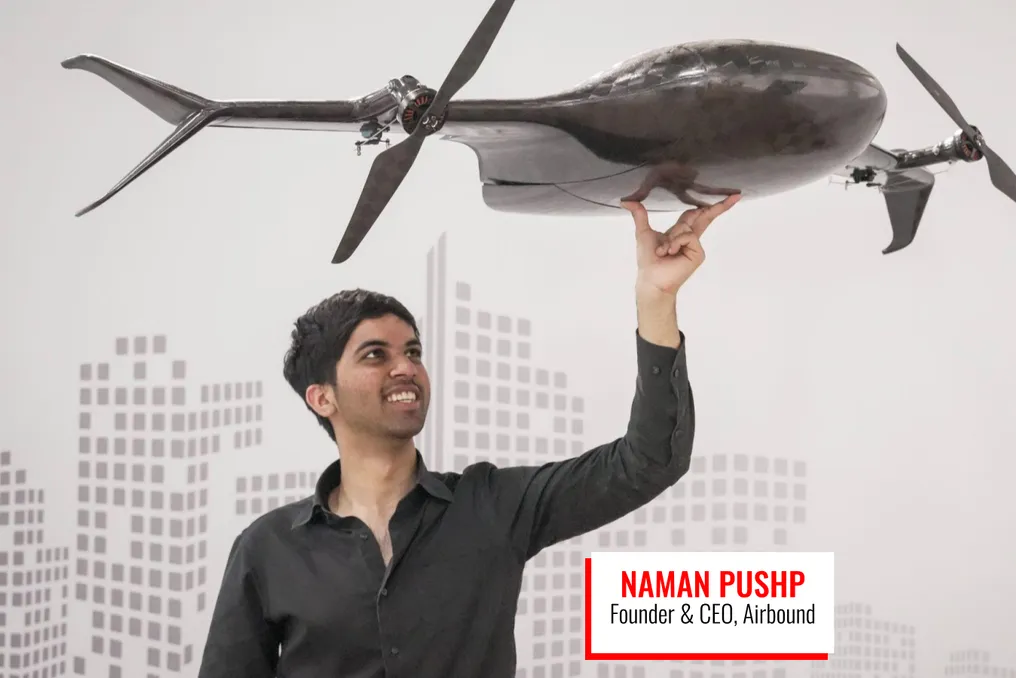
Bengaluru-based aerospace company Airbound, which develops lightweight autonomous aerial vehicles for delivery, has raised $37 million in a Series A round. Greenoaks led this round. Other participants included existing and new investors such as DoorDash, Lachy Groom, Lightspeed, and Humba Ventures.
The company announced that with this new funding, the total capital raised since its launch in 2023 has reached nearly $50 million, including a seed round of $8.65 million in October.
Airbound plans to use the funds to accelerate engineering development, transition to commercial-scale manufacturing, and strengthen efforts to bring products to market. This marks a shift from technology demonstration to establishing the necessary production base and commercial infrastructure for larger operations.
The startup noted that its aerial vehicles have already completed over a thousand autonomous flights in collaboration with Narayana Health. These flights delivered diagnostic samples between medical facilities, reducing delivery time from hours to minutes, with no mission failures recorded.
Airbound's core principle is that traditional aircraft are inefficient for transporting small cargo because a significant portion of their mass is the aircraft itself. The company designs an aerial vehicle architecture that aims to change this balance so that a larger proportion of the weight in flight is the transported material. The current vehicle uses a mixed wing and tailsitter configuration, combining the vertical takeoff of a drone with the efficiency of a fixed-wing aircraft.
Commercial testing is currently underway in Andhra Pradesh. According to an agreement announced earlier this year, Airbound intends to create a drone delivery network connecting three cities, and later expand it to 10,000 flights per day for retail, e-commerce, and healthcare needs. The company believes this project could set a standard for broader air delivery use in India.
Founder and CEO Naman Pushp highlighted the market complexity: 'The threshold for delivery in India is very high. The benchmark is doorstep delivery in 10 minutes at an extremely low cost. That is the difficulty.'
He added that if a product can work in India, it will likely work elsewhere. Pushp also noted that the company's deeper goal is to change the economics of goods movement, asserting that 'better physics leads to better economics.' He expanded on long-term intentions, stating that the same technology could potentially support passenger transport in the future, allowing a 300-kilometer journey to be completed in about 20 minutes.
The fundraising comes amid the shift of drone logistics from pilot projects to large commercial networks. In March, Delhi-based Skye Air Mobility raised $9 million in a Series B round led by IAN Alpha Fund to expand beyond the Delhi-NCR, as well as to strengthen its airspace management and autonomous logistics systems.
Neil Shah, a partner at Greenoak, stated that Airbound is capable of overcoming the long-standing trade-off between the speed of air transport and the low cost of ground transport. He added: 'When one autonomous aerial vehicle can move one package with the economic efficiency of a fully loaded 20-ton truck, fast and cheap delivery cease to contradict each other, and roads cease to be the default option.'
The regulatory environment is also evolving. India's 2021 drone rules reduced several approval requirements and laid the foundation for a more digital regulatory system, while the government announced the development of corridors for cargo deliveries. Last September, the government also lowered the GST on drones to 5%, aimed at supporting the entire drone ecosystem.
Recent activity shows that opportunities are not limited to India. In April, FedEx and IIT Madras conducted urban drone delivery trials in Bengaluru, using an air route that reduced a typical 60-minute car ride to about 21 minutes. In the US, Zipline raised over $600 million in January to expand autonomous deliveries, and DoorDash received FAA certification in July to operate its own commercial drone service.