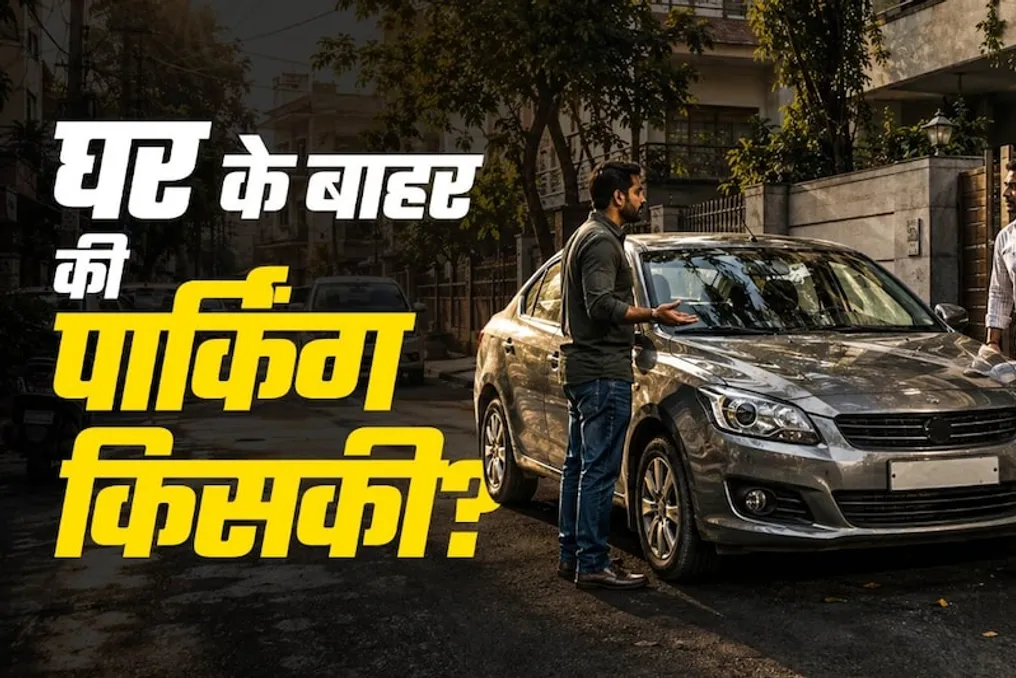
It is often observed that people mistakenly consider the street in front of their home as their parking zone. Some even place bricks, buckets, or chairs to occupy space and prevent others from parking. However, is the area on the street in front of your home truly your property?
When you see a parked car on the roadside in front of someone's house, the question of the right to park in that spot often arises. Some people treat the street in front of their home as private parking. Others occupy the space by placing bricks, chairs, or other objects on the road, obstructing others from parking. But just because the street is in front of your home, does that automatically grant you ownership of it? The answer is no.
A public road located in front of a house is generally not the private property of the person whose house faces that street. In Delhi, the laws regarding public roads are quite clear, and parking rules must be observed by both vehicle owners and local authorities.
The mere presence of a house near a public road does not give anyone ownership of that road. According to the Delhi Municipal Council Act of 1957, the public road falls under the jurisdiction of the municipal council. As per Section 298, such roads are under the control of the municipality. The maintenance and management of these roads are carried out according to established rules. This means that having a street in front of a house and owning a parking spot on that street are two different issues.
Even if a person parks a car in a specific spot for a long time, this does not grant them permanent rights to that territory. Therefore, if someone occupies part of the street in front of their home claiming it as their parking area, this in itself does not make that spot their private property.
It is incorrect to assume that any parking on a public road is illegal. In many places, vehicle parking along the road is permitted according to established rules. However, local authorities and the state government can determine where and for how long parking is allowed. Under Section 117 of the Motor Vehicles Act of 1988, state governments have the authority to establish rules related to vehicle parking. This allows them to determine where and for how long a vehicle can be left. Thus, parking on a public road is not inherently a crime, but it also does not mean you can park wherever and however long you wish.
According to Section 122 of the Motor Vehicles Act, it is prohibited to leave a vehicle in a public place in a way that poses a threat, obstruction, or inconvenience to other people. If a car is parked in a manner that disrupts traffic flow or hinders pedestrian movement, action may be taken. Furthermore, under Section 127, abandoned or uncontrolled vehicles violating parking rules may be moved or towed. Therefore, if someone parks a car in front of your home simply because it is there, you do not gain the right to have it removed. However, if this vehicle obstructs your entry, passage, or public movement, a complaint can be filed according to the rules.
Separate rules apply to parking in Delhi. The parking system attempts to be organized according to the Delhi Parking Management and Regulation Rules, 2019. These rules prohibit parking on the road within a 25-meter radius of turns and intersections. Additionally, parking is also prohibited in green zones, parks, sidewalks, bus stops, and some other areas. The goal of these rules is not only to provide space for vehicles but also to ensure smooth traffic flow, protect pedestrians, and reduce problems like congestion.
People often assume that because it is a colony road, residents have special rights to parking spaces on that road. However, this is not necessarily the case. Delhi's parking rules also contain provisions regarding the organization of parking in residential areas. The area parking plan may take into account recommendations from local residents and Resident Welfare Associations (RWAs). The aim is to organize vehicle placement in densely populated areas with limited parking spaces. It is also important to keep driveways clear for emergency services on colony roads.
Therefore, if a parking problem arises in a colony, the solution is not to declare part of the road as private parking for one person. Local authorities and relevant agencies can determine the parking system. To improve traffic in Delhi, the police also provides guidance on identifying areas where issues with illegal encroachment, illegal roadside parking, or severe traffic jams occur.