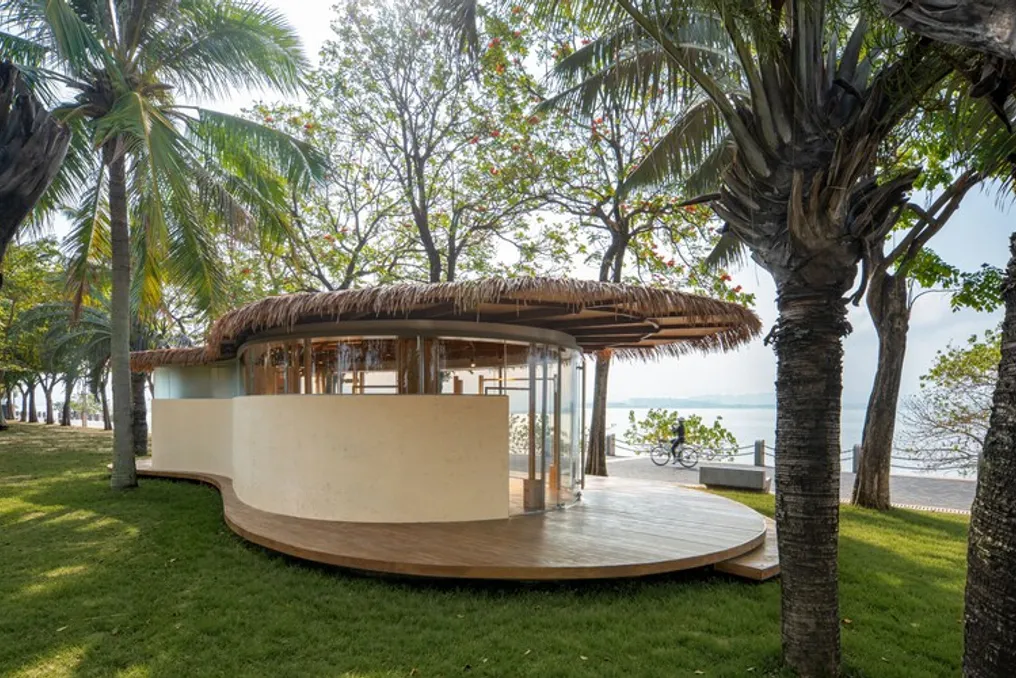
The project, named A Leaf Canopy by the Sea, was designed to be installed on a grassy and wooded slope near the edge of Shenzhen Bay Park, one of the city's most popular public parks. This location is known for hosting rich wildlife and serving as a stopover point for migratory birds from Siberia on their journey south.
The guiding philosophy of the project is that of a 'light intervention,' seeking a delicate balance between the space designated for the public, commercial activities integrated into the park, and the maintenance of environmental preservation. In a humid and rainy region like Lingnan, banana plants are natural elements that provide shade in local yards, connecting to the affective memories of the area.
The umbrellas, in turn, represent concepts of mobility, transience, and lightness. Inspired by both the shape and structure of banana leaves, the project uses a light and complex metal structure, molded like an umbrella. To ensure sustainability, low ecological impact materials and construction systems that are industrialized and prefabricated were employed.
The proposal aims to create an effective shelter against sun and rain while introducing a new model of commerce for parks. It offers citizens a discreet place for contemplation, observing the tides, and listening to the rain, complemented by external support structures to protect cyclists and pedestrians from the sun.
The structural system consists of a central pillar that functions as the umbrella pole, supported by radial metal beams that act as secondary shafts. These support a tiered canopy, inspired by banana leaves, which is waterproof and thermoacoustic. A wide eaves ensures complete shade and protection against precipitation for the semi-open wooden deck.
Slightly elevated to accommodate the terrain's slope, the deck serves as a continuous wooden bench. On the sea-facing side, floor-to-ceiling glass enclosures soften the distinction between the indoor and outdoor environment, visually integrating the space under the canopy with the tranquil waters of the coast and serving as an attractive showcase for commercial establishments.
In contrast, a low wall demarcates the land-facing side, establishing a covered, reserved, and peaceful deck where visitors can rest without the pressure to consume or socialize.
Remaining true to the concept of 'lightness,' the project evokes the image of an umbrella casually left on the coastal lawn. The light steel structure, pre-fabricated in a factory, has characteristics of portability, ease of assembly, and recyclability. This minimizes the need for soil excavation and maximizes the covered area with the least possible material consumption, thus reducing human impact on the natural landscape and construction waste production.
Its low and horizontal volume ensures that views of the coast remain unobstructed. The tiered canopy, with its gentle inclination inspired by banana leaves, facilitates water drainage and improves thermal insulation, harmonizing with the surrounding vegetation. Lighting is strictly limited to internal areas, as there are no external fixtures installed, preventing light pollution that could disturb migratory coastal birds, thereby promoting a harmonious coexistence between commerce and ecology.
To withstand sea spray and constant rain, tactile and natural details were incorporated. Banana fiber was artisanally mixed into the wall finish, increasing its durability against the elements while maintaining a rustic and handmade texture. The canopy acts as a multisensory medium for connection with nature, allowing visitors to perceive the fibrous texture of the walls, feel the salty and humid breeze under the eaves, and hear the sound of raindrops falling on the metallic banana leaves.