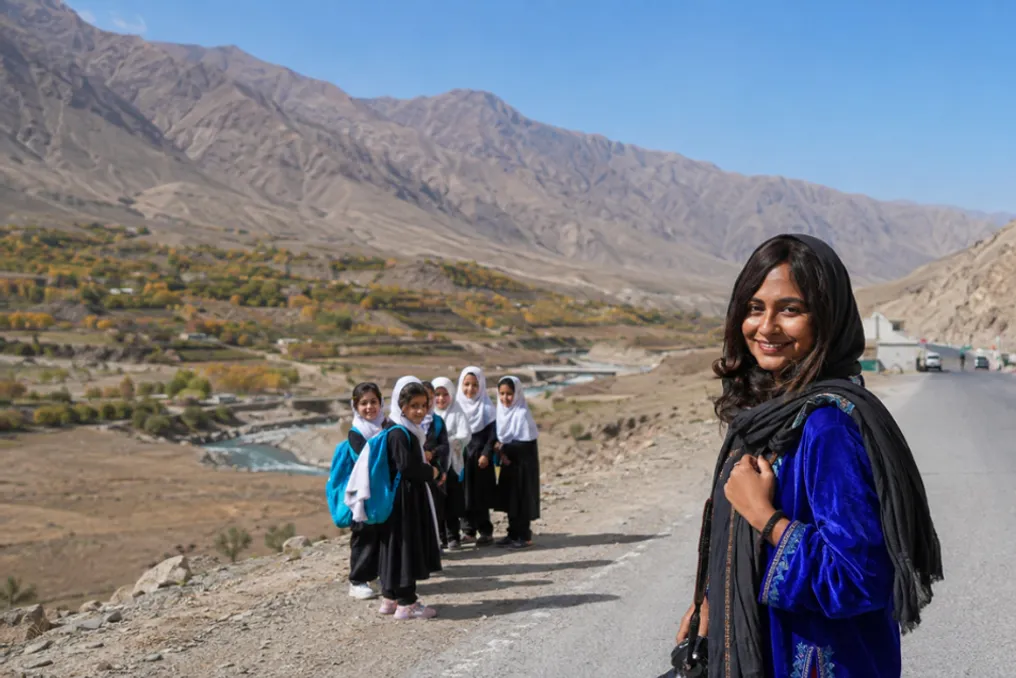
Sharanya Iyer, a travel content creator, shared her impressions of her solo journey through Afghanistan in November 2025. She emphasized that her goal is to draw attention to Afghanistan without promoting tourism in the country.
Before interviewing her, the author recalled an incident from October 2025 when Indian journalists faced a ban on entering a press conference held by the Taliban's Deputy Foreign Minister in New Delhi. This ban was lifted after the women refused to accept an exemption, and their colleagues supported them, drawing widespread public criticism. The women were able to return and ask questions about girls denied access to schools, women's rights, and the shrinking space for female voices.
For many generations, Afghanistan has often been perceived by Indians through the lens of literature rather than geography. Examples are cited from Rabindranath Tagore's works, such as 'Kabuliwala,' and Khaled Hosseini's writings, which depict scenes from Kabul during war and oppression.
Sharanya's narrative combines warmth, beauty, and complex realities. Her videos cover the crowded streets and mountain roads of Kabul, where she stops at checkpoints and drives on roads where permits are checked. She notes that the reality on the ground can differ greatly for a tourist versus a local resident.
For Sharanya, the trip to Afghanistan quickly showed that the country accessible to her as a tourist is not necessarily the one in which Afghan women can move freely. Even routine actions, such as moving from one place to another, are regulated by rules. Tourism, she explains, is only permitted with the help of authorized local guides who arrange passes for visitors in advance.
She shares, 'My passport always had to be in the car. At every checkpoint, my guide showed the documents.' This difference became particularly evident on the way to Band-e-Amir National Park. As they approached the checkpoint, the guide asked her to cover her head with a scarf because local women are forbidden from entering. However, Sharanya was allowed to pass because she was a tourist, and, according to her, 'it doesn't matter if you are a man or a woman. I have different rules.'
This moment, though seemingly minor, changes the perception of everything that follows. The same road, the same checkpoint, the same country, but a different set of freedoms depending on the individual. Sharanya tries not to confuse her access with the reality of life for women in the country.
Nevertheless, Afghanistan could reveal another side. Her series, including 'Kabul Express,' showcases Kabul's markets, roadside tea stalls, and bustling areas, focusing on people whose lives and crafts rarely make news headlines. Among them was a photographer working with an antique wooden camera, whom Sharanya describes as the last master of this craft in Kabul. She brought home one of his portraits, which, as an ordinary souvenir, reflects what her journey constantly returned to: beyond checkpoints, rules, and politics, the lives of people continued—preserving skills, producing goods, working, socializing, and welcoming strangers.
After passing checkpoints and obtaining permits, there were moments in Afghanistan that seemed surprisingly familiar to Sharanya. She observes, 'As an Indian tourist, I felt very safe.'
Sometimes, the mere mention of her being from India changed the course of the conversation. 'As soon as I said I was from India, their body language changed. They like India. They like Bollywood.'
Tea cannot be forgotten either. 'If a guest comes to you, you will be offered tea.' For an Indian traveler, this gesture is understood without extra explanation: you sit down, tea is brought to you, a conversation begins, and for a while, you become a guest in a foreign country.
This warmth defined a significant part of Sharanya's experience. At the same time, while moving through Kabul and Kandahar, she noticed who was often missing from the streets, markets, and public places. She states, 'The absence of women in public life is very noticeable.'
Once she noticed this, it was difficult to ignore. Sharanya could travel with male guides, pass checkpoints, and be in public places, but the Afghan women around her lived by completely different rules. Girls' education effectively stops after the sixth grade, universities no longer admit women, and restaurants often maintain separate seating arrangements.
This highlighted the importance of distinguishing between being accepted in a country and truly knowing what life is like there. Sharanya had access because she was a guest. The residents of the country did not have that automatic freedom.
'One must never forget that what you are experiencing is purely a tourist experience. It is not a universal truth about the country or its people,' she warns. This tension is what she constantly raises when talking about Afghanistan: the people she met might have welcomed her warmly, shared tea, and talked about India, but outside these conversations, she saw how little public space there was for many Afghan women.
Perhaps the most profound idea arising from the discussion was Sharanya's view on the necessity of separating ordinary citizens from political regimes. 'When you return from such countries, you internalize the fact that people are not their government. People are not their regime.'
She began to understand this while traveling in Iran, and this idea became even clearer in Afghanistan. Talking with Afghan women, many expressed relief at the end of decades of war. They also spoke frankly about the restrictions defining their lives.
'There is stability now,' she recalls their words. 'They no longer live constantly among bombs and rockets.'
The conversations extended beyond her trip. Today, Sharanya mentors a young Afghan girl through an international online program, where they discuss books, life, and opportunities outside formal education. 'My role is to be a friend to this girl, a source of strength.'
The more Sharanya tried to understand Afghanistan, the harder it became to fit the country into one simple version. Bamiyan added another layer to this picture. The valley holds empty niches where giant Buddhas of Bamiyan once stood, reminding one of a time when the region was an important center of Buddhist learning. Standing before them, Sharanya felt overwhelmed. 'I cried.'
For her, this moment carried the weight of everything that existed there previously, everything that was lost, and everything that remained unclear to her in Afghanistan. She is currently exploring a film about the multilayered history of this place, tracing Afghanistan's past as a center of Buddhist learning to the subsequent transformations that changed the region.
This reluctance to simplify Afghanistan into one simple story also influences what Sharanya chooses to share about the trip. Despite the attention her videos attract, she deliberately avoids publishing travel guides, routes, or tips for traveling in Afghanistan. 'I want people to learn about Afghanistan, but how to get there, when to go, or why to go—you won't see that.'
She insists that this is certainly not an endorsement. Perhaps this is the message she wants to leave with the audience. Afghanistan did not give her a single answer, and she does not want to give it to her audience. If the trip sparks a little more curiosity in people about life, history, and the people behind the headlines, that is enough for her.