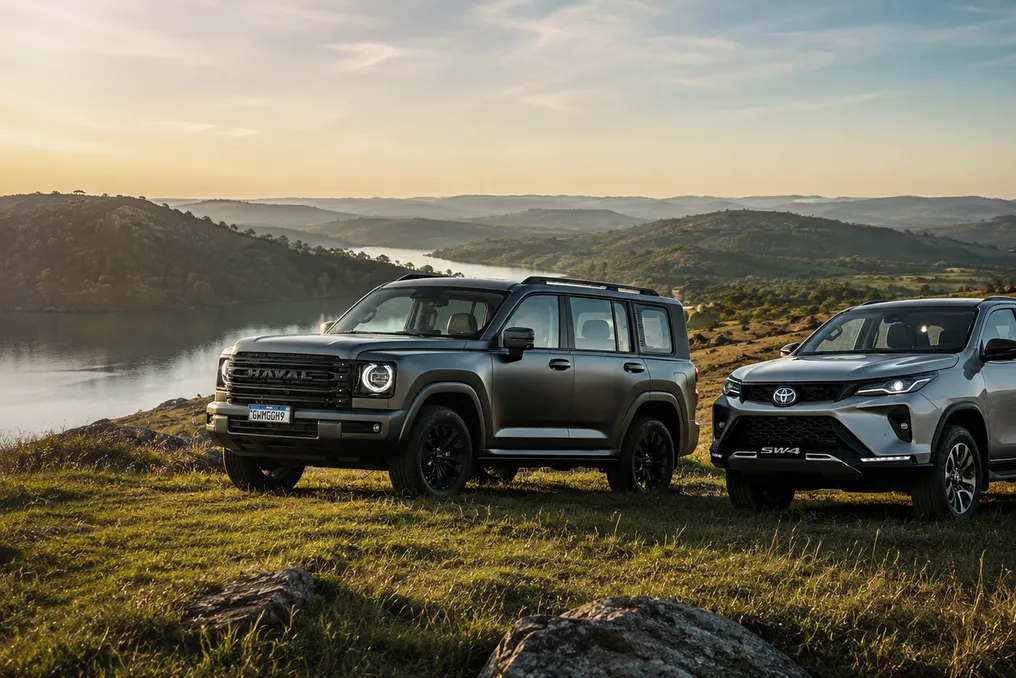
Although the desire to own only sports cars is attractive to many enthusiasts, in practice, with the advancement of personal life, such as marriage and growing family, a spacious seven-seater SUV often becomes the most suitable option for daily routine.
In Brazil, the Toyota SW4 has long been the main benchmark in this segment, being the best-selling SUV by the Japanese manufacturer in the country. Its consolidation was achieved thanks to extremely reliable mechanics, a vast list of equipment, and the respected brand image. However, the entry of Chinese manufacturers, which offer a remarkably competitive cost-benefit ratio, made the lack of tradition of these new brands no longer an impediment, winning over the public.
In this scenario, GWM introduced the GWM Haval H9 last year as a direct competitor to the Toyota. The first generation of the Chinese SUV, launched in 2014, aimed to confront the Toyota Land Cruiser Prado, and its initial design clearly reflected this inspiration from the Japanese rival. However, this rivalry remained in Asia, as the first generation was not imported to Brazil, lasting ten years.
The second generation, presented in 2024, drastically changed the vehicle's concept. Abandoning any resemblance to the Toyota, the Haval H9 transformed into a large, boxy SUV, more discreetly inspired by icons such as the Land Rover Defender and the Mercedes-Benz G-Class. It seems that Great Wall Motor understood that instead of copying a strong adversary, it would be more effective to offer something it lacks: a classic off-road style, while maintaining the comfort and good equipment expected of a superior SUV over R$ 300,000.
Specifically, the price of the single version of the Haval H9 in Brazil is R$ 335,000. This model arrived in August 2025, coinciding with the inauguration of the GWM factory in Iracemápolis (SP), where the hybrid Haval H6 SUV and the Poer P30 pickup are also produced. The Haval H9 and the Poer P30 share the P71 platform and the turbodiesel engine, being the first GWM models in Brazil without electrification.
This price is considered quite aggressive when compared to the Toyota SW4, whose more accessible five-seater version, the SRX Platinum, costs R$ 417,590. However, Toyota justifies this price due to its trajectory of more than three decades, which supports every aspect of its price tag.
The Japanese utility vehicle arrived in the Brazilian market in the early 1990s, initially as the Hilux SW4, a period when the newly opened national market was discovering Japanese 4x4 vehicles. It was only in 2005, with the launch of the IMV platform-based generation, that the SW4 stopped being just a rustic jeep to establish itself as the definitive SUV of the upper-middle class in Brazil. It combines a robust ladder chassis architecture with a sophisticated interior, seven-passenger capacity, and a turbodiesel engine.
Through successive updates and redesigns, Toyota has built a reputation for durability and high resale liquidity. This solidity allowed the model to create a kind of emotional dominance in the segment, becoming an almost automatic choice for those looking for a large seven-seater SUV that wouldn't cause problems, either in the workshop or at the time of sale.
Therefore, it is undeniable that the Haval H9 entered the market with a challenging task, even presenting a significantly lower cost. Disregarding the five-seater version of the SW4, the remaining options are the seven-seater SRX Platinum, valued at R$ 424,590, and the top-of-the-line Diamond variant, which costs R$ 475,990. Considering the seating configuration and the values, the most relevant confrontation occurs between the Haval H9 and the seven-seater SW4 SRX Platinum version, as the Diamond variant costs R$ 51,400 more, which would only highlight the price ceiling of the category by putting it in competition.
All configurations of the Japanese utility vehicle strictly use the same mechanical and structural set: the renowned 2.8 turbodiesel engine, the six-speed Aisin automatic transmission, and the 4x4 system with low range. This implies that the additional cost of the Diamond version essentially covers improvements in finishing and certain convenience items, such as two-tone paint with a black roof, beige leather interior with a dark roof, wireless phone charger, gesture or button trunk opening, ambient LED lighting, and extra USB sockets.
Thus, the fair and rational debate is established around a financial disparity of R$ 89,590 between the Haval H9 Exclusive and the SW4 SRX Platinum. This amount is enough to cover years of insurance, IPVA, and fuel, or even finance an old sports car for weekends, without compromising the family budget.
Analyzing coldly and rationally, ignoring Toyota's prestige, the SW4's tradition, or any fear of Chinese cars, choosing the Haval H9 seems to be the easiest. However, if that were the case, this comparison would lose its meaning. Both SUVs have advantages and disadvantages when examined in detail.
Engine, Transmission, and Performance
The Toyota SW4 is equipped with the 1GD-FTV engine, a 2.8 turbodiesel with direct injection, which has received several updates to achieve the current 204 hp at 3,400 rpm and 50.9 kgfm of torque at 2,800 rpm. Paired with a six-speed torque converter automatic transmission, this unit should move 2,175 kg. This results in a power-to-weight ratio of 10.6 kg/hp, giving the SW4 satisfactory performance: 0 to 100 km/h acceleration in 11.8 seconds and a top speed of 180 km/h.
In contrast, GWM equipped the Haval H9 with the GW4D24 engine, a 2.4 turbodiesel that generates 184 hp at 3,600 rpm and 48.9 kgfm of torque. Although there is a gap in the raw numbers, the Chinese engine compensates in the delivery curve because its maximum torque appears very early, already at 1,500 rpm. Additionally, the H9 has a 9-speed transmission, which theoretically optimizes the utilization of the engine's torque curve.
However, weight is also a relevant factor. The H9 weighs 2,575 kg, which is 400 kg more than the SW4. The fact that the Haval has 20 hp less does not help in this regard. The power-to-weight ratio deteriorates considerably to 13.7 kg/hp, causing the 0 to 100 km/h time to reach 13 seconds and the top speed to be 170 km/h. These data are only those released by the manufacturer, and in practice, on roads with the vehicle loaded, the difference will be even more noticeable.
Dimensions
Despite all this, the buyer of either of these SUVs is usually not excessively focused on acceleration or cornering dynamics. Normally, these vehicles are acquired considering space, and in this aspect, the Haval H9 surpasses the Toyota SW4. Its body, with an overlander aesthetic, measures 4.95 m in length (15 cm more than the Toyota), 1.97 m in width (12 cm more), and 1.93 m in height (almost 10 cm higher than the rival). The Chinese model's wheelbase is 2.85 m, guaranteeing 11 cm more internal space compared to the Japanese model's 2.74 m.
In daily use, with only five seats occupied, the H9 offers a cavernous volume of 791 liters up to the window height, a big difference compared to the SW4's 500 liters. However, when the third row of seats is in use, the situation reverses: the SW4 accommodates 180 liters of luggage, while the H9 offers only 88 liters when the last two seats are installed. Thus, in the H9, one must choose between transporting all passengers or taking the suitcases; to have both, a roof rack is necessary.
Standard Features
The SW4 SRX Platinum version presents the brand's standard package for the category: leather upholstered seats with electric adjustments and front ventilation, dual-zone automatic air conditioning with rear vents, motorized trunk, chrome interior rearview mirror, premium JBL sound system with subwoofer, and the Toyota Safety Sense assistance package. This package includes adaptive cruise control (ACC), emergency autonomous braking, blind spot warning, and cross-traffic alert.
However, the instrument panel maintains analog gauges next to a small 4.6-inch TFT screen, and the parking brake uses the traditional manual lever activation. These elements, along with the dated cabin architecture, indicate the age of the design.
The Haval H9 Exclusive, on the other hand, adds a series of comforts that even the Toyota's Diamond version, costing R$ 475 thousand, does not offer. The Chinese model includes three-zone automatic air conditioning (compared to two in the Toyota), air purifier ionizer, panoramic electric sunroof, Matrix LED headlights, electronic parking brake with Auto Hold, remote engine start, fully digital instrument panel with a 10.2-inch screen displaying driver assistance information (such as lane keeping assist, absent in the Toyota), and a large 14.6-inch multimedia center.
In terms of comfort, the front seats feature heating, driver memory adjustment, and massage function. The maneuvering package includes a 360-degree view camera with a 'transparent chassis' feature. In the driver assistance set, the H9 also has a disembarkation assistant and autonomous braking during reverse maneuvers.
In conclusion, the answer to which vehicle is more worthwhile depends on the buyer's profile. When weighing the additional weight of the H9 against the dynamic advantage of the SW4, the modern cabin of the former versus the intuitive simplicity of the latter, and the price difference close to R$ 90 thousand, it is clear that the decision is not simple.
The design, powertrain, finish, and equipment list of the Haval H9 demonstrate that we are no longer in the 2010s era, when Chinese cars competed only on low prices and lower quality plastics. The GWM's large SUV presents itself as a mature product, with a visual identity that may appeal to those who appreciate the 4x4 universe and wish to avoid a common vehicle.
GWM also offers an extended warranty of 10 years (equal to that offered by Toyota), an aggressive and necessary strategy to alleviate the biggest fear of the Brazilian consumer regarding premium cars: depreciation and the risk of being stuck with the vehicle upon resale. Paying R$ 335,000 for a voluminous, well-equipped, and stylish SUV can indeed represent a good investment.
However, the Toyota SW4 has significant weight in the Brazilian market that may be the decisive factor in the purchase. Paying R$ 89,590 more for a car with an older cabin and less visual appeal may seem irrational to some, but the utility vehicle manufactured in Zárate, Argentina, provides superior performance and drivability. More importantly, the SW4 enjoys a reputation built over three decades, which directly influences negotiations. The owner knows that maintenance is predictable and that in three or four years, there will be a queue of buyers willing to pay the Fipe Table value for trade-in, with liquidity comparable to that of a National Treasury bond. For those seeking a large SUV for the family without worrying about hidden depreciation, Toyota remains a safe haven. But for those who prefer to opt for the Haval H9 and invest this difference of almost R$ 90 thousand in a classic sports car for weekends, accepting more moderate performance and betting on...