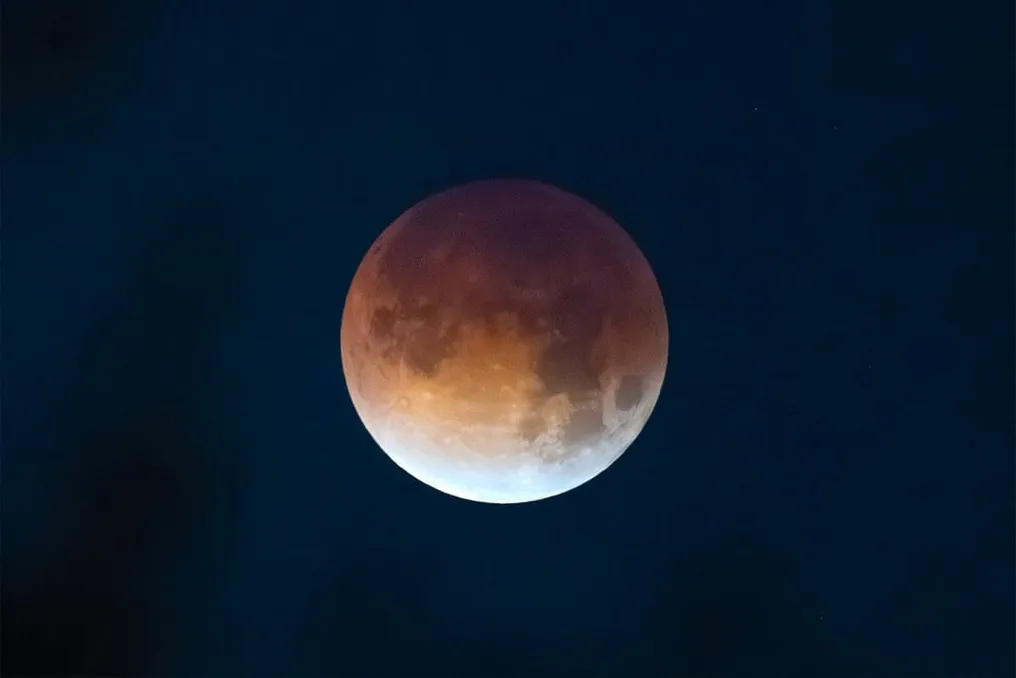
This week, the sky will host the last eclipse of 2026, characterized as a partial lunar event. Brazil has an advantageous position for observing this phenomenon, as almost the entire lunar surface will be obscured by Earth's shadow, causing the satellite to take on shades ranging from brown to reddish-copper.
The event will begin on the night of Thursday, the 27th, and extend until the early morning of Friday, the 28th. Across practically the entire national territory, the Moon will be at a high altitude in the sky, ensuring excellent conditions for naked-eye observation without horizon obstructions.
According to information provided by the Starwak.space observation guide, more than 96% of the visible area of the lunar disk will enter the umbra, the densest shadow region projected by Earth. Furthermore, the eclipse presents a 'magnitude' of 0.93 (or 93%). The difference between these two values lies in the measurement method: the 96% percentage refers to the total size of the lunar surface that will darken, while the 93% measures the shadow in a straight line, comparing the Moon's diameter with the section crossed by the shadow. In practice, the crucial point is that most of the Moon will be covered by darkness.
This occurrence takes place during the full moon phase. Although there is a noticeable reddish hue, it is not a complete 'Blood Moon,' as a narrow band of the lunar disk will continue to receive direct sunlight.
The reddish coloration of the satellite is due to the interaction between sunlight and the Earth's atmosphere. As sunlight passes through the Earth's air layers, the blue frequencies of sunlight are scattered in various directions. Simultaneously, rays of red and orange light undergo a trajectory deviation, allowing these longer rays to reach the lunar surface hidden in the shadow. This physical process is analogous to what causes the reddish tone in sunsets.
The intensity of this color can vary significantly during the early morning hours, being influenced by atmospheric factors such as the amount of dust, pollution, humidity, and smoke present in the Earth's atmosphere.
Considering Brasília time, the first penumbral phase, which is subtle, will begin at 10:23 PM on Thursday. The start of the more perceptible partial phase will occur at 11:33 PM, when a small dark area begins to cover the satellite. The peak of the eclipse will be reached at 1:12 AM on Friday, the moment when the contrast between the red area and the illuminated edge will be most apparent. The entire main partial phase should end around 2:52 AM.
Brazilian territory offers a favorable geographical location to watch the event. In almost the entire country, the Moon will be positioned well above the horizon during the period of greatest shadow coverage. The Moon's elevation varies between 59 and 85 degrees relative to the ground in Brazilian capitals. In the North and Central-West regions, the celestial body will be almost at the zenith, requiring observers only to look directly upwards. In the Southeast and South regions, it is recommended to direct your gaze north to locate the high and bright satellite. Due to this high elevation, buildings, trees, and hills should not interfere with the view in most cities.
Unlike solar eclipses, watching a lunar eclipse is perfectly safe for human health, and no filters, special glasses, or advanced optical equipment are necessary. Those who have binoculars or small telescopes can obtain a richer visual experience, observing details of lunar craters and the gradual advance of the Earth's shadow over the satellite's relief.
To ensure comfort during long periods of looking up, it is suggested to use reclining chairs or spread a towel on the ground to prevent neck pain. Light pollution in large cities does not seriously compromise visibility, as the Moon is a large and bright celestial body, visible from yards, balconies, or the street.
The only unforeseen factor that may hinder observation is the presence of clouds, fog, or rain. Completely clear skies are essential for quality observation during the early morning. Therefore, the main advice for astronomy enthusiasts is to check the local weather forecast a few hours beforehand. If there is too much cloudiness, seeking a neighboring neighborhood with clear skies might save the observation night.
For those planning to photograph with cameras or cell phones, a darker location offers practical advantages, as locations far from streetlights help enhance the brightness of the stars around the Moon. It is advisable to let professional equipment acclimatize to the cold environment of the early morning beforehand to prevent lens fogging at the peak of the event. The use of tripods or firm supports is essential to keep the phone or camera stable during photos, especially when the lunar luminosity is lower.
Partial eclipses with over 90% coverage are rare occurrences and provide a memorable visual experience, bringing science closer to daily life by demonstrating the real movement of celestial bodies at no cost. Simply check the local times, choose a comfortable spot, and wait for a cloudless sky to witness our planet's shadow crossing space in this unique opportunity for natural contemplation.