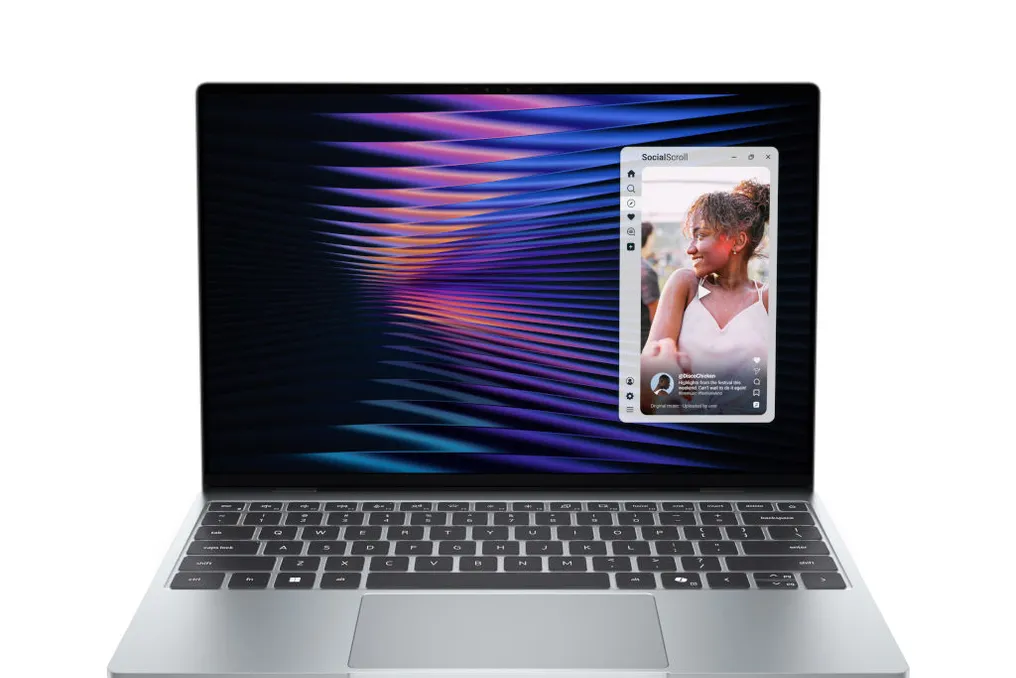
With the launch of the MacBook Neo, which features a cost 40% lower than other Apple models, the company has finally made available a product with a competitive price compared to Windows operating system notebooks. In response to this novelty, the PC market quickly released two devices: the Acer Swift Air 14 and the Dell XPS 13, both sold for US$ 699 in the United States. The author dedicated three weeks to testing the Dell XPS 13, which is scheduled to debut in Brazil in September.
Similar to the MacBook Neo, the XPS 13 demonstrates excellent build quality, featuring an aluminum chassis and a high-quality keyboard. This keyboard has a robust structure that prevents sinking during typing and very responsive keys, ensuring a precise and 'crisp' writing experience. An important detail is that the XPS 13 will be manufactured in Brazil, which implies that its keyboard will use the ABNT-2 layout, unlike MacBooks, which use the American layout.
The XPS 13 incorporates the Copilot key, intended to activate the Windows artificial intelligence assistant. However, Dell positioned this key on the right side of the keyboard, near the arrows, which caused accidental activations during typing, creating an issue that the author resolved by installing the Microsoft PowerToys application, which allows disabling the Copilot key.
Regarding the screen, the XPS 13 is notable for being very bright and slightly larger than the MacBook Neo's screen, presenting 13.4 inches versus 13 inches on the Apple. Its bezels are significantly thinner, especially in the upper area where the webcam is located. Although the webcam image quality is considered acceptable, it is inferior to that of the MacBook Neo. The XPS 13 camera has an infrared sensor, enabling Windows Hello functionality, which allows access to Windows without needing to enter a password, and this function operates correctly. The screen is also touch-sensitive, although this feature has not demonstrated much practical utility.
In terms of portability, the XPS 13 weighs only 1 kg, making it lighter than the MacBook Neo (1.2 kg). It features two USB-C ports, one on each end of the device body, whereas the Apple equipment has both ports on the left side. A noticeable difference is the absence of a P2 headphone jack on the XPS 13, a feature offered by the competitor, requiring an adapter for those who wish to use wired headphones.
During tests with the XPS 13 connected to external peripherals—keyboard and monitor—via a USB-C hub, the system displayed an initial warning indicating that it was only receiving 50 watts of power, which could be insufficient to charge the battery. However, the author was using the original 65-watt XPS 13 charger connected to an Anker USB-C hub capable of providing up to 85 watts. It was found that this alert was merely a software error, as the notebook functioned and charged normally when connected to this hub.
In the United States, the XPS 13 is sold with 8 gigabytes of RAM, equal to the amount present in the MacBook Neo. In the Brazilian scenario, Dell opted initially to prioritize configurations with 16 GB, as was the case with the unit used for testing, which came equipped with the Intel Core 5 320 processor. This CPU is relatively recent, launched in the second half of this year, and has six processing cores: two optimized for high performance and four focused on energy efficiency.
The author described his usual workflow, which involves keeping between 15 and 20 tabs open in the browser, including memory-intensive services like Gmail (with two active accounts), Google Workspace (including complex spreadsheets), and WhatsApp Web, all while listening to music on Spotify, watching YouTube, or participating in Google Meet meetings. The Core 5 320 processor handled this combination of tasks without showing slowness or crashes. This good performance is also attributed to the efficient thermal management of the XPS 13, which uses an internal graphite plate and Gore material. The laptop surface remains cool even when connected to the power outlet, and the CPU operates with thermal headroom, never exceeding 80°C, which is well below Intel's maximum limit (100°C, start of thermal throttle).
The author's workflow demands between 11 and 14 GB of RAM, which fits comfortably within the 16 GB installed on the test machine. However, he also evaluated the laptop with half the memory, i.e., 8 GB, achieving this configuration through the Windows msconfig utility. When starting the system with 8 GB, Windows consumed 4.5 GB. After opening the browser and all online tools used, the RAM was completely utilized, forcing the system to operate with the swap file, a file that functions as virtual RAM and is inherently slower because it resides on the SSD. The MacBook Neo manages this situation well without any perceived drop in performance. The XPS 13 demonstrated continuous agility even after RAM saturation, thanks to the speed of modern SSDs, which support the operation of the swap file well in this navigation-focused usage pattern. The Dell XPS comes equipped with a 512 GB SSD, while the MacBook Neo in the US$ 699 version has half that storage.
Regarding battery life, the MacBook Neo offers between 10 and 11 hours of use. The Dell XPS 13 achieved approximately 10 hours on average, keeping the screen brightness at 50% and Windows in power saving mode. To reach this level of duration, Dell had to install a 52 watt-hour battery, considerably larger than the MacBook Neo's 36.5 Wh battery. Despite this, batteries based on x86 architecture, such as those from Intel, consume more energy than Apple's ARM processors. Nevertheless, ten hours are sufficient to cover a full day of work.
In summary, the XPS 13 represents a strong response to the MacBook Neo, but its pricing in Brazil has not yet been disclosed by Dell, with an announcement expected for September 10th. If its price is similar to the Neo's in the US, it would establish itself as an excellent alternative. However, two factors may complicate this comparison: Dell's choice to offer 16 GB of RAM, which will likely increase the cost, and the existence of the 'grey market' for the MacBook Neo, where it can be found at lower prices on online platforms without official factory warranty. Therefore, a direct comparison between official retail and the grey market is not feasible, but it is a reality in which the MacBook Neo is situated and with which the XPS 13 will have to coexist.

