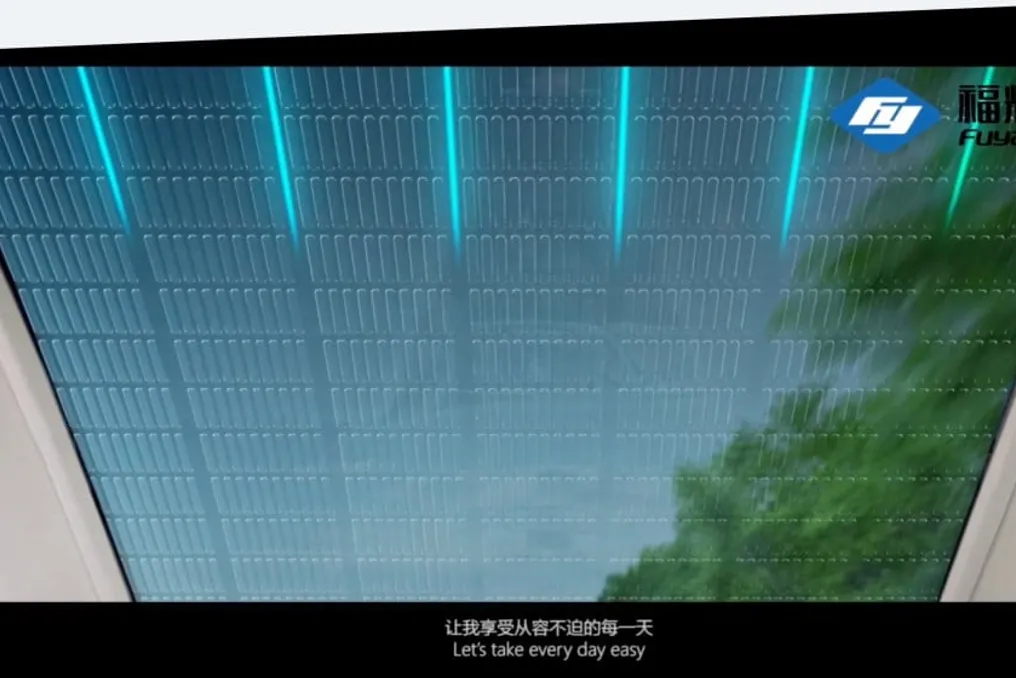
China is about to incorporate a new technology aimed at transforming the glass roof of automobiles into an energy generator. Fuyao Glass, an automotive glass manufacturer, has launched a product capable of producing electricity from sunlight, although this innovation is still far from enabling fully solar-powered vehicles.
The concept of using solar energy to power electric cars has existed since the beginning of these vehicles. However, the amount of solar energy reaching the Earth's surface, considering the area available in a car, is insufficient to meet the entire energy demand for mobility.
Despite this, the development of solar cars has continued, driven by student competitions such as the American Solar Challenge and the Formula Sun Grand Prix. However, these models are characterized by being small, extremely light, and designed to carry only one occupant, differing significantly from common vehicles.
A closer example to a conventional car is the one developed by Aptera, a company that has been working for years on an electric vehicle with a solar roof. This model has already reached drivable prototypes but still has several limitations compared to a standard car and does not generate enough solar energy to maintain continuous movement.
In contrast, with the help of a high-capacity battery, the energy generated by the panels can be sufficient to compensate for the consumption of a daily trip, including the electricity captured when the vehicle is stationary.
Fuyao Glass's initiative seeks to apply this technology to traditionally designed vehicles. The company has created an automotive glass that can be installed on the car's roof, fulfilling the dual functions of covering and solar panel.
According to the manufacturer, this product can generate approximately 150 W per square meter. This value approaches the yield of modern solar panels, which produce about 200 W per square meter. The distinction lies in the composition of the glass: the Fuyao product is translucent, whereas conventional solar panels block light passage, resulting in lower natural efficiency due to the radiation passing through the glass.
This translucent characteristic can be advantageous for automotive use, given that car glass roofs are often designed to filter a considerable portion of incident light inside.
The company demonstrated the functionality of the technology through videos and images. In one of these representations, the passage of trees through the roof was visible while the vehicle drove past them, also allowing visualization of the solar cell pattern from the interior.
In electric cars, these components are powered by the traction battery itself. Although the energy consumption is small relative to the total battery capacity, it reduces autonomy and requires the vehicle to be recharged more frequently, which also occurs while parked.
However, Fuyao does not restrict its technology only to electric vehicles. In a demonstration video, the company exemplifies its use in a gasoline-powered BMW. In this scenario, it would be essential to add a battery to store the energy generated by the solar roof, but the system would allow combustion engine cars to incorporate features common to electric vehicles equipped with large traction batteries.
An infographic released by Fuyao itself illustrates an exhaust outlet on the represented vehicle, suggesting that the technology can be applied to cars with combustion engines and plug-in hybrids.
Press reports indicate that BYD could offer Fuyao's solar glass as an optional accessory in its electric cars. According to these sources, the system's cost would be 8,000 yuan (about 6,500 Brazilian reais) and would have enough area to produce up to 720 W under ideal conditions.
It is important to note that neither Fuyao nor BYD has officially confirmed such information. With a power of 720 W and perfect solar incidence, the system could, in certain situations, provide energy for very short trips, measured in a few kilometers. However, energy generation would depend directly on lighting conditions, being reduced by shadows from buildings or trees.
As an automotive glass supplier for global markets, Fuyao has the potential to bring the technology to automobiles outside of China. To date, however, rumors about BYD adopting the glass have not been confirmed, and there is no data on other manufacturers interested in the system.
Fuyao also claims to be a pioneer in presenting a commercial technology of semi-transparent automotive solar glass. Another potential application area is civil construction, where buildings maintain stable positions relative to the Sun and have large glazed surfaces that do not require movement, creating more favorable conditions for solar capture.
Fuyao supplies glass to the construction sector and plans to develop applications in this segment. Although other companies are already working on similar solutions, solar glass can serve as a complementary energy generation source for electric cars, combustion engine vehicles, and buildings. Despite the progress, the technology does not yet guarantee the realization of cars that operate exclusively on solar energy.