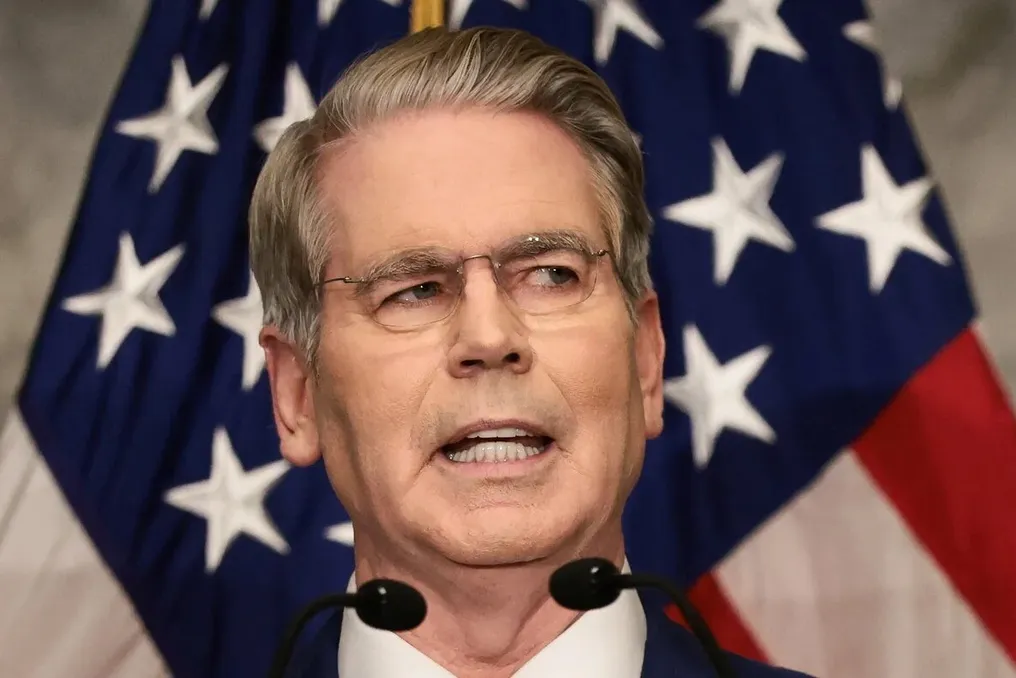
The U.S. Secretary of the Treasury, Scott Bessent, announced a new wave of sanctions targeting Iran and its 'accomplices' on Monday. He characterized this measure as an attempt to 'strangle the regime' amid tensions in the Strait of Hormuz.
Bessent told reporters in Washington, D.C., that Iran now faces a clear choice: either complete global isolation and an economy of survival, or a path to normalization with the possibility of resuming participation in the world economy.
It remains unclear what the 'path to normalization' might look like, given that the Trump administration has only tightened pressure on Iran since the first round of sanctions at the White House in 2017.
Operation 'Economic Outcasts'
Bessent declared the launch of 'Operation Economic Outcasts' aimed at closing all alternative options available to the Iranian regime. He emphasized: 'America no longer manages the threat from Iran. We are ending it.'
Using a 'zero leakage' approach, he stated that the Treasury Department has mapped every nodal point, intermediary, and network that Iran used for oil smuggling and sanctions evasion. Furthermore, President Donald Trump has already made phone calls to relevant global partners with specific requests to cease interaction with the regime.
He declined to name the countries, as well as 60 other organizations and individuals, who are reportedly set to face secondary sanctions in the coming days and weeks. When asked about the reason for not immediately imposing sanctions, Bessent replied that he does not wish to 'blow up the global financial system.'
He added that each country has a set deadline to cease activities identified by the authorities, and failure to comply will result in unilateral action through the Treasury Department. For example, he cited the need to close every branch of Bank Melli.
Bank Melli is a major Iranian commercial bank that previously served as the central bank before the 1979 revolution. It has branches in various parts of Europe and the Middle East.
Impact on Relations with China
When asked how these sanctions might affect Washington's relations with China, given Beijing's close partnership with Tehran, Bessent responded that the best way to interact with states is through quiet diplomacy, and they are setting expectations with all countries.
Chinese President Xi Jinping is expected to visit the White House next month, with China being a major recipient of Iranian energy products. According to the research institute SRI International, based in California, other major export destinations include Iraq, the UAE, and Turkey.
Bessent warned that 'it is no longer possible to operate in the gray zones of this conflict.' He noted that Iran's accomplices buy and transport its oil, facilitate the movement of its finances through exchange offices and free trade zones, accept Iranian flights and maintain registries on its behalf, ignore maritime fuel transfers and land transit, and approve the illegal use of their banks while concealing the extent of their complicity.
Sanctioned parties are largely excluded from participating in the global financial system, as the international network is largely determined by U.S. banking standards and the U.S. dollar.
Pressure
Last week, Bessent pledged to impose 'the harshest sanctions in history' against Tehran, as the economic damage from the war between the U.S. and Israel, which has effectively lasted six months, is putting pressure on the global economy and significantly raising energy prices for U.S. voters ahead of the November midterm elections.
Trump also warned of the start of an 'economic Day D' against Iran. In a social media post, he wrote: 'ANY country that allows its financial institutions, businesses, airports, or government structures to provide any form of vital support to Iran will itself face HUGE economic consequences.'
These warnings from Washington came amidst the inability to assert military control over the Strait of Hormuz, where a quasi-truce between the two countries has nearly collapsed. The war has disrupted global shipping trade, leading to a sharp rise in the cost of charter tankers. The ETF fund BWET, which allows investors to bet on freight rates, rose by 98 percent in the last month.
Mohammad Bagher Ghalibaf, a speaker of the Iranian parliament, stated on Thursday that Tehran and Baghdad will not allow foreign governments to decide their fate, which can be seen as a response to the sanction threats from Washington. Speaking at the Arbaeen ceremony in Karbala, Iraq, he insisted that the two countries should develop their security cooperation and 'unite for economic prosperity and development.'
Warning
The National Iranian-American Council (NIAC) reported on Monday that Iran is likely to intensify its tactics in the region—whether through blocking waterways or attacking Persian Gulf energy infrastructure—following repeated statements that it 'will not tolerate economic warfare.'
The NIAC statement reads: 'We have gone down the path of maximum pressure on Iran many times. We have learned that President Trump can inflict serious economic damage on Iran, but the ordinary Iranians bear the main burden. The ruling elite in Iran remains largely protected, while Tehran has repeatedly refused to comply with Washington's demands.'
According to Ryan Costello's group policy director, 'Trump's adventure is that this time, against the backdrop of war destruction and increased blockade, time is on his side, and ultimately Iran will be forced to admit defeat.'
Richard Neffy, a former national security official in the Biden administration and architect of previous sanctions against Iran, suggested that Bessent's comments are mostly bluster. He wrote on X on Monday: 'So, they spent the weekend seeing what they were going to do, thought: 'hmmmmm', and now they are turning it not into 'D-Day', but rather into 'don't make me count to three.'
Gregory Brew, Senior Analyst at Eurasia Group, called it a 'warning shot' in an X post, noting that the U.S. 'is trying to increase pressure without provoking significant Iranian actions or irritating Iran's trading partners (primarily China).'