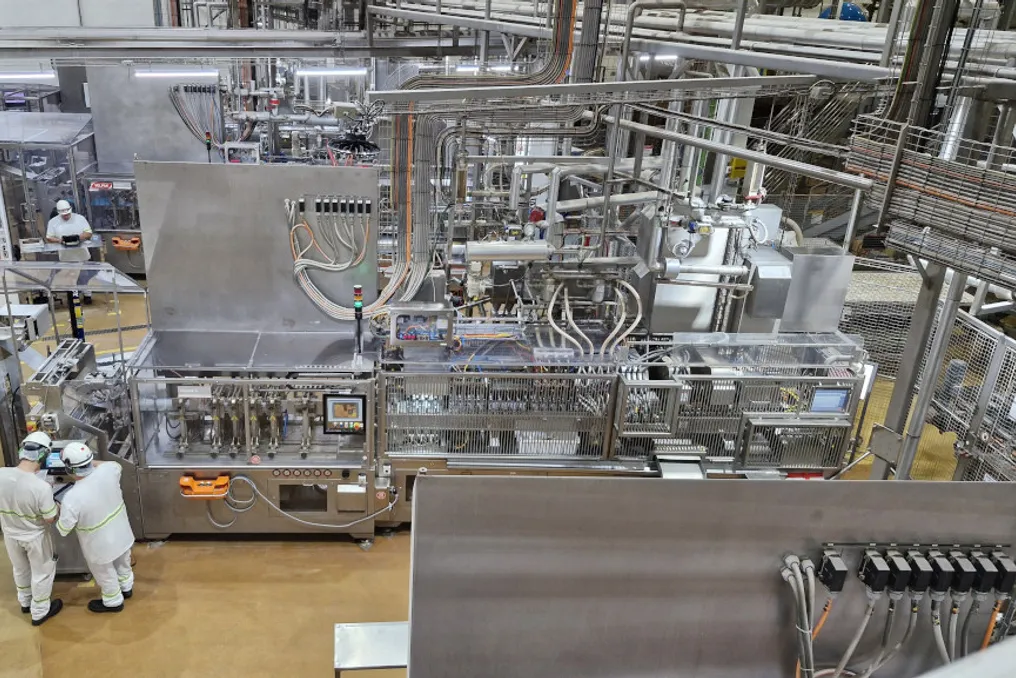
In the city of Ribeirão Preto, São Paulo state, there is a multinational company Purina (which has belonged to Nestlé since 2001) that produces pet food. The company opened its factories to a group of journalists and veterinarians last Tuesday (the 18th).
One can imagine how a mixture of meat, grains, and vegetables turns into hard brown balls with a characteristic smell. The complex employs 600 staff working in three shifts and is capable of producing 170 thousand tons of feed annually. Over the past ten years, 1 billion reais have been invested in it. It combines three productions: one for dry food, a second for wet products (such as cat pâtés), and a third for treats.
Visitors were able to inspect the first two productions, but not all stages of the process were available for viewing.
Raw materials such as barley, corn, and wheat, as well as animal protein (meat, chicken, and fish, sometimes already in mince form), are used in the dry food production. The initial stage involves mixing and grinding these ingredients, which Purina did not show during the visit, citing sanitary control.
The mixture may also contain active components, such as bisulfite sulfate. This component is used in a specific brand of food that, according to the label, promotes 'urinary health' in cats. The substance helps make urine more acidic, thereby reducing the formation of urinary stones—a problem quite common among cats that drink little water.
Next, the mass goes to extrusion—a stage that was visible (though not photographed). Here, the product is passed through perforated dies under the influence of heat and pressure. The extrusion process is similar to that used in the food industry for making chips and pasta, and it is this process that transforms the product into balls at the feed factory.
The dry food production line is equipped with 13 extruders connected by a pipeline that runs throughout the factory. Like most of the complex, it is very noisy; during the visit, the plant director used a microphone to communicate with guests via wireless headphones.
The feed balls leave the extruder moist and porous, entering a pipeline that transports them to drying machines. They then undergo a coating stage, during which the company adds 'liquid and powdered palatabilizers,' i.e., flavorings, to make the food more appealing. After this, the product is cooled and packaged by other machines.
Wet food production follows a similar process, but with one key difference: autoclaves are used—machines resembling large pressure cookers designed for sterilizing the product. An automated system places the pâtés in the autoclave, where they are subjected to high temperatures, ensuring complete sterilization of the product, including the packaging.
As with the dry food factory, access to the so-called 'blue zone,' where meat, chicken, and fish are processed and added, was not provided. The complex in Ribeirão Preto receives about 750 tons of animal protein monthly.
It operates jointly with a distribution center, also located in Ribeirão Preto, which has a capacity for 13 thousand pallets and moves 450 tons of feed daily. In addition to meeting the needs of the Brazilian market (where there are 62.5 million dogs and 33.3 million cats), the factory exports products to ten Latin American countries. The journalist visited the facility by invitation of Nestlé.