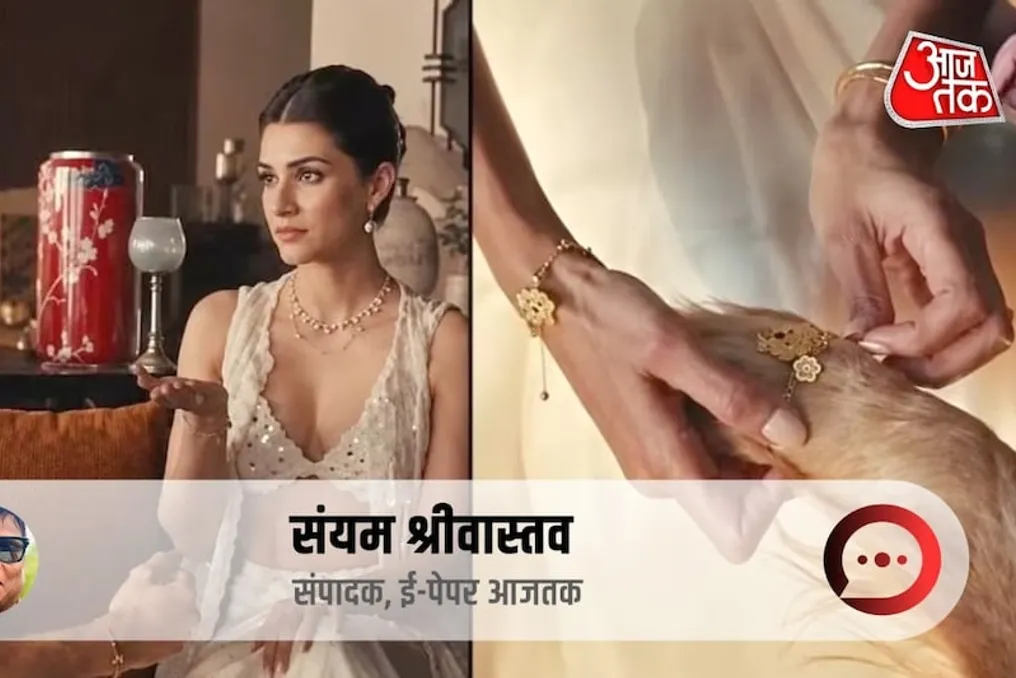
When a woman's choice of clothing is equated with her character, morality, or religious beliefs, the issue ceases to be about fashion and turns into a discussion about how much society wishes to control a woman's body and personal preferences. This is the perspective from which the controversies surrounding Kriti Senan's advertisement for Raksha Bandhan should be viewed.
In the jewelry brand Kriti Senan's advertising campaign, she is depicted in a bralette-style blouse, a cap, and a draped skirt. In the video, she ties a bracelet onto her on-screen brother. Some social media users considered this outfit inappropriate for Raksha Bandhan. Some condemned it as contradictory to Indian culture, while others questioned the absence of traditional elements such as a ritual headband or tilak. The scene where a dog was put a bracelet also caused dissatisfaction.
Disagreement regarding the creativity, presentation, or message of any advertisement is a natural right. It can be argued that attempts to excessively modernize a religious-cultural festival for commercial purposes may distort its true essence. However, the problem arises when criticism of an advertisement turns into social surveillance of a woman's clothing.
What Kriti wore might be a matter of personal choice. But whether she has the right to wear it is a question of rights. This is a fine line that is extremely important to realize today. In an Hindu family, on Raksha Bandhan, a sister can choose a sari, salwar-suit, lehenga, or Western attire—it depends on the preferences of the family and the individual herself. A ritual plate may be a tradition, but every family's traditions are unique. The main feature of the Indian Hindu tradition has always been its diversity: methods of conducting rituals, diet, clothing, and manner of celebration vary depending on the region, caste, family, and community.
To recognize one specific outfit as the ultimate proof of 'Indian culture' is to diminish the diversity of Indian society itself. From here arises a serious threat. Today, people are discussing how much fabric a woman wore in the Raksha Bandhan advertisement; tomorrow, they might start asking what a girl should wear on a festival, what to wear for a walk, who and how one should dress. Ultimately, this issue can go beyond clothing and touch upon human freedom.
Radicalism rarely reaches its peak in a single day; it paves its way through minor social demands. First, someone says, 'This outfit is against our culture'; then the assertion sounds: 'Good girls do not dress like this'; after which society begins to dictate how women should behave. When this mindset becomes institutionalized, restrictions begin to be placed on women's freedom.
The experience of Pakistan serves as a warning in this context. The spread of religious extremism there has gradually led to a significant part of society becoming accustomed to social pressure that establishes strict norms regarding women's clothing and public behavior. Although the social conditions of India and Pakistan are not identical, and their religious-cultural paths cannot be placed side-by-side, one thing is clear: when society turns women's clothing into a matter of its collective honor, the space for freedom begins to shrink.
The argument is often made that the actress could have worn such clothing in an advertisement for an Islamic holiday. However, the real answer lies in this question: should Hinduism adopt Islamic extremism as a model for defining its social norms? If another religion has stricter restrictions on women's clothing, will it be an achievement for Indian society to follow this example? The advantage of the Hindu tradition lies in its open and pluralistic nature. Therefore, the question is not 'can it happen there,' but 'do we want to bring our society to such a state?' The strength of religion lies not in imposing discipline, but in accepting diversity.
The strength of India is not that all women dress alike. The strength of India is that a woman in a sari is one thing, and a woman in jeans is another; a woman in a hijab is one thing, and a woman without it is another; a woman visiting a temple is one thing, and a woman attending a fashion show is another. To protect Indian culture, it is not necessary to lock women into a single outfit. If Hinduism truly wants to become stronger, it does not need to fear female freedom. The soul of Indian society cannot be so weak that its religion is threatened by the outfit of one actress. The defense of religion happens not by controlling the woman's body, but by the strength of its own values.
Therefore, if you do not like Kriti's outfits, do not accept them. If you did not like the advertisement, reject it. Question the brand's marketing strategy. But do not turn this disagreement into a tool for controlling women's freedom. Because the veil falls not only on the face. Sometimes it descends upon thoughts too. And on the day when society gets used to deciding what women should wear, the danger will be far greater than that posed by Kriti Senan's clothing. Then the question will not be how much she wore, but what freedom she has left to live according to her own choice.