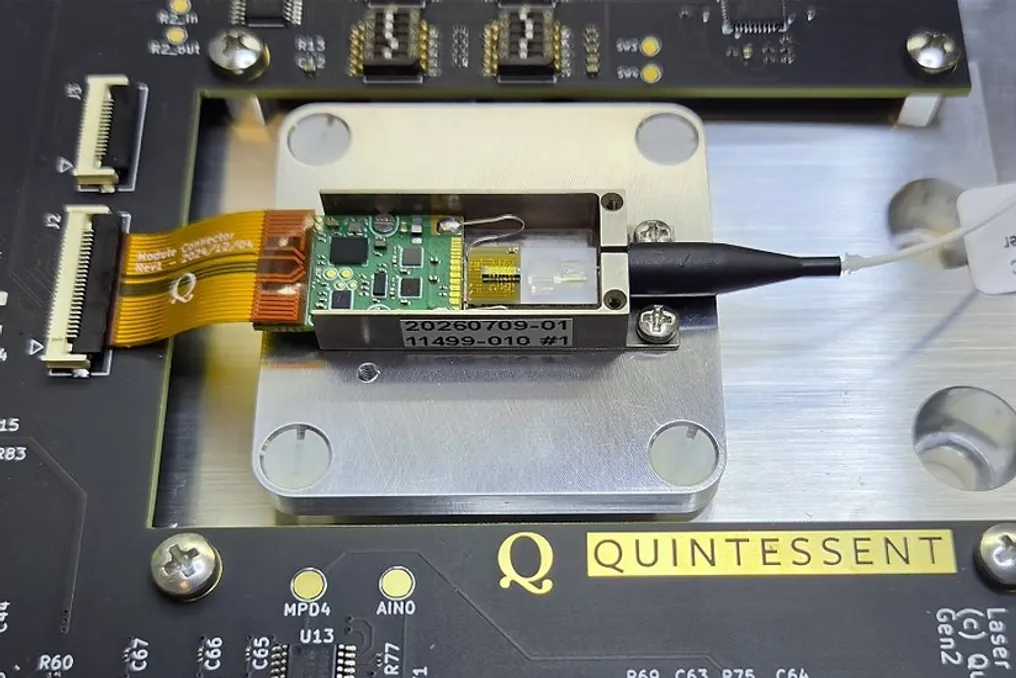
Artificial intelligence data centers require the transfer of huge amounts of data between computers, which traditionally necessitates numerous lasers. However, there is a shortage of lasers, and existing models consume too much energy. The company Quintessent has raised $40 million to develop a new type of laser chip capable of solving both these problems.
The growing popularity of AI demands an increase in the number of data centers, and data centers need more efficient ways to transmit data using light, including lasers and fiber optic cables. Thus, there are two main challenges: AI companies require significantly more lasers than factories can produce, and existing lasers consume a large amount of energy.
Quintessent claims to have found a solution. The company announced securing new funding of $40 million and stated that it now allows customers to test its first product. The funding round was led by Cycle Capital. Other new investors included Goldman Sachs, Ciena, and Susquehanna International Group, while previous investors also increased their investments.
Major technology companies recently agreed on a new method for connecting AI computers that uses multiple colors of light simultaneously. This method requires a large number of lasers, and the primary material for manufacturing such lasers is currently in global shortage because factories cannot keep up with production.
Instead of using eight separate lasers, Quintessent integrated all eight into one chip. This is comparable to eight flashlights packed into a single device that emit slightly different colors. This design simplifies management, reduces the number of potentially failing components, and lowers energy consumption. Furthermore, production becomes cheaper because it uses a common material already produced in large volumes, helping to overcome the shortage issue affecting current lasers.
The company states that its development increases efficiency, allowing for up to 40% reduction in energy consumption for data transmission compared to current systems. The chip's design also allows for its manufacturing on large factories using standard chip production tools, ensuring scalability as AI demand continues to grow.
The technology was first demonstrated at a major industry event earlier this year. Customers can now order an evaluation kit for testing in their own laboratories. Quintessent plans to use the $40 million raised to complete testing, ensure product reliability, and begin mass production. The company also intends to develop other components necessary for AI data centers, such as amplifiers and connection modules.
Andre-Lisa Metho, a representative of Cycle Capital, noted that as the demand for data centers accelerates due to AI, power supply systems are under significant strain. Quintessent's goal is to become a key element in increasing data center performance while simultaneously reducing energy consumption.
Quintessent CEO Alan Liu stated that the company is transitioning from laboratory research to selling finished products. He emphasized: 'We focused on simplifying the deployment and scaling of optical connections. Now we are moving to meet customer needs.'