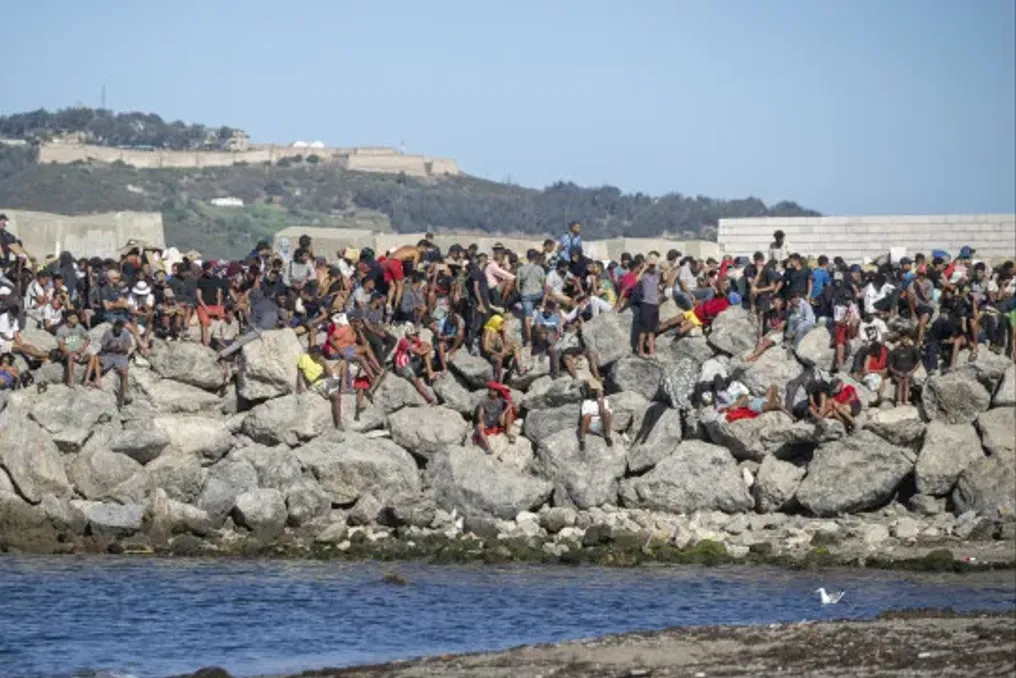
Spain's Deputy Prime Minister and Minister of Economy, Trade and Business, Carlos Cuerpo, announced that authorities have registered just over 2,900 children in Ceuta. This information was shared by him after a meeting with the Mayor of Ceuta, Juan Jesús Vivás, at the city's Palacio de Asamblea.
The Economy Minister explained that the current identification work aims to maximize the speed of processing these cases. He emphasized that this public initiative is a response to the primary concern for the well-being of minors, with the goal of finding a solution to a potentially 'critical' situation.
This work is being carried out by the Spanish Ministry of the Interior and the Ministry of Migration in cooperation with the Ministry of Youth and Childhood, as well as local authorities. Cuerpo noted that coordination between departments is intended to improve and resolve issues concerning children under guardianship.
He specifically highlighted that in many cases, the individuals are girls, some of whom are under 13 years old and are not even adolescents, calling this an 'overriding priority' for them.
The government did not specify how many of these 2,900 minors are unaccompanied migrants. Nevertheless, the Ministry of Youth and Childhood plans to meet on Thursday with autonomous communities at a Sectoral Conference to discuss allocating an additional 25 million euros to Ceuta, designated for the accommodation of unaccompanied migrants.
Prime Minister Pedro Sánchez convened the National Security Council for Tuesday to analyze the situation in Ceuta after more than 72,000 migrants arrived in 24 hours in July (of which more than 70,000 voluntarily returned to Morocco the following week, according to authorities).
Government sources confirmed this information to the Spanish news agency EFE, which was originally published by the newspaper El País regarding a meeting scheduled before the Council of Ministers session on Tuesday—the first after the summer recess.
During August, Sánchez held two video conferences to coordinate the situation in Ceuta, which took place on the 7th and 17th, involving several ministers from his cabinet.
Furthermore, the deputy prime minister announced that the government will declare on Tuesday a 'situation of interest to national security' in Ceuta and establish a unified team to coordinate the response to the migration crisis, as well as expanding the 2022 socio-economic plan for the city.
This structure will be headed by the Minister of Territorial Policy and Democratic Memory, Ángel Víctor Torres. Carlos Cuerpo also announced an extraordinary and immediate expansion of Ceuta's Comprehensive Socio-Economic Development Plan for 2022, which was previously secured with over 180 million euros, and which will include measures to strengthen security, manage returns, and revitalize the city's economy.
The minister explained that both measures are intended to address both the situation caused by the mass influx of migrants at the end of July and its consequences for the population and economic activity of the autonomous city.
Ceuta, a small region with a population of about 83,000, located in the extreme north of Morocco and bordered by the Strait of Gibraltar, is one of the two land borders between Africa and Europe, alongside another Spanish enclave—the city of Melilla.