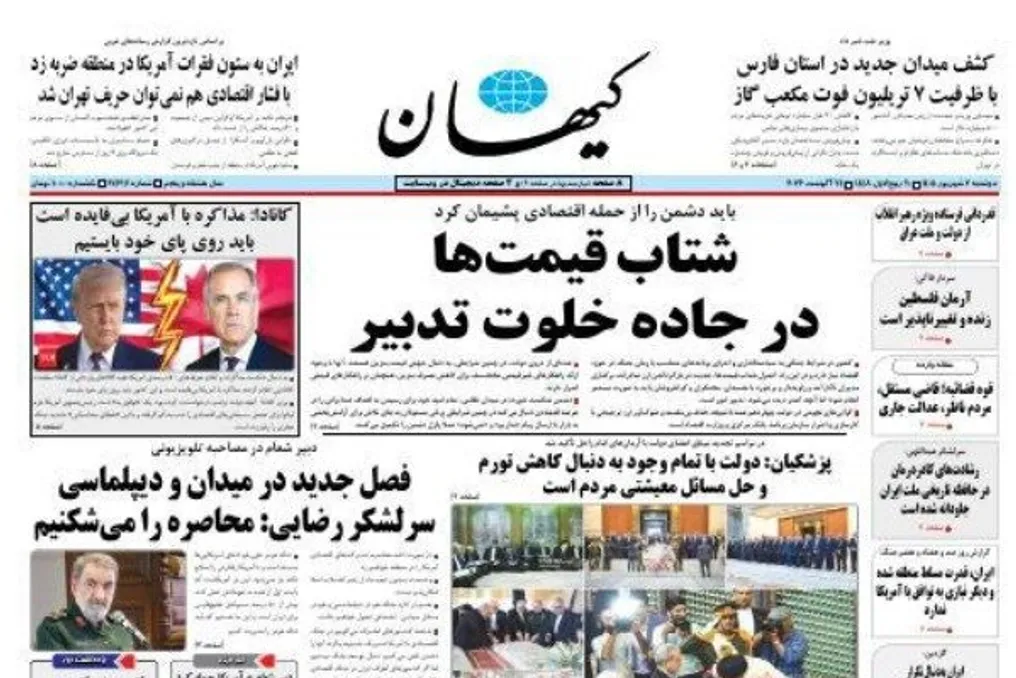
Expert Kayhan analyzed Trump's state of despair in the current situation. Trump's frustration and anger are evident at a time when Axios acknowledged that changes in oil prices in response to Trump's social media posts about the war with Iran are gradually weakening.
Fluctuations in oil prices affect the economy of the US and the entire world, and the conflict has caused unprecedented supply disruptions. In the first weeks, markets reacted excessively to many of Trump's posts, but over the past months, the market has ignored them because they do not reflect reality and are not connected to the actual number of barrels leaving the Strait of Hormuz.
The reduction in Trump's influence on oil markets has political consequences, as Democrats use energy prices as an argument against Republicans in midterm elections. In the first months, the White House successfully controlled the narrative and lowered prices, but now it has lost this lever of influence.
Ettelaat assessed the Mekan Pact. Although there is currently no tension between Iran, Turkey, and Pakistan, under certain circumstances—with financial support from Saudi Arabia and combined with US provocations—tensions could arise between these two countries. Therefore, Tehran should not worry too much about the Mekan Pact. If the pact adopts a strongly oppositional stance towards Israel, it will be an opportunity for Tehran. If it remains indifferent to Israel but shows sensitivity to Iran, it will turn into a threat. The Mekan Pact can be inflated by Riyadh and Washington at a critical moment, which will complicate Iran's relations with Ankara and Islamabad. In any case, it is better for Iran to strengthen good relations with its neighbors and remain extremely vigilant and prepared for all possible scenarios, risks, and breaches of obligations, even in the worst case.
Arman-e-Emrooz: A Complex Situation
Arman-e-Emrooz analyzed the strengthening of US sanctions and the naval blockade of Iran, presenting three possible scenarios. It seems that one of these three scenarios will soon materialize. One option is that the Trump administration will back down and announce progress in negotiations, meaning abandoning the imposition of harsh sanctions. The second scenario involves announcing and implementing a plan, but after a short period, it will be quietly postponed as both sides demonstrate flexibility and the negotiation process begins. The third option is the continuation of harsh economic sanctions until the US midterm elections, after which they will be accompanied by military strikes to change the situation on the ground.
Each of these three scenarios has its supporters, but they are heavily influenced by two factors: firstly, the degree of firmness in current positions; and secondly, the results of the upcoming elections in the US and Israel.
Shargh: Crisis in the Global Economy
In its analysis, Shargh examined the global economic crisis triggered by the closure of the Strait of Hormuz. The withdrawal of oil tankers from the strait amid escalating military tensions raised freight rates more than four times compared to pre-war levels. The closure of the Strait of Hormuz became a crisis for the global economy. This unprecedented increase in transportation costs entails a chain of negative consequences. Firstly, the final cost of oil for consuming countries has sharply increased, meaning increased pressure on household budgets and rising inflation worldwide. Secondly, countries without sufficient strategic reserves face serious difficulties in securing necessary oil and may face fuel shortages. Thirdly, the increase in transportation costs raises the final price of basic goods and industrial raw materials, as oil plays a key role in the production and transportation of many products. The closure of the Strait of Hormuz has unleashed a full-scale economic crisis on the world, affecting all countries, from major importers to ordinary consumers.
Resalat: Violation of the Arab-American Alliance Building Game
American strategists openly speak about efforts to unite the Arab states of the Persian Gulf against Iran. Diplomacy must anticipate the opponent's moves and deprive it of reasons to build coalitions. The agreement to restore relations with Saudi Arabia, as well as expanding ties with the UAE and Qatar, must be transformed from a simple political truce into deep economic and defense ties. If the Gulf states develop closely intertwined commercial and economic interests with Iran, they will not be able to easily participate in Washington's anti-Iranian agenda. It is necessary to show their neighbors that regional security is united and indivisible. Any provision of bases to the United States or the Israeli regime for actions against Iranian interests jeopardizes the climate of security and investment throughout the region.
At the same time, proposals for non-aggression and cooperation pacts to ensure maritime navigation neutralize the pretext for the presence of foreign fleets.