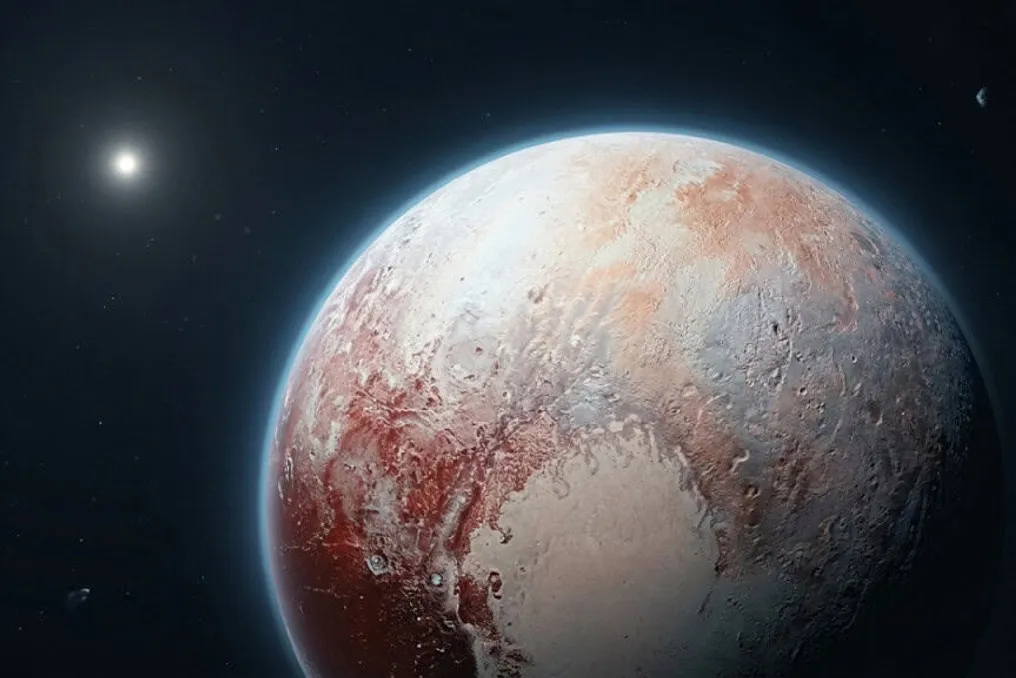
Pluto is one of the Solar System bodies that generates great controversy, being the subject of study even two decades after formally losing its planetary status, which occurred on August 24, 2006. On that date, the International Astronomical Union (IAU) established a new definition for the category, maintaining Pluto's classification as a dwarf planet, despite criticism from some scientists.
The astronomer Clyde Tombaugh discovered Pluto in 1930, and it was known for decades as the ninth planet in the Solar System. The situation began to change with the use of more advanced telescopes, which revealed a quantity of frozen objects beyond Neptune, many with characteristics similar to Pluto's, raising doubts about what distinguishes a planet from other celestial bodies.
The discovery of Eris in 2005 accentuated this dilemma. Eris has dimensions comparable to Pluto's and is farther from the Sun. If Eris were classified as a planet, it would be necessary to justify why other similar bodies would not receive the same treatment. The possibility of the Solar System containing dozens or hundreds of planets made the need for objective criteria urgent.
The IAU defined three requirements for a celestial body to be considered a planet: it must orbit the Sun, possess enough mass for its gravity to make it approximately spherical, and finally, have cleared the majority of the objects in its orbital region, becoming gravitationally dominant in that space.
It was this last criterion that led to Pluto's exclusion from the main list. The concept of 'orbital clearing' does not imply the total removal of all objects, but rather that the body's gravity must control the dynamics of that area. Due to its relatively small size, Pluto shares its neighborhood with several other bodies in the Kuiper Belt.
The adopted solution was to classify it as a dwarf planet, a category that also includes Ceres, Eris, Haumea, and Makemake. Other distant bodies, such as Sedna and Quaoar, are frequently mentioned in discussions about potential dwarf planets. Thus, the 2006 change did not turn Pluto into an asteroid; it remains a gravity-rounded body, but without the necessary gravitational dominance over its region.
Scientific Divergence and Critics' Arguments
The new classification generated divisions within the scientific community. Alan Stern, lead researcher of NASA's New Horizons mission, is one of the critics of the definition established by the IAU. This mission conducted the first close flyby of Pluto in 2015 and subsequently explored the Kuiper Belt, also studying the object Arrokoth. A central argument of Stern is that the criterion of orbital dominance may be less relevant to defining the nature of a world than its own physical characteristics.
He points out that Earth also has asteroids and other objects near its orbit, which does not negate its dominance, but illustrates that the expression 'clearing the orbit' can lead to incorrect interpretations. For critics, the focus should be on understanding the internal workings of the body, and not just its interaction with its neighbors.
Stern and other proponents argue for a classification based primarily on physical properties. Under this model, Pluto would be considered a planet because it is a spherical world due to its own gravity and possesses a complex geological structure, including mountains, plains, nitrogen glaciers, and an atmosphere.
The controversy, therefore, lies in the choice of parameters used to define what constitutes a planet, and not in the existence or intrinsic characteristics of Pluto.
Future Perspectives and Technical Rigor
Although the 2006 decision remains valid, the debate over Pluto's status continues. Recently, the discussion gained new momentum following statements by Jared Isaacman, current NASA administrator, who expressed support for the idea of 'bringing Pluto back'.
Marcelo Zurita, president of the Paraíba Astronomy Association (APA), member of the Brazilian Astronomical Society (SAB), technical director of the Brazilian Meteor Observation Network (BRAMON), and columnist for Olhar Digital, emphasizes that any revision must be conducted with extreme technical rigor. He stresses that the classification does not devalue Tombaugh's discovery nor the scientific importance of the world, recalling that the 2006 decision was the result of intense debates and voting among global astronomers in the main international organization in the field.
Zurita states that science operates by technical consensus, not by popularity or passing political influence. Changes occur only with the emergence of new evidence or solid arguments that convince the specialized community.
A modification to the IAU would require a new vote or a scientific consensus that revises the current criteria, which would have implications beyond Pluto, as some Solar System moons have complex geological activity that could fit into similar categories.
The term 'dwarf planet' is also questioned. Byrne argues that the word 'dwarf' suggests a hierarchy among worlds, which he considers nonexistent, given that they all formed from residual materials of the Solar System's construction, going through the same basic aggregation process.
Zurita also highlights this perception of demotion, mentioning that although the IAU resolution sought to unify scientific understanding, it should not be used to satisfy sentimental affection for Pluto.
New Discoveries and Limits of Classification
The discussion could become more complex with new observations in distant regions of the Solar System, such as the Scattered Disc and the Oort Cloud, which are still little known. Models suggest the existence of many Pluto-like bodies in these areas.
According to Byrne, the discovery of an object the size of Mars or Earth in the most remote regions could challenge the current IAU definition. Even if it had planetary dimensions, such an object might not be classified as a planet if it did not dominate its orbital neighborhood, demonstrating the limit of defining a planet solely by its location and orbital dynamics.
Currently, Pluto maintains its official status as a dwarf planet, but twenty years after the IAU deliberation, the debate persists, revealing the continuous need for science to update its categories in light of growing discoveries about the Solar System.