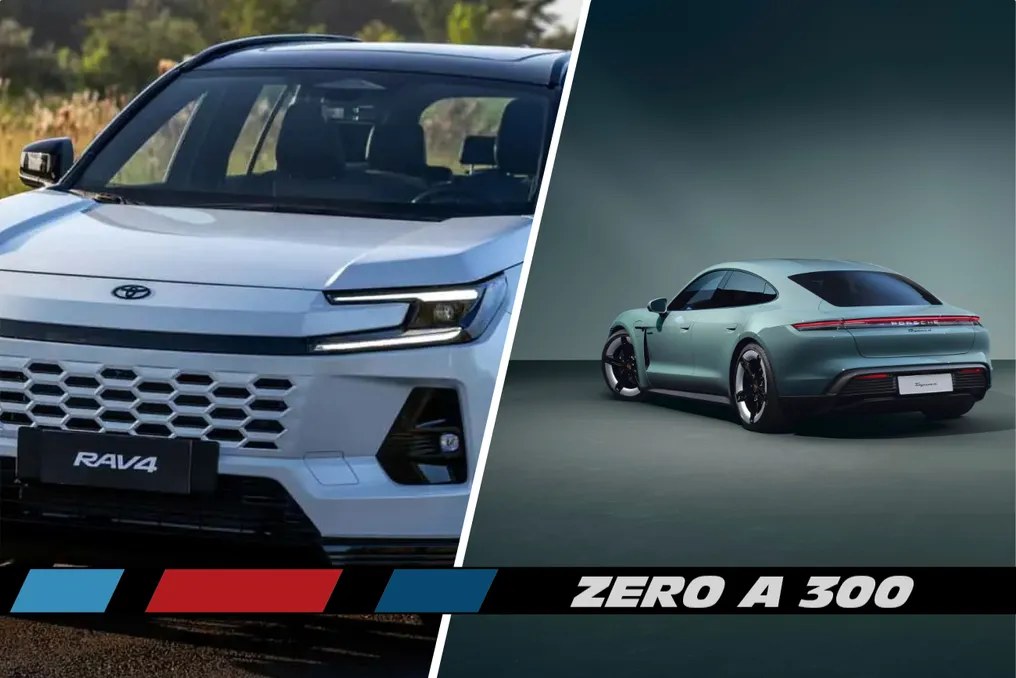
Porsche has refuted speculation that it plans to discontinue the Taycan model, while the automotive market presents other news, such as the launch of a plug-in hybrid version of the Toyota RAV4 and studies on Chevrolet's return to the truck segment in Brazil.
Historically, Porsche diversified its line by introducing the Cayenne SUV and the Boxster in the 1990s to support the 911. However, in 2026, a curious reversal is observed: the 911 maintains consistent sales figures, while the rest of the line faces commercialization difficulties.
Recently, there was extensive media coverage regarding Volkswagen Group's intention to optimize its lineup to contain costs and losses, aiming to halve the number of models across all its brands. Within this scope, the Porsche Taycan was pointed out as one of the potential candidates for discontinuation. A note published in the German economic magazine WirtschaftsWoche suggested that the electric sedan could be discontinued by 2030, with Porsche having considered an even earlier shutdown.
In direct response to these rumors, Porsche made a public statement. A brand spokesperson informed the publication Robb Report that there are no short-term plans to remove the Taycan from the market. On the contrary, the manufacturer has made significant investments in the vehicle and is monitoring demand for it.
Despite this, demand for the Taycan has shown a noticeable reduction in recent years, registering just over 16,000 units sold in 2025, which represents a sharp drop compared to the more than 41,000 units sold in 2021. This suggests that Porsche may have overestimated public interest in electric vehicles in its niche.
The statement made to Robb Report echoes Porsche's previous stance on future electric Boxster and Cayman models, reinforcing that the plans remain valid due to the large investments already made in these cars, making it impossible to abandon them at this time. The future of these models remains under observation.
Automotive Industry Trends
In the sector, a growing trend is the reduction of buttons on dashboards, replacing them with touch screens and voice commands. BMW follows this trend, claiming that the absence of physical controls in its newest models is due to young people's preference for interacting with their cars by voice. Vikram Pawah, CEO of BMW's Australian division, commented to CarExpert that voice and touch controls are becoming popular, attributing this partly to a generational issue. He observed that the younger generation, aged 45 or under, adopts these technologies more quickly, prioritizing speed and being multitaskers.
Although this justification seems plausible, it neglects crucial aspects of ergonomics and safety. Physical and tactile buttons offer the unparalleled advantage of not forcing the driver to look away from the road. Muscle memory allows for quick adjustments, such as temperature control or radio switching. In contrast, a touch screen requires visual focus and menu navigation, diverting attention necessary for driving.
It is argued that justifying the end of buttons as an adaptation to the 'multitasking youth demand' is, in fact, a convenient narrative. The real reason for this forced change is financial: software and screens are cheaper to produce than physical controls. Benedetto Vigna, current CEO of Ferrari, confirmed that touch control units can cost up to 50% less than a complete panel of mechanical switches, dedicated wiring, and plastic molds.
Launch of the New Plug-in Hybrid Toyota RAV4
Toyota introduced the new RAV4 equipped with a plug-in hybrid system to the Brazilian market. This version, named XSE, completes the SUV line, whose new generation was presented in Brazil in April 2026. At a price of R$ 399,990, the RAV4 XSE PHEV is positioned above the S and SX versions, which use a traditional hybrid system.
The powertrain combines a 2.5-liter naturally aspirated four-cylinder engine, generating 189 hp and 24.2 kgfm, along with three electric motors. The total power achieved is 329 hp, allowing the SUV to accelerate from 0 to 100 km/h in 5.7 seconds and reach a top speed of 180 km/h, making it the most powerful version of the RAV4 sold in Brazil. Toyota reports that the new 22.7 kWh lithium-ion battery allows for up to 61 km of travel in fully electric mode, according to INMETRO standards. Additionally, the SUV now supports fast DC charging of up to 50 kW, in addition to 11 kW AC charging.
Internally, the SUV features a 12.3-inch digital dashboard and a 12.9-inch multimedia center equipped with JBL sound, as well as the 4.0 version of the Toyota Safety Sense package. However, the installation of the larger battery under the floor results in a practical limitation: the trunk offers 421 liters, a volume lower than the 749 liters available in the conventional S and SX hybrid configurations. Despite the increase in power (329 hp versus 306 hp of the previous plug-in version) and the inclusion of fast charging, Toyota kept the price at R$ 399,990, identical to the value charged at the launch of the previous generation's PHEV in 2024.
Chevrolet Studies Return to Truck Segment in Brazil
More than three decades have passed since Chevrolet suspended the sale of trucks in Brazil. The last models, which were medium and heavy duty from the Series 11000 to 22000 (such as D-12000 and D-14000), were discontinued in the mid-1990s. Subsequently, GM attempted an incursion in the second half of the 1990s, transferring the heavy commercial division to the GMC brand. During this period, the GMC Kodiak, a twin-cab truck imported from the United States, and the light models of the 6-100 and 6-150 lines, as well as medium lines based on Isuzu projects, were introduced to the country.
This operation, however, had a short duration and was formally ended in the early 2000s. Now, more than twenty years later, Chevrolet is evaluating a return to the heavy vehicle segment in Brazil. According to Autoesporte, the current focus would be to reestablish local collaboration with Isuzu, primarily targeting light trucks intended for urban use.
In the United States, Chevrolet markets the Low Cab Forward (LCF) line, which consists of flat-nosed urban trucks, essentially Isuzu models rebranded with the brand's visual identity. Although the details of this possible partnership in Brazil are still uncertain, an alternative raised is the importation of models manufactured in Uruguay, following the example of Ford and Kia with their respective commercial vehicles. The reason for this possibility lies in the Mercosur free trade agreement, which exempts vehicles assembled in the neighboring country from import taxes, significantly reducing entry costs into the national market.
If this project advances, the goal is to compete with established brands in urban transport, such as the Volkswagen Delivery family and South Korean and Chinese models in the sector. For Chevrolet, this would represent an opportunity to regain a historically lucrative and important segment, with a relatively low development cost, leveraging the vast infrastructure of its dealership network covering the entire national territory.