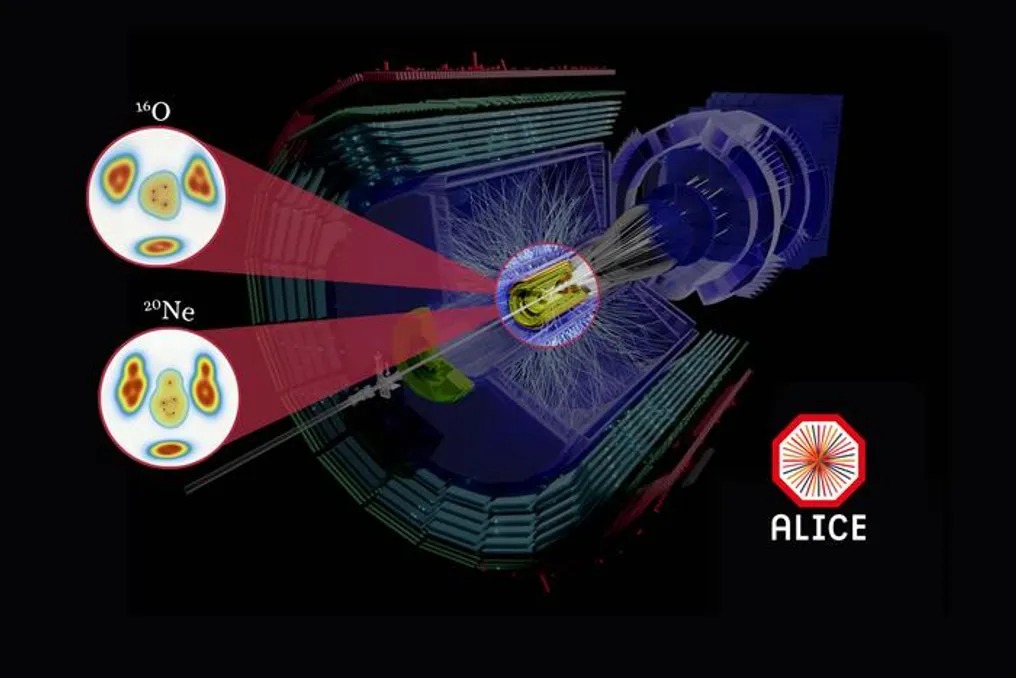
Researchers from the Niels Bohr Institute and the ALICE collaboration managed to replicate a type of matter that existed in the early stages of the Universe. To achieve this, they collided oxygen-16 and neon-20 nuclei at speeds close to the speed of light.
This procedure generated a quark-gluon plasma, classified as the most primitive form of matter in the cosmos. The study also demonstrated that nuclei significantly smaller than lead are capable of producing this extreme state.
The collision takes place at CERN, located in Switzerland. When these nuclei meet at speeds very close to the speed of light, their constituents form a tiny droplet of this quark-gluon plasma. This droplet persists for a fraction of a second before expanding.
This state of matter would have been predominant in the Universe during its first millionth of a second. At that time, the temperature was so high that protons and neutrons had not yet formed; quarks and gluons were free.
Expansion of the Experimental Scenario
Previously, experiments of this nature were mainly linked to collisions involving very heavy nuclei, such as lead. The new work expands this perspective by demonstrating that it is possible to reproduce this primordial matter—which can be called a Mini Big Bang—using smaller atomic nuclei.
You Zhou, an associate professor leading the experiment, commented that this discovery helps define the necessary conditions for matter to reach such a state.
Since the plasma decays too quickly for direct observation, scientists analyze what remains after the impact. The particles released by the shock carry a pattern that reflects the configuration of the nucleus that initiated the process. In the case of oxygen, the pattern is more rounded, while neon adopts a shape similar to a bowling pin.
Emil Gorm Dahlbæk Nielsen, a postdoctoral researcher at the Niels Bohr Institute and co-author of the study, used an analogy to explain the method: it is comparable to illuminating an object and observing its shadow. Similarly, the movement of the particles provides information about the invisible nucleus.
The study of atomic nucleus geometry has interested physics for over seven decades. This topic is also part of the trajectory of the Niels Bohr Institute, given that Aage Bohr's work on nuclear structure was fundamental to the Nobel Prize in Physics he received in 1975.
This geometry is not limited to shape; it indicates how protons and neutrons are organized and offers clues about the strong force, one of the four fundamental forces of nature.
New Approach in Nuclear Research
The research introduces a distinct methodology. Instead of focusing on nuclei only at low energies, scientists employ extreme collisions to identify the traces left by the resulting particles.
The next planned test will involve even smaller nuclei, such as helium-4. Researchers aim to determine the maximum limit of size reduction of nuclei that still allows for the production of quark-gluon plasma.
Zhou emphasized that the fascinating aspect is the ability to use the same experiment to investigate both the organization of atomic nuclei and to gain a deeper understanding of the emergence of matter at the beginning of the Universe.
Thus, the experiment establishes a connection between two central questions in physics: how nuclei are structured and how matter originated in the early Universe.