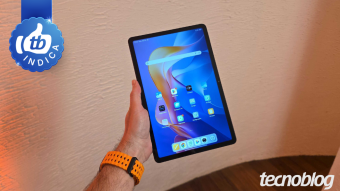
When selecting the ideal tablet for reading, it is essential to analyze features such as pixel density and peak brightness, as these factors directly influence the ease of reading books and other materials. Furthermore, battery life and device weight are relevant aspects; lighter devices with greater autonomy provide a superior experience during long reading periods.
Tecnoblog compiled a list of ten tablets focused on reading, detailing the pros and cons of models manufactured by Huawei, TCL, Apple, Samsung, Xiaomi, Positivo, and Lenovo.
Huawei MatePad Mini PaperMatte
The Huawei MatePad Mini PaperMatte features an 8.8-inch OLED screen with 2.5K resolution, specifically developed for reading enthusiasts. This model was designed to minimize visual discomfort caused by natural light and other light sources. With a peak brightness of 1,800 nits, it ensures good visibility even under strong sunlight.
Additionally, the screen has 343 PPI and includes certifications aimed at reducing eye strain and preventing flickering. A distinguishing feature is the eBook mode, which replicates the tactile sensation and comfort of physical paper while reading. In terms of ergonomics, the device is quite compact, measuring only 5.2 mm thick and weighing 260 g, making it easy to handle. Its 6,400 mAh battery offers good off-grid resistance, complemented by support for 66W fast charging.
TCL Nxtpaper 11
The TCL Nxtpaper 11 features an 11-inch LCD screen with 2K resolution and a 60 Hz refresh rate, simulating the texture and lightness of paper. However, its pixel density, limited to 212 PPI, may be a limiting factor for the definition of edges and curves in large character texts. The peak brightness of 500 nits might present visibility difficulties under direct sunlight.
As compensation, the screen system uses artificial intelligence to automatically adjust the color temperature, adapting to indoor or outdoor environments. It also has blue light reduction certification to decrease eye strain. A significant highlight is the robust 8,000 mAh battery, which provides long duration for extensive reading sessions. Despite this, this battery contributes to a weight of 462 g, although it is still considered one of the lightest on the list.
The iPad (A16 Bionic) offers good definition quality for reading through its 11-inch Liquid Retina display and 264 PPI. The True Tone functionality automatically adjusts brightness and color temperature according to ambient lighting, but its maximum brightness of 500 nits favors indoor environments. The display operates at a 60 Hz refresh rate, a more basic standard that may result in less smooth scrolling, although this does not drastically affect static text reading.
Regarding power, this model's battery has a capacity of 28.93 Wh and estimates up to 10 hours of use with Wi-Fi. The Wi-Fi + Cellular version, weighing 481 g, includes 5G support, being slightly heavier than the basic version (477 g).
The iPad mini (A17 Pro) also features a display that reaches 500 nits of peak brightness and is compatible with True Tone. However, its LCD screen has a smaller size, 8.3 inches, but offers higher reading sharpness thanks to a pixel density of 327 PPI. Another notable advantage is the anti-reflective coating, which minimizes interference from ambient light, especially in open areas. Like the previous model, the refresh rate remains at 60 Hz. Due to its reduced size, the iPad mini is lighter (293 g) and provides greater comfort during prolonged reading. Its 5,078 mAh Li-Ion battery can last a full day without needing a recharge.
Galaxy Tab S10 FE
The Galaxy Tab S10 FE positions itself as a mid-to-premium tablet, presenting an excellent cost-benefit ratio. It is equipped with a 10.9-inch LCD screen (WUXGA+), which displays crisp text (249 PPI) and improves outdoor visibility thanks to a peak brightness of 800 nits. The screen also supports a 90 Hz refresh rate, making page and book scrolling smoother. Additionally, the device includes an eye protection mode with a blue light filter and IP68 certification for greater resistance in humid environments, such as pools. The 8,000 mAh battery supports charging up to 45W and ensures good autonomy for extended reading. The only negative point mentioned is the weight of 497 g, which can cause arm fatigue when held for many hours.
Huawei MatePad SE
The Huawei MatePad SE has an 11-inch FHD+ display, ensuring a comfortable viewing area. The LCD screen reaches a peak brightness of 400 nits and has a pixel density of 206 PPI, making it more suitable for reading in indoor environments or for those who prefer enlarged text. This model includes TÜV Rheinland certifications to mitigate blue light emission and flickering. It also incorporates an eBook mode to reduce eye strain and a multi-window function that allows for simultaneous note-taking while reading. The tablet weighs 475 g and is powered by a 7,700 mAh battery, with support for 22.5W fast charging.
Galaxy Tab A11+ 5G
The Galaxy Tab A11+ 5G is presented as a tablet with great cost-benefit. It comes with an 11-inch LCD screen (WUXGA), which, despite having a large area, has a maximum brightness of 480 nits, which can compromise content visibility under direct sunlight. The 206 PPI density also reduces clarity in smaller texts. In contrast, the 90 Hz refresh rate provides significantly smoother page and document scrolling. The device also offers eye protection features, limiting blue light and using warmer tones to reduce visual fatigue. The battery has a capacity of 7,040 mAh and lasted over 11 hours of video playback in tests. Its weight of 482 g facilitates portability, although it may cause discomfort if held in the hands for long periods.