Against the backdrop of global economic fragmentation and unilateral sanctions, Iran and Cuba, which possess years of experience in overcoming external pressure, are actively working to deepen bilateral economic relations. Recent high-level meetings and business delegation visits indicate a mutual determination to transform long-standing political solidarity into tangible commercial partnerships.
The essence of these efforts lies in the complex interplay of opportunities and obstacles: Cuba's gradual opening to private sector participation, Iran's resilient industrial base, and persistent logistical and financial barriers that have previously limited substantial cooperation.
This report summarizes the outcomes of two key diplomatic and business events: a meeting in Tehran between the head of the Iranian Chamber of Commerce and the Cuban ambassador, and a subsequent visit by an Iranian business delegation to Havana at the end of 2025. The first part covers bilateral discussions on frameworks and aspirations, while the second part describes the examination of specific investment projects on the ground. Together, they paint a complete picture of a partnership ready for growth, provided issues of regulatory transparency and payment mechanisms are adequately addressed.
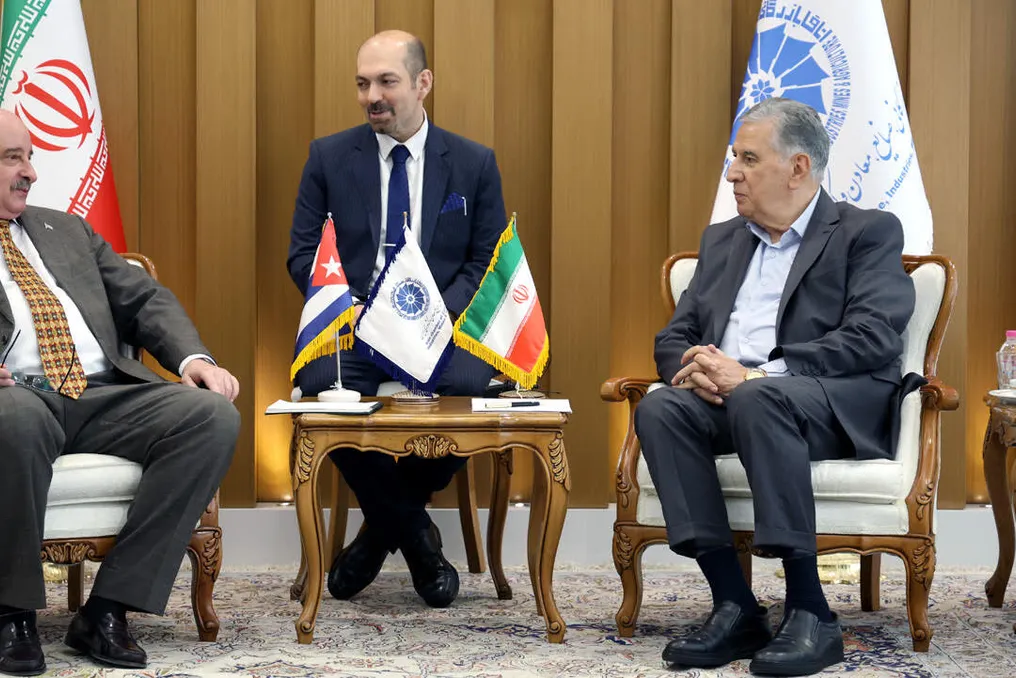
During a significant diplomatic exchange, Samad Hassanzadeh, head of the Iranian Chamber of Commerce for Trade, Industry, Mining, and Agriculture (ICCIMA), met with Jorge F. Lefebre Nicolas, the Cuban ambassador to Tehran, at the ICCIMA building on August 24. The goal of the meeting was to assess the changing landscape of economic relations between Iran and Cuba. It was emphasized that while political ties are strong, economic interaction remains below its potential, mainly due to logistics and money transfer issues.
Hassanzadeh began the dialogue by confirming Iran's readiness to enter the Cuban market provided two critical bottlenecks are resolved: transport and financial settlements. He unequivocally stated that 'if the problems with logistics and money transfers are solved, Iranian investors will enter the Cuban market.' He highlighted several promising sectors for joint cooperation, including aquafarming, sugar production, auto parts, and sanitary goods. These areas, he noted, align with Iran's industrial strengths and Cuba's need for import substitution.
The Cuban ambassador responded by detailing the significant legal and structural reforms underway in Cuba. He explained that increased US sanctions forced the Cuban government to revise its economic model, shifting towards a more developed private sector. This shift, he stressed, now has legal status, allowing private banks, exchange offices, and a broader role for foreign investment in previously state-owned sectors. Ambassador Nicolas invited Iranian investors to consider opportunities in fuel supply and distribution—now managed by the Cuban private sector—as well as in hospitality, where Spanish companies previously dominated, and in agriculture, where Vietnam has already implemented land lease agreements. He also highlighted mining (nickel and quartz), car rental services, and renewable energy as areas open to Iranian participation.
A central theme of the meeting in Tehran was the evolving legal framework in Cuba. Hassanzadeh stressed the need for written documentation of these new laws so that the Iranian Chamber of Commerce could provide accurate information to its members. He recalled previous talks with Cuban officials during his visit to Cuba, where proposals for creating specialized committees to remove trade barriers were discussed but not yet implemented. He strongly urged the Cuban side to provide official investment packages and clear regulatory guidelines, noting that Iranians, having overcome forty years of sanction-related restrictions, are uniquely prepared to operate under constraints. He presented economic interaction not merely as a search for profit, but as a religious and moral duty—to stand alongside other nations and improve living standards through mutual cooperation.
Ambassador Nicolas acknowledged that transport remains the main operational challenge but expressed confidence in solutions, including route reconfiguration and alternative payment corridors avoiding the dollar system. He proposed practical steps: conducting online B2B meetings through the embassy, organizing a delegation of interested Iranian companies to visit Cuba, and facilitating a reciprocal Cuban business mission to Iran. He emphasized that Iranian companies, unafraid of sanctions, can operate in Cuba in any currency, and the Cuban embassy is ready to act as a bridge for market familiarization.
Hassanzadeh provided more detailed information on potential areas of cooperation. He reported on his visits to Cuban farms and sugar production facilities, concluding that joint investments in sugarcane cultivation and sugar processing hold great potential. He also proposed the creation of free trade zones in Cuba exclusively for Iranian products, which could serve as a distribution hub for the Caribbean and Latin America. Furthermore, he mentioned that official invitations had been sent to the Minister of Economy, the Minister of Industry, and the President of the Cuban Chamber of Commerce to visit Iran, hoping such a high-level visit would accelerate mutual understanding and deal-making.
The Cuban ambassador confirmed these initiatives, reiterating that Cuba's new legal framework allows foreign investors to repatriate earned funds—a critical assurance for any potential investor. He noted that even fuel supply and distribution—a strategic sector—has been privatized, demonstrating the depth of Cuba's commitment to economic transformation. He concluded by emphasizing that this is a favorable time for Iranian companies, especially large network enterprises, to enter the Cuban market, provided they quickly study the new investment laws.
Moving from high-level political discourse to operational interaction, the Iranian business delegation led by ICCIMA head Samad Hassanzadeh visited Havana at the end of November 2025 to examine specific investment projects aimed at reviving Cuba's unused industrial potential.
The delegation's agenda was much more concrete than the discussions in Tehran, focusing on restoring inactive factories and establishing joint ventures in sectors where Iran possesses proven technical expertise. In meetings with Cuban officials, Hassanzadeh requested a complete list of non-operational enterprises, especially in the sugar and cement industries, to guide Iranian companies seeking investment opportunities. He argued that Iran could play a key role in reviving Cuba's once-prominent sugar industry using Iranian mechanical engineering and agricultural technologies. Similarly, he noted that joint cement production would be more economically efficient than continued imports, and Iranian investors are ready to build several cement plants provided clear regulatory conditions and investment guarantees are established.
ICCIMA Deputy Head Ghader Ghiyafeh expanded the industrial scope, naming mining as the cornerstone of sustainable cooperation. He characterized Cuba as resource-rich but having an underdeveloped mining market, where Iranian firms—possessing advanced technical expertise in exploration, extraction, and processing of minerals—can make a significant contribution. He specifically mentioned cobalt and nickel production, from geological surveys to processing, and noted that Iranian engineering companies are ready to assist in training Cuban specialists for a planned national steel plant. The company 'Khorezmstan Steel' has already expressed willingness to cooperate. Ghiyafeh predicted that a clear legal framework could help increase bilateral trade to one billion dollars within five years, focusing on construction, road building, food industry, agriculture, and mining as preferred sectors for Iranian investors.
In a separate meeting with the Cuban Minister of Internal Trade, Hassanzadeh insisted on preparing an official investment package tailored for Iranian companies. He reiterated Iran's industrial strength in agriculture, mining, petrochemicals, tourism, and energy, but stressed the need for transparent rules and investment security. The Cuban Minister reacted positively, stating that President Miguel Díaz-Canel had instructed ministries to identify opportunities for importing food, clothing, and consumer goods from Iran following the Havana International Fair 2025 (FIHAV). The Minister emphasized that Cuba seeks to boost domestic production as a buffer against US sanctions and is ready to support foreign investors willing to take risks.
The visit concluded with a symbolic yet important moment during Iran's National Day at FIHAV 2025. Hassanzadeh stated that the presence of Iranian producers reflects a general commitment to expanding cooperation, calling on both countries to translate political ties into economic results. He outlined additional areas of Iranian contribution, including dam construction, road and housing projects, and the development of hydropower and renewable energy. The Cuban Minister of Industry, Eloy Álvarez Martínez, supported this view, calling for practical cooperation aligned with political solidarity, citing the comprehensive cooperation agreement of 2023 as the necessary foundation for forming direct partnerships among small, medium, and large enterprises.
The most significant event was President Miguel Díaz-Canel's personal visit to the Iranian stand at the fair, where he was met by Hassanzadeh, Ghiyafeh, and the Iranian Ambassador to Cuba, Zabiollah Naderi. The Cuban President spoke with representatives of Iranian companies, learning about their products and export potential. He expressed hope that the exhibition would pave the way for improved mutual cooperation and stressed that his government supports the expansion of economic exchanges and joint investments. His visit underscored the highest level of political will to achieve tangible results, particularly in petrochemicals, food industry, industrial equipment, and commercial services.
The combination of diplomatic dialogue and the activities of business delegations reveals a clear trajectory: Iran and Cuba are not merely maintaining symbolic solidarity, but are actively building a practical economic partnership. The meeting in Tehran established fundamental principles—acknowledging legal changes, defining sectoral opportunities, and agreeing on the necessity of resolving logistical and monetary issues. The delegation in Havana then tested these principles in practice, identifying specific factories for restoration, mining projects, and target trade volumes.
Three critical takeaways emerge for both sides. First, solving banking and transport issues is not just a technical matter but the key unlocking all other potential. Alternative payment mechanisms and shipping routes must be operationalized immediately. Second, Cuba's legal reforms must be translated into accessible, written investment guidelines that give Iranian companies confidence to invest capital. Third, high-level political endorsement, exemplified by President Díaz-Canel's visit to the Iranian stand, must be backed by bureaucratic efficiency—simplified permits and a clear process for fund repatriation.