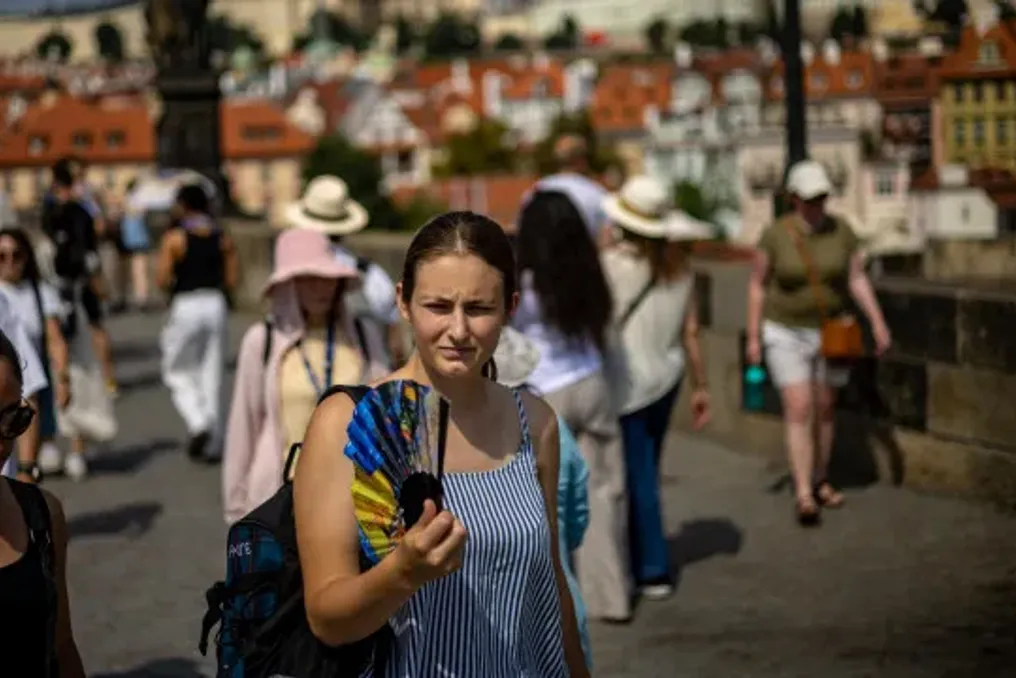
The heat this summer will be considered the 'new normal' in the coming decades. Aïssa Gurbuz, a 25-year-old student from Lyon (Central France), told AFP that heatwaves are not stopping but returning every time it seems they are ending.
By August 19, France had already recorded 52 days of heatwaves since mid-June, a record, even though the summer is not over. In the rest of Europe, temperatures reached absolute records: 45.1 degrees in Andújar (Spain) on June 22, 48.4 degrees in Orani (Sardinia) on July 19, as well as 42.2 degrees in Slovakia and 37 degrees in Denmark.
Rising heat increases mortality. On August 6, Portuguese authorities registered three periods of increased mortality in recent months, accounting for 680 deaths above the expected level. The National Institute of Health Ricardo Jorge (Insa) and the General Directorate of Health believe that most of these deaths occurred among people aged 75 and older, with cardiovascular, respiratory, and neoplastic causes being predominant.
According to these two institutions, deaths primarily caused by extreme heat constitute only a small part of the overall impact of heat on mortality. In most cases, heat acts as a triggering or aggravating factor for other pathologies, rather than the main cause of death listed in the death certificate.
Extreme climate changes, including periods of near-tropical heavy rains, serve as a 'harsh reminder of the chain consequences of the climate crisis, both for humans and the economy,' warned Simon Stiel, an UN Climate representative, in May.
A new habit has set in across Europe—watching temperature increases with anxiety and monitoring weather forecasts—but for French climatologist Jean Juzel, this will become the new normal. The former Vice-President of the Intergovernmental Panel on Climate Change stated: 'What we are experiencing is what our scientific community predicted about thirty years ago.'
On the first day of summer, alarming signals came from the Basque region and eight Italian cities, which declared a red alert due to the heatwave. As a result, schools were closed, festivals were canceled, and World Cup broadcasts or San Juan holidays were suspended.
Preliminary data indicates that more than 32,000 additional deaths were recorded in Europe from mid-June to mid-August. The number of people suffering from eco-anxiety sharply rose to 2.6 million, according to a study by the Eco-Anxiety Observatory.
From southern European regions to the northernmost areas, fires destroyed about 600,000 hectares by August 12. In other places, drought emerged, turning green landscapes into desert horizons; by the end of July, half the continent was in such a state. In France, Switzerland, Austria, and Slovenia, soil moisture dropped to historically low levels.
John Powys, a 62-year-old British farmer, reported on his sunburnt quinoa fields: 'Everything suddenly dried up. The only plants that grew were sorrel and thistle.'
Major rivers such as the Rhine, Loire, and Thames reduced their flow; nuclear power plants were forced to stop production due to water shortages, and wreckage of WWII ships or submerged equipment appeared.
Aquifers, despite replenishment this winter, began to drop in France, Piedmont in Italy, and Spain, forcing many municipalities to secure drinking water. Water scarcity is already noticeable in agricultural lands, affecting corn and sunflower harvests and accelerating the harvest of grapes.
Even the sea temperature rose sharply. In July, the Mediterranean Sea recorded the highest average sea surface temperature for the month—27.07 °C.
However, this extreme summer period only foreshadows the future, warns Jean Juzel. He notes that 'by 2100, it is highly likely that 2026, taking this year as a reference, will be considered a 'normal summer',' calling for 'a conscious decision.' He emphasized: 'We must understand that we are heading towards a catastrophe if we cannot reverse the trends,' saying this from his native Brittany, a former wet Atlantic province, where temperatures exceeded 40 degrees multiple times this summer.