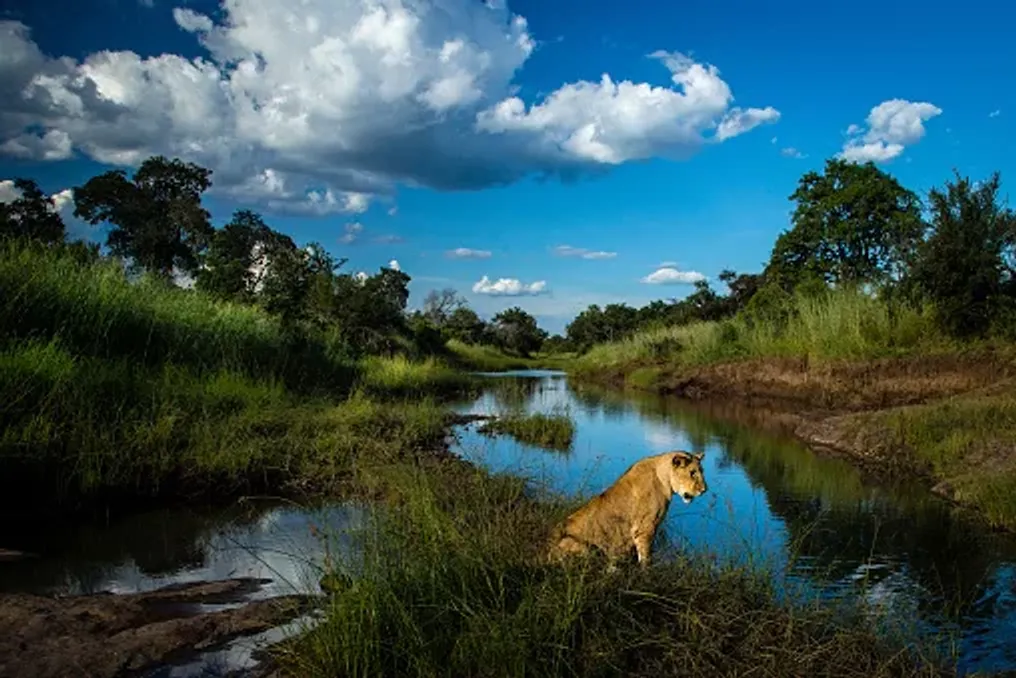
Lower Zambezi National Park is a main attraction in Zambia because the Zambezi River shapes the landscape, attracts wildlife to its banks, and creates a unique safari experience that includes both time on the water and movement through the savanna.
The park covers an area of about 4,092 sq km, situated against the backdrop of the Zambezi Escarpment, and protects a mosaic of riverine forests, floodplain grasslands, mopane, and miombo woodland, as well as open grassy areas. During the dry season, animals gather around the river when other water sources dry up.
A three-day visit is enough to experience the different facets of the park: one can quietly drift through the channels in a canoe, observe elephants along the river, catch tiger perch, take walks in the savanna, and learn about the conservation methods of this important river ecosystem.
The easiest way to reach Lower Zambezi is from Lusaka, where visitors usually fly to one of the park's airstrips and then transfer to their lodge or camp. Access is also possible by road through Chirundu.
The first afternoon should be spent at a relaxed pace. After checking in, it is better to head to the river rather than immediately embarking on a long journey across the savanna. In this section, the Zambezi is wide and generally calm, with islands, lagoons, and channels dividing the water, and the escarpment rising behind the valley. UNESCO describes the combination of the river, floodplain, forest, and escarpment as one of the defining features of the park.
In the afternoon, it is worth getting out in a boat to watch the riverbanks come alive as the temperature drops. Elephants may feed close to the water, hippos remain partially submerged, and crocodiles lie almost motionless in the shallows. Buffalo and wading antelopes are regularly seen, and fish eagles emit one of the characteristic sounds of the area.
A sunset cruise is ideal for a first introduction to Lower Zambezi. Instead of just noting the animals seen, one should pay attention to the relationship between the animals and the river. The same water that serves as drinking water for elephants and bathing spots for hippos supports fish, birds, crocodiles, and the vegetation bordering the floodplain. This results in a safari landscape where the river never seems merely a backdrop; it is the connecting thread of the entire ecosystem.
To see more, one must wake up early and get onto the water before the heat intensifies. Canoeing is one of the signature experiences of Lower Zambezi, with organized tours through the channels between the river islands. The current can carry boats downstream, allowing visitors to move quietly through the landscape with minimal disturbance.
From a canoeing perspective, the viewpoint changes: there is no vehicle between you and the river. You can observe hippos in the water, elephants grazing on the bank, and antelopes among the trees. A quieter approach also facilitates concentration on small details, such as wading birds and tracks in the mud, as well as insects moving on the surface.
Zambezi Tourism notes that canoe tours can take place in remote channels between islands, where hippos, elephants, zebras, pukus, impalas, buffaloes, kudu, and baboons can be seen.
Lower Zambezi Park is interesting not only for its elephants. The park's diverse habitats support a wide range of wildlife, including lions, leopards, African wild dogs, and cheetahs, while the river itself provides a rich aquatic community. UNESCO's preliminary application for World Heritage status in 2026 notes the presence of nearly 50 fish species in the Zambezi within the park.
Bird lovers should also keep an eye out for fish eagles, kingfishers, and colorful species inhabiting the riverbanks. Zambia Tourism particularly highlights red-billed hornbills that nest on the riverbanks. The slow pace of canoeing allows appreciation of this biodiversity without constantly searching for the next large mammal.
Fishing gives the afternoon a completely different rhythm. Lower Zambezi is known for tiger perch, and other species found in the river include catfish and wundu. Fishing is usually offered as an organized activity through safari operators, with gear provided by the participating lodges. Tiger perch are especially valued by anglers, but the experience lies in spending time on the Zambezi and understanding the river as a living system, not just a picturesque backdrop.
Sustainable fishing and the state of fish stocks are becoming increasingly important aspects of conservation efforts. UNESCO's 2026 assessment points to concerns regarding fish stocks and exploitation, underscoring the need for careful management of the river's water resources.
Returning to the water in the late afternoon, as the heat subsides, gives the Zambezi a different sound as the sun sets behind the escarpment. Elephants move towards the river, hippos become more active, and birds cross the channels between the islands. This is a fitting end to a day spent almost entirely near the water.
In the last morning hour, one should leave the river and explore Lower Zambezi on foot with a qualified guide. A walking tour changes the scale of the safari: instead of focusing on distant animals, one begins to notice tracks, droppings, insects, plants, and sounds. The guide can explain how animals move between the river and the forest, what plants serve as food, and how seasonal changes affect wildlife behavior.
It is here that the diversity of Lower Zambezi's habitats becomes apparent. The park extends from the river and its floodplains into the forest and up to the escarpment. UNESCO defines riverine and alluvial forests, mopane, and miombo woodland, savanna grasslands, and the escarpment as the main vegetation types in the area.
The Zambezi is one of Africa's largest rivers and a transboundary waterway supporting ecosystems and communities in several countries. Within Lower Zambezi National Park, it serves as a refuge for wildlife during the dry season. As temporary water sources disappear, animals increasingly concentrate in the valley and near the river, creating one of the park's most vital ecological cycles.
This seasonal migration is part of what makes a dry-season safari so rewarding, but it also demonstrates why protecting the river is paramount.
The history of the park's conservation extends beyond its borders. Across the Zambezi into Zimbabwe lies Mana Pools National Park and associated safari zones, which are part of the same broader Middle Zambezi ecosystem. UNESCO recognizes the ecological link between Mana Pools and Lower Zambezi, and cooperation between Zambia and Zimbabwe strengthens transboundary conservation.
Lower Zambezi boasts wildlife expected of a major African safari destination, but its greatest appeal lies in how these sightings are experienced. An elephant crossing the riverbank, a hippo surfacing near a canoe, or a fish eagle crying over the water—all gain greater meaning when the river is understood as the center of the ecosystem. This is why conservation here is inseparable from tourism.
Lower Zambezi was included in Zambia's preliminary UNESCO World Heritage list for 2026 due to its biodiversity, ecological processes, and exceptional riverine landscape. This nomination highlights the importance of the park for species such as elephants, African wild dogs, leopards, and cheetahs, while also identifying challenges like poaching, river hydrology changes, and concerns over fish stocks.
The best time for a safari in Lower Zambezi is generally from July to October, when the dry season concentrates wildlife around the remaining water sources. Zambia Tourism recommends the mid-season, from July to October, noting that most lodges and canoe operators operate roughly from April to November. Fishing is considered particularly good in September and October.
The period from April to June may be greener, but denser vegetation and long grass can make spotting wildlife difficult. The simplest option is flying from Lusaka to the park's airstrip, with lodge or safari operator transfer arranged. Driving is another option, especially through Chirundu, although some routes require a 4x4. Operators can also arrange access from Chirundu and, in some cases, across the border into Zimbabwe. Since activities such as canoeing, fishing, boat trips, and walking tours are usually organized through safari camps and lodges, accommodation should be chosen based on the desired experience, not just location.
Lower Zambezi does not need to compete with Victoria Falls or South Luangwa on their terms. Its appeal is quieter. Here, the safari unfolds between the water and the wildlife: a canoe glides through a narrow channel, an elephant drinks at the river's edge, a tiger perch strikes beneath the surface, tracks discovered during a morning walk, and the cry of a fish eagle flying over the valley.