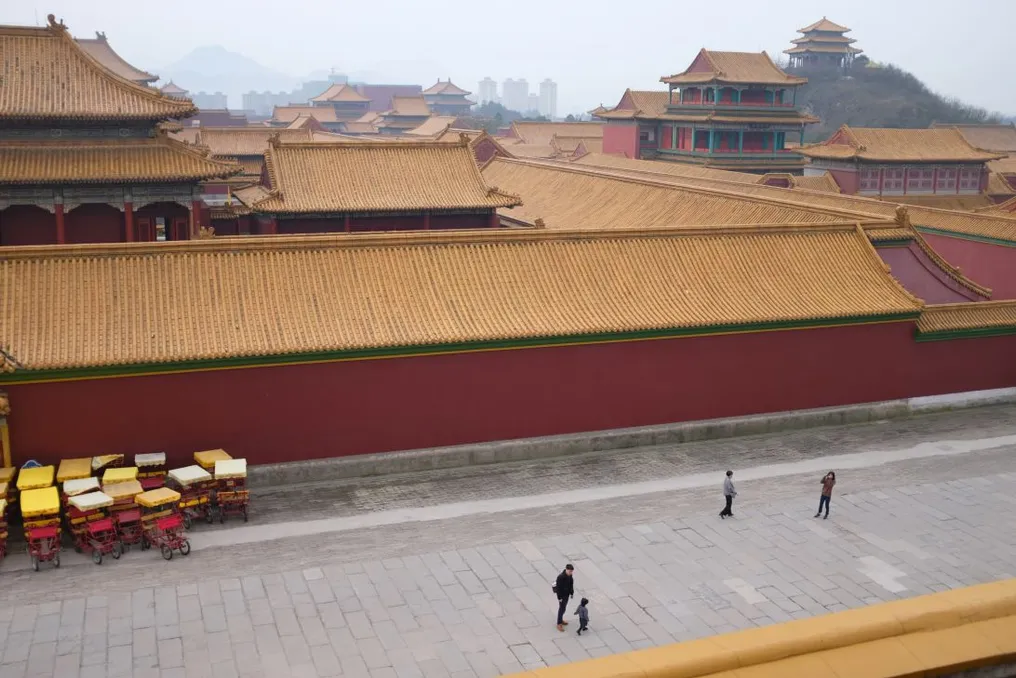
Despite the apparent ordinariness of the filming locations in Hengdian, a city known as 'Hollywood of China' due to its extensive film studio complex, a lull has set in. Initially, filming proceeded as usual: camera operators hastily adjusted lighting, choreographers rehearsed fight scenes, and the props team prepared to raise the net for the hostage capture. Actors, dressed as killers and mercenaries, waited for the scene to begin, smoking cigarettes and receiving cosmetic enhancements from stylists.
However, behind this hustle lay a new reality: just a few months ago, the production of so-called 'micro-dramas' flourished in Hengdian and other centers, but today these sets are empty. New AI-based video generation tools have suddenly taken over the micro-drama industry, allowing popular vertical shows to be created at a much lower cost, which has led to a sharp decline in live productions nationwide and an inundation of platforms with AI-generated content.
According to Chinese state media, over 120,000 micro-dramas were released in the first three months of this year, with 95 percent of them being generated using AI. This has made the industry a vivid example of how China's rapid transformation using AI affects people's livelihoods, destroying jobs and creating new ones, leaving everyone uncertain about the future. Many creative workers fear that such a technological shift could change the filmmaking process far beyond China.
Actress Junlin, who asked to be called by her stage name, spoke about the difficulties of surviving in the face of a 'harsh winter' for such projects. She noted that due to the decrease in filming orders, her opportunities for survival are constantly narrowing. In June, she worked only seven days, a sharp drop compared to spring when she filmed 25 out of approximately 30 days a month in Hengdian and other cities. She admitted to being easily nervous, and the lack of work on set causes her constant anxiety.
Hengdian, a city with a population of just over 200,000, located in the rural part of Zhejiang province in China, experienced a boom thanks to the growth of the micro-drama industry in recent years. These dramas, broken down into approximately 90-second episodes, emerged during the pandemic, leveraging the popularity of short video applications like Douyin and Kuaishou when cinemas and studios were closed. Although each episode is designed for quick consumption on a mobile phone, they weave together storylines that can reach the length of a feature film.
These micro-dramas, with their often melodramatic or unbelievable plots about evil mothers-in-law, mistaken identities, heroic military feats, and wronged lovers, spread across China and reached international audiences, giving rise to a rapidly growing multi-billion dollar industry. They also attracted the attention of Chinese censors, who are tightening supervision over micro-dramas with new rules taking effect in September. For instance, storylines must 'conform to the correct political direction.'
Last year, the domestic micro-drama industry was valued at nearly $15 billion, according to research firm DataEye, almost double the market volume of feature films in the country. Its rise marked a long-awaited flourishing for young creative workers during a period of high youth unemployment in China. Bi Zhijian, a 27-year-old actor living in Hengdian who quickly built a career after moving there in 2021, noted that after micro-dramas became popular, he had a continuous stream of roles. He added that many people without formal training in acting or film joined the industry due to the growing number of opportunities.
This appeal attracted thousands of film crews to Hengdian last year to work in the vast Hengdian World Studios. This provided a new influx of energy to the city and its long-standing studio, known for large-scale replicas of iconic Chinese imperial architecture, such as the Summer Palace and the Forbidden City, as well as for producing Chinese blockbusters. Other centers, such as Qingdao, Xi'an, and Zhengzhou, also appeared across the country, where micro-drama crews worked in specially built complexes featuring fake mansions, conference halls, and emergency departments.
However, the industry quickly turned into a 'pressure cooker' for actors and film crews due to the hyper-competitive model based on producing as many micro-dramas as possible in the hope that one of them will go viral. Actors and crew members describe standard working days lasting 18–20 hours, as productions rush to meet budgets, effectively shooting feature-length films in about a week. Director and actor Go Ertai of the National Theatre of China in Beijing, who followed the audience and money into the micro-drama industry several years ago, stated: 'As long as they keep shooting, they can keep releasing. And the logic is that there will always be one that becomes a hit.'
At the bottom of the hierarchy are extras, who can work long shifts for as little as 10 Chinese yuan ($1.50) per hour, which, according to one former actor, is less than the cost of renting some animals used in filming. Nevertheless, the allure of success sustained the industry with young, ambitious actors, directors, and creative workers.
Unlike cinema, which has a high barrier to entry, micro-dramas 'gave ordinary people a chance,' as director Go said. His thought was that 'I can get rich overnight, I can become a star overnight, I can earn a lot of money overnight with very little investment.' Micro-drama actors themselves became celebrities with millions of social media followers. Some TV and film stars, including martial arts legend Jackie Chan, acted in micro-dramas. Even those without widespread fame who managed to secure leading roles in successful dramas could earn several times the average monthly city salary.
But as more money and famous names entered the industry, competition intensified, pushing towards exporting dramas abroad for higher revenue—and using any available means to cut costs. Actress Zhuang Wenxue, 28, realized something was wrong several weeks after returning to Hengdian after celebrating Chinese New Year in February. She moved to the area last summer and felt she was just beginning to make a name for herself and could start trying for more prestigious roles. At first, she didn't connect the empty streets around her with the growing number of AI-generated micro-dramas she saw in her social media feed. However, it soon became clear: people weren't returning because jobs were disappearing. Zhuang said: 'A sense of impending crisis suddenly arose.'
SeeDance 2.0 from ByteDance took over. It seemed that overnight Chinese social networks were flooded with realistically looking, AI-generated videos as users experimented with this new powerful video generation tool. And regarding micro-dramas, SeeDance 2.0 was perfectly positioned. ByteDance owns two major platforms in China where micro-dramas are hosted: Douyin, the sister app of TikTok, and Hongguo. Furthermore, the company has a repository of novels that serves as a source of copyrighted material for scripts, from which collaborating production teams can draw.
Other tech firms have released competing video generation technologies in recent months, including the owner of another short video app, tech giant Alibaba, and the AI company MiniMax. Using advanced AI video tools, a production company told CNN that a standard 120-minute project could be created by a team of five people in about a week for approximately 15,000 yuan, about $2,200, less than one-tenth of the typical claimed low cost of live production. On Douyin alone, 220,000 new AI-generated micro-dramas in the first half of the year garnered an astonishing 500 billion views, according to DataEye.
Zhuang decided to leave the city in April, joining the exodus of actors and crew members from the area. She stated: 'The number of jobs in Hengdian decreased day by day, and the pay also kept getting lower... the difficulties truly defeated me.'
Actors who remained described a sharp drop in salaries; for example, they were offered 300 yuan (about $45) per day for a lead role that previously could bring in thousands. Some are forced to take side jobs to make ends meet. Liu Yujian, 29, recounted that he was earning steadily in the last couple of years, getting four new roles a month. Now, according to Liu, he works in food delivery. He explained that with a mortgage and being responsible for his parents' pensions, the current micro-drama market 'is simply not enough to cover daily expenses.'
As AI tools displace micro-drama actors, social media chats that previously advertised acting opportunities are flooded with a different type of advertisements: for AI editors, programmers, designers, and screenwriters. A new wave of companies, editors, and entrepreneurs has poured into this field. Among them is Tan Chen, a 21-year-old college student who founded an AI production startup in April. His team, based in Jinan, the capital of the eastern province of China, takes scripts or novels and 'optimizes' them for micro-dramas, condensing the narrative and intensifying the tension. They define the appearance of characters and sets, a process Tan describes as 'similar to casting and location scouting,' and then create storyboards.
Tan explained that 'we need to transform what we see in words into something that can be expressed visually. This really tests the directorial thinking and audiovisual linguistic abilities of our production staff.' How well the AI images come together depends on this language. Staff, known as 'card pullers,' must use prompts—usually written by AI—to repeatedly generate AI video clips until they achieve those that best convey the scene, and then these clips are edited together.
When his team started, Tan said clients paid them 1,000 yuan (about $150) per minute, usually for a 120-minute project. But, like the actors and crews of live production, these creative workers also feel the pressure. The profits of teams like Tan's are decreasing due to the influx of programmers and intermediaries taking a commission for connecting creators with clients. He now accepts projects for only 150 yuan per minute, which is about $20. He notes: 'This rapidly growing market inevitably has a certain degree of bubble.'
The company has also recently switched to creating AI-generated cartoons to avoid the unintentional use of AI images based on real actors' faces. The use of AI characters resembling real actors without permission has become a key issue in the industry; according to state media reports, in at least one case, a famous actor received compensation through a court ruling.
However, other actors are not so fortunate. Actress Yu Shutian, 31, recently discovered that her own face had been 'mixed in AI' after fans alerted her to an AI-generated character resembling her. She understood that proving the resemblance to her face was almost impossible, so she never sued. She also believes that the technology itself is likely to be to blame, rather than the creator. Yu stated: 'AI is unstoppable. If you cannot beat it, join it, so I prefer to find a sensible way to accept AI,'—and now she is starting to use this technology, redirecting some of her focus to directing.
} ]