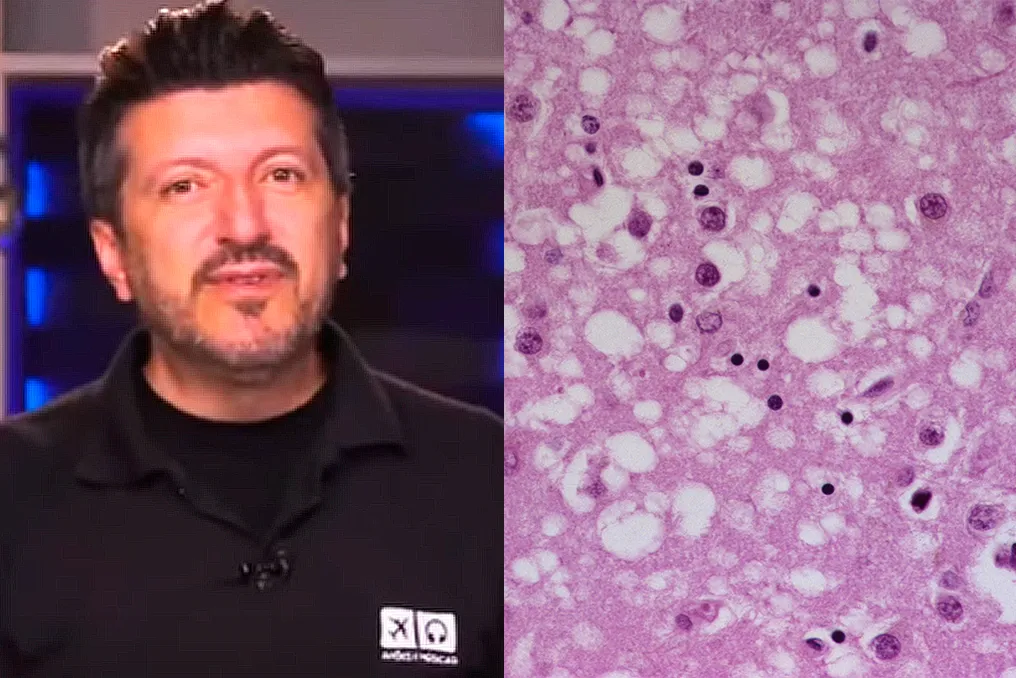
The diagnosis of Creutzfeldt-Jakob Disease (CJD) in the influencer and aviation specialist Lito Sousa has brought to light a rare and highly aggressive illness. Currently, there is no known treatment that can reverse or stop the progression of this disease; however, scientists are testing medications designed to interfere with the prion mechanism.
The information was detailed by Tuane Vieira, a Doctor of Biological Chemistry and professor at the Institute of Medical Biochemistry of UFRJ, in an article published in The Conversation. She mentioned that two medications are already under evaluation in patients, while another line of investigation focuses on compounds capable of acting on protein aggregates that have already formed.
CJD is caused by prions, which are abnormal forms of a protein produced by the body itself. When this protein changes, it can cause other proteins to alter their structure. This cycle repeats, resulting in aggregates that end up impairing brain function.
This condition affects about one to two individuals per million inhabitants annually. In most cases, it arises sporadically, without an identifiable source of infection, and is not transmitted through daily contact between people.
Vieira emphasizes that 'there is currently no therapy capable of stopping or reversing CJD.' Current care is palliative, focusing on relieving symptoms and ensuring patient well-being.
Research Strategies Against CJD
One of the approaches being studied aims to decrease the production of the normal protein, which serves as raw material for the creation of new prions. This is the main focus of ongoing tests. The ION717 trial involved 56 participants in 2024 and will have a new arm added in March 2026, with results expected only in 2027. The PRiSM study, meanwhile, is a Phase 1 trial with 15 symptomatic patients, aiming to assess safety and tolerability.
It is important to note that neither of the first two studies is recruiting participants in Brazil. Furthermore, there is currently no proof that these researches can interrupt CJD in humans. However, there has been an improvement in the nature of scientific bets: molecules specifically designed for the central mechanism of the disease are now being tested, and these have already shown efficacy in animal models.
Another crucial issue for researchers is how to treat the aggregates that have already accumulated at the time of diagnosis. A study conducted by UFRJ, in collaboration with the Federal University of Fluminense and the Federal University of Goiás, analyzed Moringa oleifera. Among the 18 compounds present in the extract, two—chlorogenic acid and neoclorogenic acid—showed the ability to bind to the prion protein.
In in vitro tests, these two substances managed both to reduce aggregate formation and to disrupt structures that were already established. However, Vieira stresses that 'our work with moringa compounds is a scientific lead, not a ready therapy.' The next step involves verifying effects in cells and animals, in addition to determining the amount of these molecules that reaches the brain and what happens after disaggregation.
Additionally, the RT-QuIC test, available at the UFRJ laboratory mentioned by the researcher, allows for the detection of prion protein conversion in cerebrospinal fluid, thus enabling the confirmation of CJD while the patient is still alive.
Symptoms and Prognosis of the Disease
CJD tends to manifest predominantly between the ages of 60 and 70. Its symptoms may include accelerated memory loss, behavioral changes, mobility difficulties, involuntary movements, and visual alterations. Due to the similarity of signs with other neurological pathologies that are treatable, correct identification of the cause becomes vital to guide the patient and their family.
Although CJD remains incurable, research has advanced by beginning to investigate methods to directly interfere with the prion production process. Although the results of these attempts still need to be proven, this advance signals the beginning of new therapeutic possibilities.